Warning: Creating default object from empty value in /home/sites/30b/a/a8be13db6d/public_html/wp-content/plugins/zanmb/reduxframework/ReduxCore/inc/class.redux_filesystem.php on line 29

Warning: Cannot modify header information - headers already sent by (output started at /home/sites/30b/a/a8be13db6d/public_html/wp-content/plugins/zanmb/reduxframework/ReduxCore/inc/class.redux_filesystem.php:29) in /usr/share/php/wp-stack-cache.php on line 2088

Warning: Cannot modify header information - headers already sent by (output started at /home/sites/30b/a/a8be13db6d/public_html/wp-content/plugins/zanmb/reduxframework/ReduxCore/inc/class.redux_filesystem.php:29) in /usr/share/php/wp-stack-cache.php on line 2089

Warning: Cannot modify header information - headers already sent by (output started at /home/sites/30b/a/a8be13db6d/public_html/wp-content/plugins/zanmb/reduxframework/ReduxCore/inc/class.redux_filesystem.php:29) in /usr/share/php/wp-stack-cache.php on line 2090

Warning: Cannot modify header information - headers already sent by (output started at /home/sites/30b/a/a8be13db6d/public_html/wp-content/plugins/zanmb/reduxframework/ReduxCore/inc/class.redux_filesystem.php:29) in /usr/share/php/wp-stack-cache.php on line 2088

Warning: Cannot modify header information - headers already sent by (output started at /home/sites/30b/a/a8be13db6d/public_html/wp-content/plugins/zanmb/reduxframework/ReduxCore/inc/class.redux_filesystem.php:29) in /usr/share/php/wp-stack-cache.php on line 2089

Warning: Cannot modify header information - headers already sent by (output started at /home/sites/30b/a/a8be13db6d/public_html/wp-content/plugins/zanmb/reduxframework/ReduxCore/inc/class.redux_filesystem.php:29) in /usr/share/php/wp-stack-cache.php on line 2090

Warning: Cannot modify header information - headers already sent by (output started at /home/sites/30b/a/a8be13db6d/public_html/wp-content/plugins/zanmb/reduxframework/ReduxCore/inc/class.redux_filesystem.php:29) in /home/sites/30b/a/a8be13db6d/public_html/wp-includes/feed-rss2.php on line 8
Totnes – Easymalc's Wanderings https://www.easymalc.co.uk I’d be unstoppable if only I could get started Sun, 24 May 2026 13:59:25 +0000 en-GB hourly 1 https://wordpress.org/?v=7.0.7 https://www.easymalc.co.uk/wp-content/uploads/2019/09/cropped-easy-malc-logo-32x32.jpg Totnes – Easymalc's Wanderings https://www.easymalc.co.uk 32 32 140253175 Along the Lower Dart https://www.easymalc.co.uk/along-the-lower-dart/ https://www.easymalc.co.uk/along-the-lower-dart/#comments Sun, 24 May 2026 13:59:20 +0000 https://www.easymalc.co.uk/?p=11413 Originally posted 2020-11-27 14:50:56.

The post Along the Lower Dart appeared first on Easymalc's Wanderings.

]]>

Along the Lower Dart

Of all Devon’s rivers, the Dart has to be my favourite: From source to sea, it’s the most beguiling of rivers, and for this post I’m going to describe its charms between the lowest bridging point at Totnes to the mouth of the river at Dartmouth.

At Totnes the river is still tidal, and until the area around Totnes Bridge was drained, it was wet, marshy ground; and I suppose it must have been around here where Brutus, the first king of Britain landed – that’s if you believe the story of course – but I’ve covered more about the history of Totnes in a separate post.

Totnes Bridge was built between 1826-28 and is the latest in a long line of bridges that has spanned the river here over many centuries. Today a modern road bridge just upstream, called Brutus Bridge, has taken the brunt of the traffic, not just away from this bridge, but from the town centre as well.

Totnes Bridge
The view towards Totnes Bridge from Brutus Bridge

I don’t suppose too many people think of Totnes as a port, but the export of tin, slate and wool cloth made it one of Devon’s wealthiest towns during medieval times, but these days the former warehouses have been converted into living accommodation and businesses.

Converted Warehouses in Totnes

The river at Totnes Bridge is bisected by Vire Island which is a pleasant place to sit and feed the ducks for half an hour or so, but if it’s a boat trip you want, you’ll need to cross over the bridge into Bridgetown, where at Steamer Quay, boats will transfer you down to Dartmouth when the tide is right.

A River Boat

If, like me, you’re a sucker for boat trips, you’ll love this one, but you won’t see everything from the river. That said, I highly recommend that you find time for one of the boat trips on offer, but you need to be aware of the tide times if you want to start or finish at Totnes. My advice, if you have the time to do it, is take a full day to do the Round Robin, which includes the Steam train from Paignton to Kingswear, ferry across the river to Dartmouth, boat trip up to Totnes, and an open top bus back to Paignton. You can of course do it the other way round and start at any point on the journey. This way, you should have enough time to see a bit of Dartmouth and Totnes as well. You can find all the relevant info here: –

https://www.dartmouthrailriver.co.uk/

A view of the river below Totnes with Dartmoor behind

The first place of note downriver is Sharpham. You can see the estate from the river including the rather attractive looking Bathing House. Its main claim to fame is the production of fine English wine and cheese, and even if this isn’t your thing, it’s worth making your way down through the lanes from Totnes even if only to take a self-guided tour around the estate.

For just £2.50 (as of Nov 2020) you can follow one of the trails through the vineyard and down alongside the river, but there are other options as well which include samples of their wine and cheese. For example, you can select 4 wines for £7 and a slice of cheese fresh from the dairy for £3: Ok, you’re not going to be flat on your back after drinking these samples, but for a tenner I can’t think of a better way of spending a couple of hours or so in the South Devon countryside.

N.B On revising this post in March 2022, the vineyard appears to be moving its operations to Sandridge Barton which is on the other side of the river near Stoke Gabriel. You can find out the latest details from their website below.

https://sharpham.com/

The Sharpham Estate
The Bathing House at Sharpham
Sharpham Vineyard
A selection of Sharpham Wine

If you managed to make it to Sharpham, you would have driven into the small village of Ashprington where St David’s Church has memorials to the Bastard (pronounced B’stard) family. They were a well-respected family around these parts, and one of them, Robin, opened up an antiques business in Plymouth under his own name – I kid you not (you might need to read that again).

Church of St David, Ashprington
Memorials to the Bastard Family

Back on the river, after passing the Sharpham Estate, the Harbourne River joins the Dart at Ashprington Point. Known as Bow Creek, the river runs past the Maltsters Arms at Tuckenhay, whose most famous owner was Keith Floyd, the celebrity chef who was more often found at the bar instead of the kitchen. He certainly knew how to brighten up a pub and a cookery programme, but he wasn’t so good at making money or keeping wives, and in the end, the pub – and him – went bust. Hardly surprising when you see how he used to run the place.

Ashprington Point
A cold day on Bow Creek at the Maltsters Arms

If it’s just a nice quiet drink sat by the river is what you prefer, then at the head of the creek at Bow Bridge, is a smashing little place called the Waterman’s Arms.

This is another pub that I’ve come back to time and again and never tire of it. In the summer, the riverside benches make it a lovely spot to spend an hour or two on a sunny afternoon, and in the winter a log fire is usually burning to keep the warmth in and the cold out. Wonderful!

The Waterman's Arms at Bow Bridge

So far, we’ve been looking at the western side of the Dart, but between Ashprington Point and Bow Creek on the opposite bank of the river is a tiny place called Duncannon. Officially, it’s a village and not a hamlet because someone made a typo in the Domesday Book. Instead of 10 people living here they inadvertently added an extra zero.

Duncannon

The lane from Duncannon leads up to the larger settlement of Stoke Gabriel, which as the boat sails, is around the other side of Stoke and Mill Points and up into Mill Pool.

The Dart at Mill Point

Mill Pool was created by damming the tidal inlet forming a weir called the Foss. Swans and ducks have made their home here and encourage people to feed them, but it’s the crabs that seem to get the most to eat.

This is a crabbing hotspot and nets, lines, buckets and baits are all available in the adjacent River Shack café, but while the kids are occupied catching buckets full of small crabs, the adults are happy to sit at one of the benches with a glass of Devon cider or something.

Stoke Gabriel still has a number of cider apple orchards – and of course, a couple of good pubs too, and is about 4 miles from the centre of Paignton by road.

Below are pictures of 1) the inlet from the mouth of the Dart, 2) The Foss, 3) The view downstream from the Millpool, 4) Crabbing at the Foss, 5) View from the Rivershack.

If you’re wondering what the big white house is just a bit further downstream from Stoke Gabriel, it’s Sandridge Barton, a house built by John Nash in 1809 and where Sharpham Wines are going to concentrate their business from Spring 2022. Before Nash went to work on it, Sandridge was the probable birthplace of Captain John Davis.

This navigator and explorer set sail from here in 1585 and made it his mission to chart the world’s trade routes. He was responsible for the invention of the Quadrant, attempting to find the North-West Passage between the Atlantic and Pacific (the Davis Strait is named after him), he fought against the Spanish Armada and discovered the Falkland Islands. 56 years after he was born, he was murdered by a pirate near Singapore. He certainly crammed in a bit during those 56 years.

I haven’t got any pictures of the house, but the one below shows the landscape around it from the river.

The Dart near Sandridge

I have got some pictures of the village on the opposite bank though. Dittisham is referred to by locals as ‘Ditsum’, but don’t worry too much about it because most of the locals these days aren’t ‘local’ anyway.

The village lies on a bend in the River Dart and is an ideal place for mooring a boat- and consequently has become an expensive place to live. Even the tiny cottages cost a small fortune, and if you want a mooring here, you’ll have to wait 10 years for the privilege.

Dittisham

There’s not really an awful lot to do here if you haven’t got a boat, but the charm of the place is just admiring the activity on the water – and the best place to do it from is the Ferry Boat Inn. This pub is reassuringly down to earth and not in the least pretentious. Naturally, it can get quite busy in the summer, but it has very limited parking and so it doesn‘t get too congested. If you do attempt to drive down here then be aware of the tides. You wouldn’t be the first person to find your car under water if you don’t.

Inside the Ferry Boat Inn
View from the Ferry Boat Inn

I said that there wasn’t much to do in Dittisham, but that’s not strictly true because if you ring the bell, the ferryman will come across from Greenway Quay and deposit you back over to the other side from where you can climb the hill to Greenway House, the holiday home of Agatha Christie. If you want to find out more about Greenway you can read my blog which you can find here.

As we approach Dartmouth you may notice an increasing number of oak trees that stretch right down to the water’s edge, and this is where the river gets its name from, as Dart is an old Celtic name for ‘oak’.

We end this journey at Dartmouth, probably my favourite South Devon town, and so perhaps you can now see why the River Dart is my favourite river in Devon – and I haven’t described the stretch above Totnes to its source on Dartmoor yet.

ORIGINAL POST – NOVEMBER 2020

LATEST UPDATE – MARCH 2022

Originally posted 2020-11-27 14:50:56.

The post Along the Lower Dart appeared first on Easymalc's Wanderings.

]]>
https://www.easymalc.co.uk/along-the-lower-dart/feed/ 16 11413
Berry Pomeroy Castle – Romantic Ruin, or Just Plain Spooky? https://www.easymalc.co.uk/berry-pomeroy-castle-romantic-ruin-or-just-plain-spooky/ https://www.easymalc.co.uk/berry-pomeroy-castle-romantic-ruin-or-just-plain-spooky/#comments Sun, 24 May 2026 13:59:20 +0000 https://www.easymalc.co.uk/?p=12214 Originally posted 2021-03-05 16:10:17.

The post Berry Pomeroy Castle – Romantic Ruin, or Just Plain Spooky? appeared first on Easymalc's Wanderings.

]]>

Berry Pomeroy Castle - Romantic Ruin, or Just Plain Spooky?

Lying deep in the countryside just a couple of miles east of Totnes, Berry Pomeroy Castle has been described as one of the most picturesque and romantic ruins in England, but it has also been described as one of the most haunted castles in England as well!

The village and castle’s name comes from the Pomeroy family whose first owner was Ralf de Pomaria, a Norman knight from La Pommeraye near Falaise. He was given the manor by William the Conqueror, but it was another four centuries before the castle was built. Neither the precise date, nor the reason for its construction is really known, but it was most likely at the end of the 15th century, and possibly because of the family’s involvement in the War of the Roses. Whatever the reason, it’s pretty certain that it never saw any real military action.

The First Floor of the Gatehouse

In December 1547, due to a shortage of finances, Sir Thomas Pomeroy sold the estate to Edward Seymour, the 1st Earl of Hereford and the 1st Duke of Somerset. As unbelievable as it may sound, Edward Seymour was the richest and most powerful man in the land at the time. He was the brother of Henry VIII’s favourite Queen, Jane Seymour. Jane, his third wife, died just after giving birth to Henry’s only legitimate son, Edward, and when Henry himself died in early 1547 Edward Seymour became Lord Protector of his 9-year-old nephew, who was now Edward VI of England.

Without going into all the Seymour family history, the castle was turned into a Tudor mansion; but by 1700 everything had fallen into disrepair, and what we see today are the remains of both the castle and the mansion.

The Elizabethan House

Ghost stories have abounded ever since and most have been disproved but there is one about the ‘White Lady’ which seems to still stick around. It’s the story of Elinor Pomeroy who was jealous of her prettier sister’s attraction to the man that she loved. The story goes that she left her sister Matilda for dead in a dungeon below the chapel. The name Matilda seems to have changed to Margaret for some reason, but the basement of St. Margaret’s Tower is supposed to be the dungeon where Margaret (or Matilda) was supposedly starved to death.

The Curtain Wall and St Margaret's Tower

Come here on a nice sunny day and it’s easy to see why the castle is regarded as a romantic ruin, but if you would like to find out how strong your heart really is, then I recommend you come here on a foggy day when nobody else is around, and see if you think it’s a romantic then.

06
07

POSTED – MARCH 2021

Originally posted 2021-03-05 16:10:17.

The post Berry Pomeroy Castle – Romantic Ruin, or Just Plain Spooky? appeared first on Easymalc's Wanderings.

]]>
https://www.easymalc.co.uk/berry-pomeroy-castle-romantic-ruin-or-just-plain-spooky/feed/ 26 12214
Dartington – A Place of Culture, Learning and Social Thinking https://www.easymalc.co.uk/dartington-a-place-of-culture-learning-and-social-thinking/ https://www.easymalc.co.uk/dartington-a-place-of-culture-learning-and-social-thinking/#comments Sun, 24 May 2026 13:59:25 +0000 https://www.easymalc.co.uk/?p=12062 Originally posted 2021-02-18 11:38:08.

The post Dartington – A Place of Culture, Learning and Social Thinking appeared first on Easymalc's Wanderings.

]]>

Dartington - A Place of Culture, Learning and Social Thinking

If you’ve come to Totnes and wondered why the town has attracted so many people who prefer to live an unconventional lifestyle, then look no further than Dartington, a village just a couple of miles outside of town.

The village is home to the Dartington Hall Estate which occupies 1200 acres of unspoilt countryside adjacent to the River Dart. The history of the estate goes back a thousand years, but it’s not the past that people come here for, but to seek a better future, and it’s all thanks to Dorothy and Leonard Elmhirst who bought the estate in 1925 and transformed it into a centre for individual thinking and freedom of expression in music, art and all things ethical.

Dartington Estate

These days, the estate is managed by the Dartington Hall Trust, a registered charity, and although the complex of buildings are primarily used for educational purposes, there are parts of the estate which are open to the general public.

Footpaths allow people to freely wander around the estate and alongside the river, but if you would rather conserve your energy for a bit of retail therapy, then you can always browse around the arts and craft shops of the Cider Press Centre instead.

The focal point of the estate though is the fabulous 14th century medieval courtyard with its impressive Great Hall built by King Richard II’s half-brother, the 1st Duke of Exeter. The Tudor Period saw the property briefly fall into the hands of two of Henry VIII’s wives, Catherine Howard and Catherine Parr, and in 1559 it was acquired by Sir Arthur Champernowne, a member of one of South Devon’s most illustrious families who continued to own it right up until the time the Elmhirsts bought it.

Unfortunately, the Hall was in a sorry state by then and William Weir was commissioned to bring it all up to scratch, and if you’re lucky enough to be here when the Hall is not being used, you’re free to wander in and see what it looks like for yourself.

Inside the Great Hall

Behind the Great Hall are the Estate’s delightful gardens. Up until fairly recently there was no charge to visit them (although a donation was always welcome), but the Trust has now deemed it necessary to introduce an admission fee. Very few people know that they are here, and in my view are one of South Devon’s hidden gems, so if you’ve come this far it would be a shame to miss them.

The Rear of Dartington Hall
The Summer House and the Elmhirst Children's Playhouse

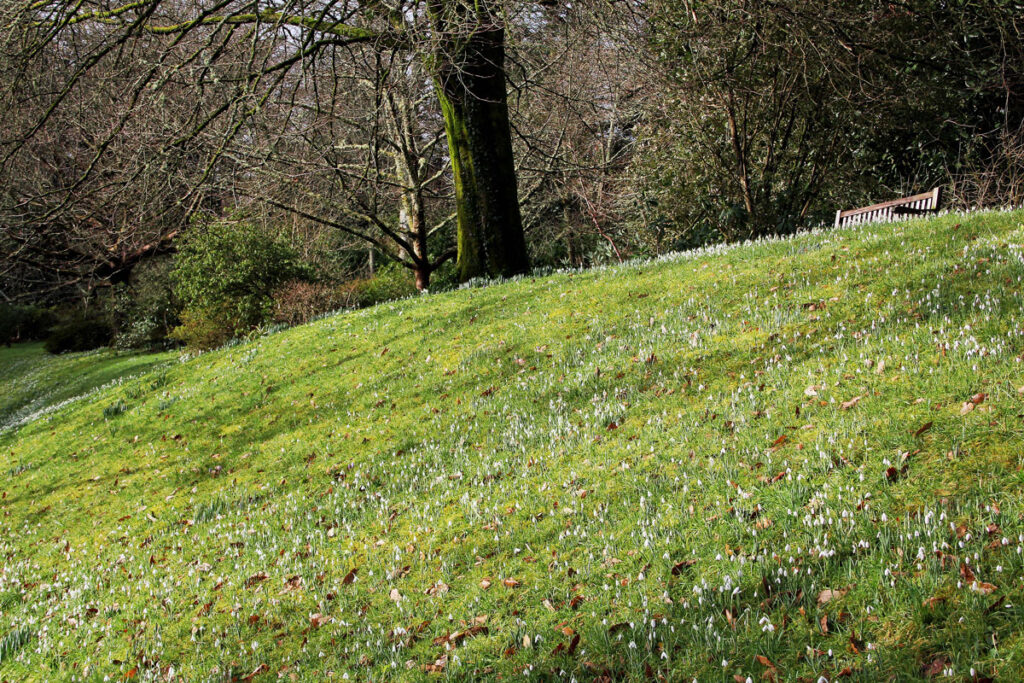
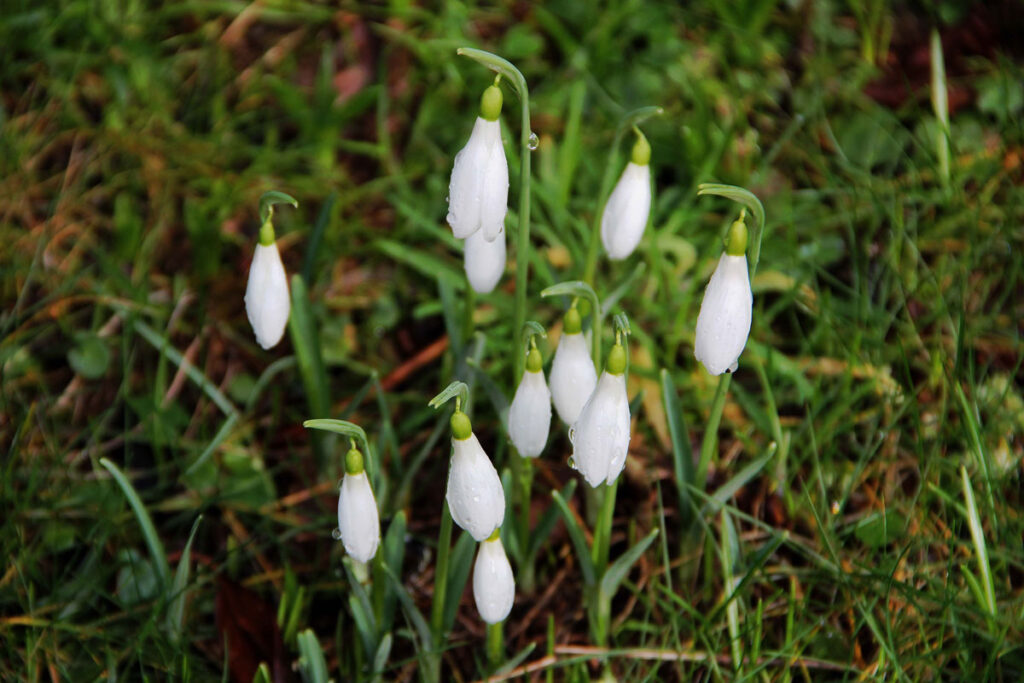
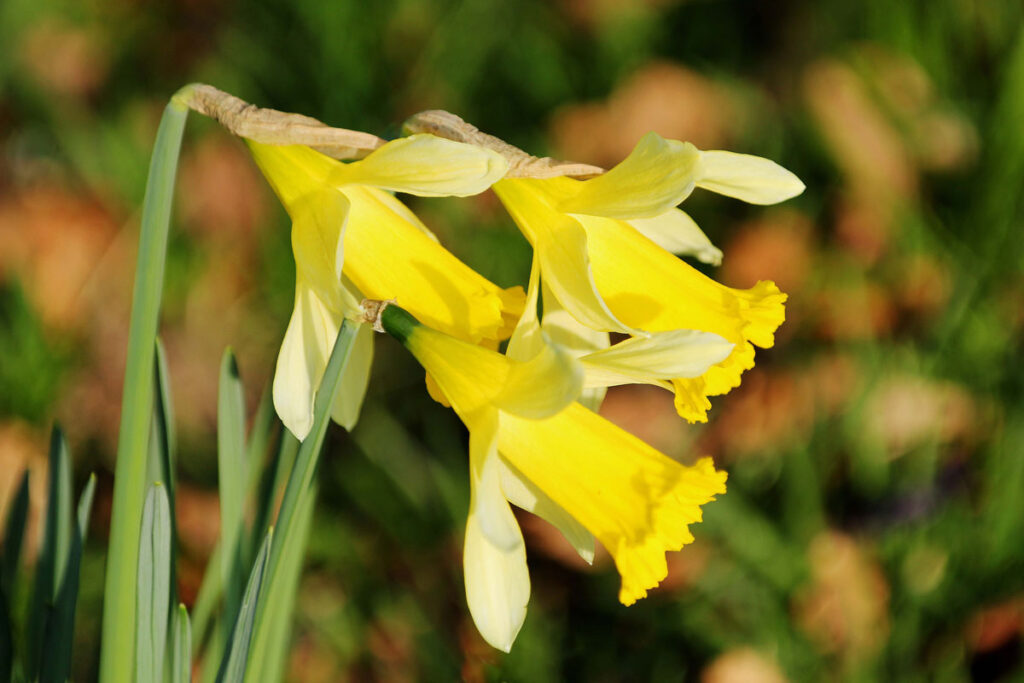
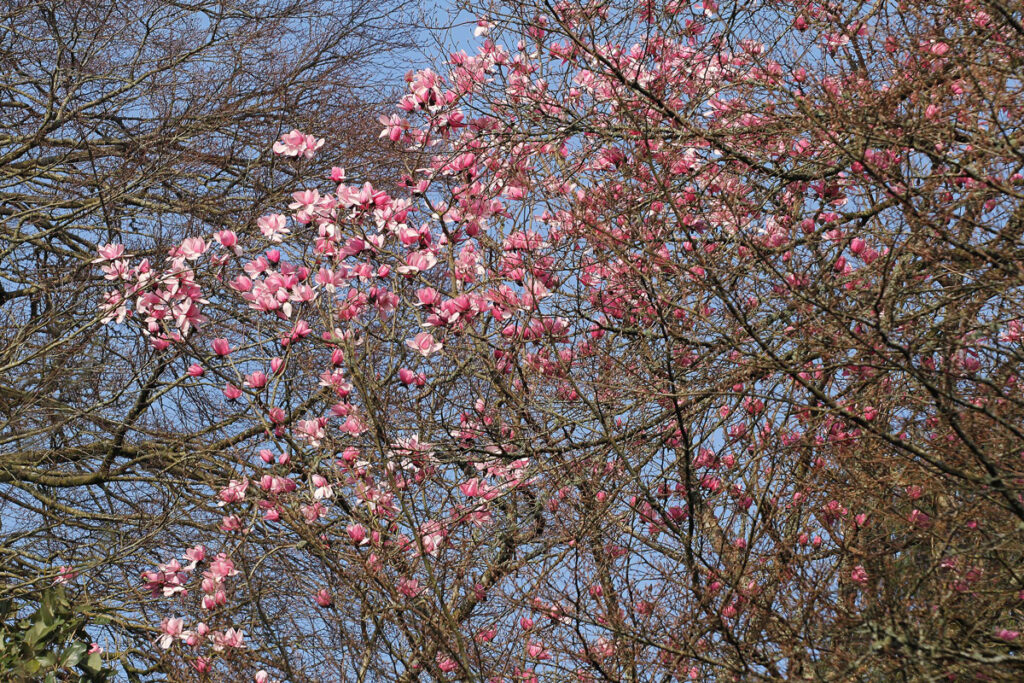
The word ‘Garden’ probably conjures up an area of formal design with herbaceous borders and the like, but in reality, the 25 acres that it covers is more of an informal arrangement. Spring is especially alluring when banks of snowdrops give way to crocuses, daffodils, primroses and some especially magnificent magnolias.

Dorothy and Leonard Elmhirst rejuvenated the medieval estate with ideas of their own, and there are some interesting sculptures dotted around that are no doubt there to get you thinking.

Try not to miss the one entitled Flora which is on the site of the Elmhirst’s ashes.

'Flora'
'Flora'

If your first port of call at Dartington Estate was the Great Hall, then it may also be your final one as well because attatched to it is the White Hart. As you might imagine, the food on offer and everything connected with it is done as ethically as possible, which doesn’t necessarily translate as cheap, but to be honest, I think I would be disappointed if it was any different.

The White Hart

I couldn’t possibly let you leave Dartington though without mentioning another pub – the Cott Inn, which is located in Cott Road on the other side of the roundabout at Shinner’s Bridge.

According to the date above the entrance, this pub has had a licence since 1320, and it doesn’t take a lot of imagination to realise that it was originally several cottages. The man responsible for the change of use was a Dutchman called Johannes Cott who converted them into a staging post for shepherds taking their sheep to the port at Totnes.

There are older pubs elsewhere but what I like about The Cott is that its appearance would have hardly changed over the years. You won’t find a longer thatched pub roof anywhere – at least not in England, and the inside has many genuine reminders of how long the building has stood here.

The Cott Inn

I haven’t brought you to Dartington for a pub crawl though, because for me, the Dartington Estate is quite unique, and has made Totnes what it is. The Elmhirsts were ahead of their time, and their philosophy is one that we should perhaps all try and emulate – if only the real world wouldn’t get in the way.

ORIGINAL POST – FEB 2021

LATEST UPDATE – FEB 2022

Originally posted 2021-02-18 11:38:08.

The post Dartington – A Place of Culture, Learning and Social Thinking appeared first on Easymalc's Wanderings.

]]>
https://www.easymalc.co.uk/dartington-a-place-of-culture-learning-and-social-thinking/feed/ 18 12062
Wandering Through Totnes https://www.easymalc.co.uk/wandering-through-totnes/ https://www.easymalc.co.uk/wandering-through-totnes/#comments Sun, 24 May 2026 13:59:20 +0000 https://www.easymalc.co.uk/?p=11867 Originally posted 2021-01-21 17:00:25.

The post Wandering Through Totnes appeared first on Easymalc's Wanderings.

]]>

Wandering Through Totnes

Totnes has a reputation for being one of the country’s quirkiest towns, and even its foundation has a mythical story attatched to it. According to legend, after being defeated in the Trojan War, the Trojans sailed off to find another home, and one of them, a prince by the name of Brutus, landed at Totnes, where he proclaimed “Here I stand and here I rest, and this town shall be called Totnes”.

Thanks largely to Geoffrey of Monmouth’s 12th century account Historia Regum Britanniae, Brutus was regarded as the founder of the Britons and therefore the first King of Britain. If you subscribe to this part of our island’s history, and want to embrace it even more, then there’s a granite slab in Fore Street called the Brutus Stone, which is supposed to be the spot where he came ashore. Seeing that it lies several hundred yards uphill from the river, either the stone or the river has moved since then, but I suppose that wouldn’t bother anyone who has magic mushrooms on toast for breakfast.

The Brutus Stone

As I wasn’t around at the time of Brutus, and there’s no concrete evidence to support the claim, I’m going to move on to AD 907 when King Edward the Elder is known to have replaced the burg at Halwell with one here at Totnes.

Burghs were Anglo-Saxon fortified settlements, and it was Edward the Elder’s father, Alfred the Great, who created a network of these burghs around Devon (and elsewhere) for protection against Viking raids.

The burgh at Totnes would have been ideally placed to thwart any Viking incursions up the River Dart, as it was as far as the tide would be able to take them. If you take a look at the town from above on Google Maps you should be able to make out the extent of the original Saxon burgh with the castle at the top of the hill. The Norman castle wasn’t here then of course, but it seems like a good place to start our tour of the town.

View from the Castle

The first Norman castle was constructed by a man named Juhel, one of William the Conqueror’s Breton commanders, and was built to keep both the local Saxon population under control and to guard the crossing point over the river.

His impressive motte and bailey earthwork still survives and is one of the best preserved in England, but the original wooden tower and palisade was replaced by a more robust construction in the early 13th century. This was also replaced about a hundred years later by the stone structure that is still here today.

The castle never saw any serious military action and so there’s no history of any real consequence either, but you would be wrong to think it’s not worth paying it a visit because the motte and bailey earthwork and remaining circular stone tower are both in excellent condition – and of course, there are also those fabulous views from the top.

Inside the Keep

As the title of this post suggests, Totnes is somewhere to wander through rather than around, and that’s because the road that runs down in a straight line from the castle at the top of the town to the river at the bottom covers most of the things of interest that visitors would want to see.

This spinal cord is in two parts; High Street runs from the top of the town to Eastgate Arch (and is the original Saxon and Medieval part of town) and then Fore Street which takes over and continues down to The Plains which lies next to the river.

The natural way to go after visiting the castle is to turn left at the top of Castle Street and start walking down High Street, but if you’re not in a hurry then I suggest you turn right instead and walk along The Narrows. Officially speaking, it’s still the High St but it’s been known as The Narrows for so long that everybody just calls it that, and it’ll soon become obvious why.

It’s an area full of old buildings, unusual shops and vegetarian cafes, and ends in a short distance at The Rotherfold, a square that was used as a cattle market for hundreds of years, not that you would realise it nowadays.

The Narrows

After taking the short diversion up through the Narrows, we need to return back to Castle Street where the High Street starts to descend down towards the Eastgate Arch, but don’t be in too much of a hurry, because this top end of town is not just the oldest, but in my view, also the most interesting.

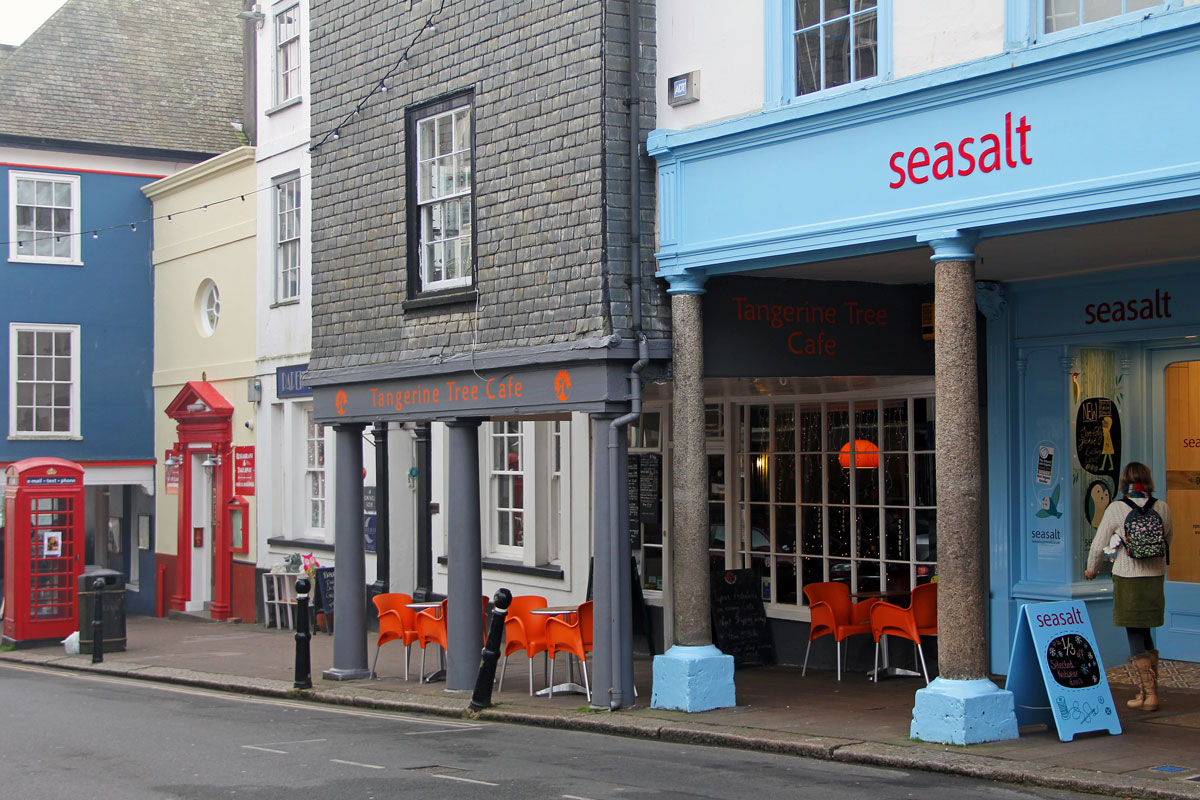
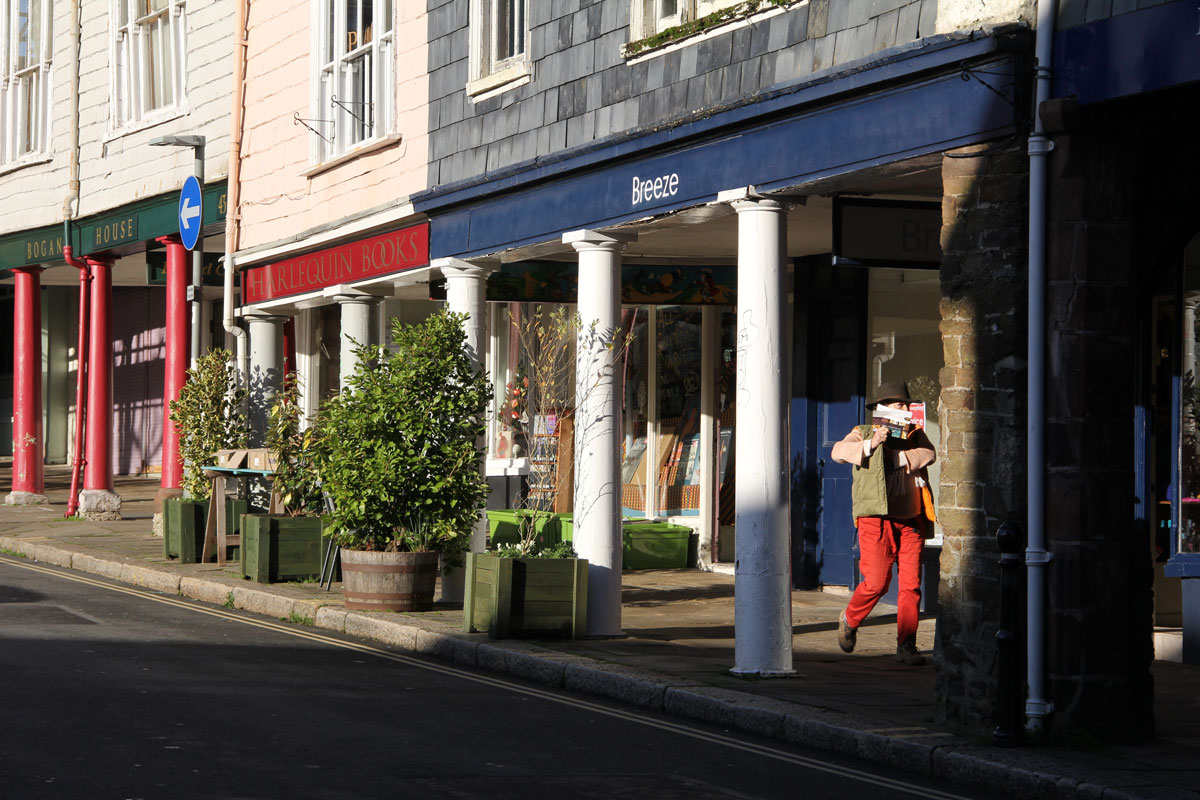
On either side of the High Street are two covered walkways: On the right-hand side is the Poultrywalk and on the left-hand side, the Butterwalk, both of which were built during Tudor times to protect their market goods from being exposed to the elements.

The buildings themselves have also been adapted to protect them from the weather using slates hung on the timber-framed facades. This is not an unusual feature in South Devon, but Totnes has to be one of the best places to see them. Bogan House at Number 43 in the Butterwalk is also a museum of period costume if you’re into that sort of thing.

The Poultrywalk
The Butterwalk

If period costume really is your thing and you’re here on a Tuesday morning during the summer months, then you might want to nip across the road from the Butterwalk to Market Square where stallholders dress up in Tudor costume for the weekly Elizabethan market.

The square used to be known as The Shambles, the traditional name for the meat market, but after several changes, especially after a fire in the 1950s it has become a rather nondescript square housing the Civic Hall. Fridays and Saturdays hold a more traditional open-air market, but traditional in Totnes may be slightly different to what the word means elsewhere.

I don’t normally use my camera for taking videos, but I’ve included this lame effort as an experiment, and also to show you what Totnes Market and the Butterwalk are like. Apologies for the rather abrupt ending.

Continuing on down High Street, you won’t be able to miss the handsome-looking St. Mary’s Church on the left-hand side. The 15th century red sandstone building is at least the third church on this site, replacing the Norman one which had already replaced the original Saxon St. Mary’s. If you have time it’s worth looking inside if only to see the superb 15th century stone Rood Screen.

St Mary's Church

If you’ve been following my blogs you should realise by now that I know very little about anything of any consequence, and nothing about anything that is – and here’s another example that will probably only interest somebody who plays Trivial Pursuits.

Until recently, the building opposite the church at No.16 was Barclays Bank, which is quite appropriate because it belonged to a wealthy merchant by the name of Nicholas Ball. He lived here with his wife Ann, but after his death she married Sir Thomas Bodley of Exeter; and with her wealth and his enterprise, they helped to found the world-famous Bodleian Library in Oxford. Now you can’t say that I didn’t warn you.

Ann Ball's House
Ann Ball's House
013

Of more interest is the Eastgate Arch which is just a short distance downhill and probably the town’s most famous landmark.

If you think this archway which led up into the medieval town looks new, that’s because it is. It wasn’t new though when fire devastated it in September 1990. My heart sank when I saw the news reports on TV, because no matter what anyone says, reconstruction can never be quite the same as the original.

Below is a picture that the Totnes Fire Brigade took during that fateful night.

The Eastgate Arch at the height of the fire © Totnes Fire Station

It might not be the same but there’s no denying that an excellent job was done on restoring it, and below are two pictures of how it looks today. The first one is looking downhill from High Street, and the second one is looking uphill from Fore Street.

The Eastgate Arch from High Street
The Eastgate Arch from Fore Street

Before heading down through the arch into Fore Street I want to take you on another short diversion: Underneath the archway are some steps that lead up to the Ramparts Walk which leads round to the Guildhall, which in my view is one of the hidden gems of Totnes.

The Guildhall

St Mary’s Church, which overshadows the Guildhall, was at one time a Norman Benedictine priory, and the adjacent land where the Guildhall now stands included a refectory with a kitchen, bakery and brewery that served the monks that lived here. Thanks to good ol’ Henry VIII, little remains of the original buildings, but in 1542 some wealthy local businessmen bought what was left and created a meeting place for the guild of merchants: When King Edward VI signed a charter giving the land to the town in 1553, the buildings also became a meeting place for the council.

Edward VI Royal Crest

In 1624 the Guildhall became a courthouse and remained so until 1974, and the council still meets in the upper chamber in front of two tables supposedly used by Oliver Cromwell and Lord Fairfax at the time of the Civil War. It’s also worth making a note of the boards showing the names of over 600 mayors stretching right back to 1359.

The Council Chamber
The Old Courtroom

Courts are places that also have prison cells, and there are two here – one male and one female, neither of which have been used since 1887.

This Grade I listed building relies on volunteers to show visitors around, but they aren’t always available, and if that’s the case then enter the red door to the right of the Guildhall and speak to someone from the council. They’re very obliging and will help you gain entry so that you can have a self-guided tour. The offices will only be open during weekdays, but try not to miss it.

The Male Prison
The Male Prison
Entrance Door to the Guildhall

After visiting the Guildhall, return to the Eastgate Arch and then walk through into Fore Street, where a few doors down at number 69, is a shop called Narnia which also used to feature the Timehouse, a museum which the owners referred to as a time travel experience. The museum has been closed for a while but it’s rumoured to be re-opening again in 2022 – who knows? If you want to know why there’s a shop called Narnia here, then take a look at my post Totnes – Twinned with Narnia.

Narnia

If traditional museums are more to your liking then across the street is the official Totnes Museum.

The thing I like about this museum the most is the building itself. It was built in the 16th cent for a wealthy merchant at about the time that Totnes was the second most important town in Devon (after Exeter). Obviously, there’s been some restoration over the years to this Grade I listed building, but many original features still exist, including a winding wooden staircase that would make it difficult for people with reduced mobility.

If you can’t make it upstairs, then the Bennet Room at the back of the building does have a few interesting items on display including some Saxon coins and the Lee Ring. This ring is one of two rings made for the daughters of merchant Richard Lee around 1640: The other one is in the Victoria and Albert Museum. Judging from its prominent position, the museum seems to have a high regard for this item, but it was all a bit lost on me I’m afraid.

Totnes Museum
Totnes Museum
The Lee Ring
The Lee Ring

There’s no point in going into detail about all what’s on display here but there is one room you should know about – The Babbage Room. Charles Babbage is without doubt the most illustrious person to come out of Totnes. He’s most famous for inventing the ‘Difference Engine’ which was a huge calculating machine, and many people regard him as the “father of the computer”. Although he wasn’t born in Totnes he went to King Edward VI Grammar school in the town before going on to Trinity College, Cambridge.

The life and inventions of Charles Babbage would take up a whole book, so I’m not going to go into it all here. This is where the Babbage Room in the museum will help, but if you’re hoping to see a lot of items from his life, I’m afraid you’ll come away disappointed.

The Babbage Room

This isn’t a large museum by any means and if you’re happy to pay the modest admission fee to help keep the place going, then a quick visit will reward you with at least an insight into what a Totnes merchant’s house would have looked like back in Elizabethan times

The Elizabethan Kitchen

In Devon and Cornwall, the High Street of a village or town is very often known as Fore Street, but just to confuse things, Totnes has both a Fore Street and a High Street. As we’ve seen, High Street is the main thoroughfare through the original Saxon and Medieval town, but now that we’re on the other side of the Eastgate, the road becomes Fore Street, and consequently has a different feel to it.

Fore Street from the Eastgate Arch
Looking up Fore Street

There are still a couple of things to look out for: The Brutus Stone is outside number 51 (not 57 as Google maps say), and an interesting looking early 19th century villa called the Gothic House in Bank Lane (which is located between numbers 28 and 30).

The Gothic House

At the bottom of Fore Street is Totnes Bridge, Vire Island and The Plains. I’ve described some of this area’s features in my post Along the Lower Dart, but there are a couple more worthy of mention.

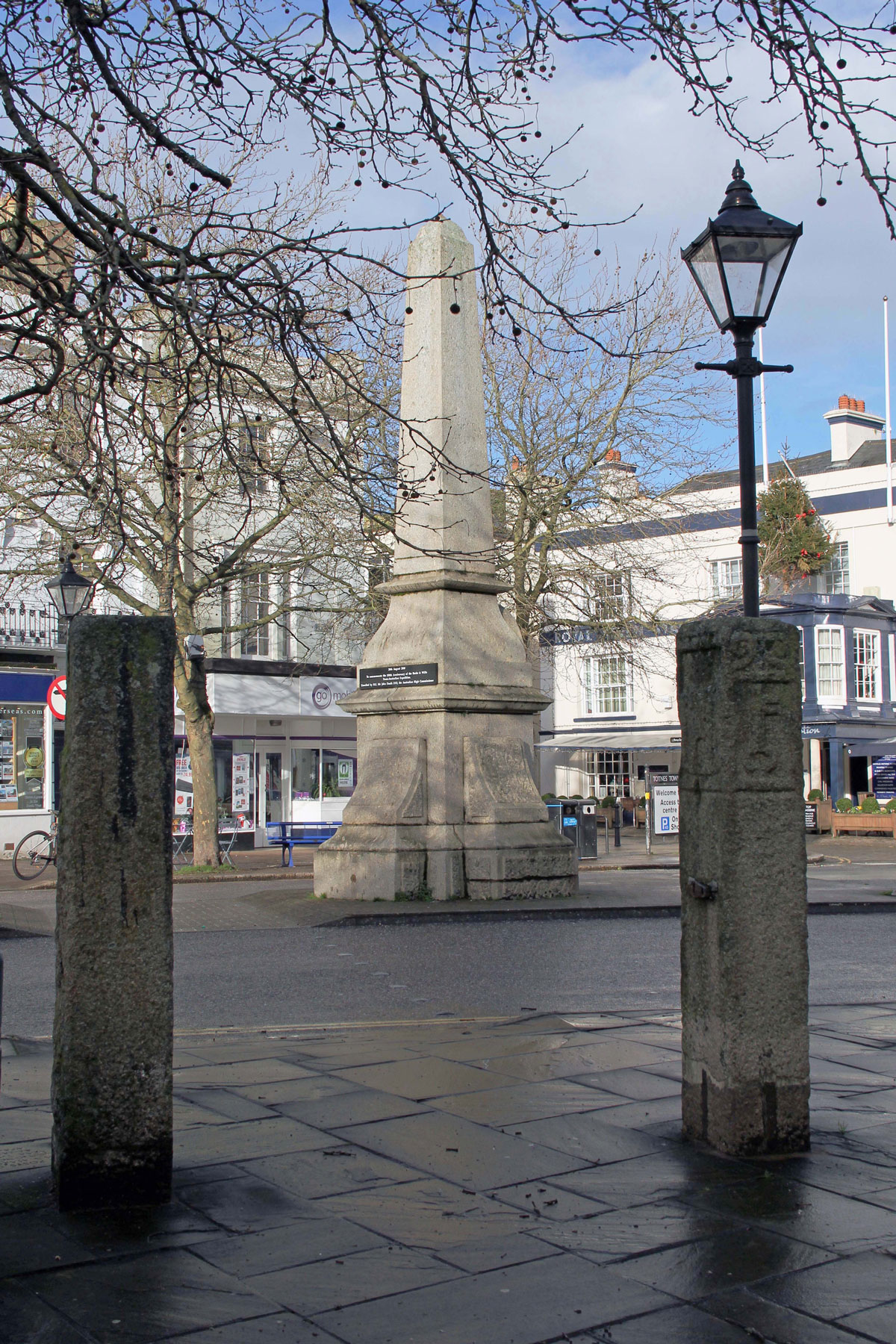
The first of these is a pair of granite pillars that I doubt anybody notices very much, but they represent the gateway to the town marsh. On one of them, the date 1681 (or it could be 1687) is engraved, and on the other you should be able to make out a castle and keys which represent the town’s coat of arms.

Much more obvious, and possibly of interest to somebody from the Antipodes, is the Wills Monument on an island near to the roundabout opposite the Royal Seven Stars. William J Wills lived on The Plains (look for the blue plaque on the building on the Fore St side of the monument) and was one half of the Burke and Wills expedition who crossed Australia from south to north in 1860. Unfortunately, they both perished on their way back in 1861 as did other members of their team. Whether they have monuments in Australia recognizing their achievement I wouldn’t know, but at least there’s one here.

Pillars from the Old Marsh Gate (Foreground)
The Wills Monument

This is where we conclude our tour of Totnes, and although I’ve done this walk from the top of the town to the bottom in order to follow a chronological order, there’s no reason why it shouldn’t be done the other way round if it makes more sense to you.

I’ve also tried to cover most of the things people would want to see on a day’s visit without spending too much time on each point of interest, and of course, there’s plenty more to see within a short distance of the town, some of which I’ve covered elsewhere.

There’s only one thing left to do, and that is to finish off with a drink and a bite to eat somewhere. There’s certainly no shortage of places on offer, but as we’re at the bottom of the town, I have to mention the Royal Seven Stars, which you can’t miss, and perhaps shouldn’t.

The Royal Seven Stars

The building itself has been here for about 350 years and it was an inn when Daniel Defoe stayed here back in 1720. As soon as you walk in through the front entrance it becomes pretty obvious that in years gone by it would have catered for horses as well as humans, and indeed it became a Posting House in the 1840s with stagecoaches running to both Plymouth and Exeter. When the railway came to Totnes the stagecoaches disappeared and the Royal Seven Stars became a hotel.

As regards its name, it probably derives from connections to St. Mary’s Church. It was customary during the Middle Ages for places of religion to act as hostels for pilgrims and travellers, and there was just such a hostelry located near to where the present hotel is now. Apparently, although I’m not conversant with this sort of thing, St. Mary wore a crown with seven stars in it, hence its name. Nobody knows for sure where the Royal prefix comes from but Charles II, William of Orange and Edward VII have all had connections here, but I’m still not convinced that Brutus first set foot on British soil nearby.

I like this hostelry, and whether Brutus landed here or not, to me, it seems a fitting place to end a leisurely wander through Totnes.

ORIGINAL POST – JANUARY 2021

LATEST UPDATE – JANUARY 2022

Originally posted 2021-01-21 17:00:25.

The post Wandering Through Totnes appeared first on Easymalc's Wanderings.

]]>
https://www.easymalc.co.uk/wandering-through-totnes/feed/ 20 11867
Totnes – Twinned with Narnia https://www.easymalc.co.uk/totnes-twinned-with-narnia/ https://www.easymalc.co.uk/totnes-twinned-with-narnia/#comments Wed, 15 Apr 2026 09:44:00 +0000 https://www.easymalc.co.uk/?p=7775 Originally posted 2019-07-12 09:09:21.

The post Totnes – Twinned with Narnia appeared first on Easymalc's Wanderings.

]]>

Totnes - Twinned with Narnia

On the ‘Welcome to Totnes’ sign that greets people to the town somebody added ‘Twinned with Narnia’ below it. It’s been removed since by those who don’t have a sense of humour, but to me it’s a perfect description of Totnes.

The town has been described as ‘New Age’, ‘Alternative’ and even ‘eccentric’ but however you like to describe it, Totnes is different to any other town in the South Hams, or even Devon for that matter.

The alternative lifestyle that many people in and around Totnes have adopted originally stems from the Dartington Hall Estate, and in particular the ideas of Dorothy and Leonard Elmhirst who came here in 1925. Dartington is just a couple of miles outside of Totnes and I’ve given it a separate page, but for now I’ll just say that it’s somewhere that specializes in the ‘arts, social justice and sustainability’.

Dartington Hall

Students from Dartington have walked the streets of Totnes (barefoot sometimes) for many years, and their unorthodox lifestyle spilled over into the type of clothes they wore, the food they ate, and the life they led – and others followed.

03

Rob Hopkins, an activist and writer on environmental issues, moved to Totnes in 2005 and the following year created the ‘Transition Town Movement’, making Totnes his first Transition Town. The network has now expanded into around 1,400 communities in over 50 countries.

It was this ecologically motivated organisation that introduced the Totnes Pound, and the idea spawned any number of local currencies elsewhere, but unfortunately for Rob and his followers the modern day has finally caught up with them because as people use cash less and less then the need for the Totnes Pound (or any cash for that matter) has diminished and the currency ceased to exist on 30th June 2019. It’s a shame in a way because it helped small businesses in the town, and I’ve never heard of any fraud, insider dealing, or money laundering activities going on: Neither by the way, could you have an offshore account, unless there was one on Burgh Island that I haven’t heard about.

The Eastgate Arch
The Eastgate Arch
05

It may be that it’s one battle lost, but the environmentally aware and ethical people of Totnes are not in any danger of allowing globalization to take over the town any time soon. Back in 2012 they saw off Costa Coffee even though the company’s plans to open an outlet in the High Street were approved.

High Street and Fore Street has attracted all sorts of other businesses that follow the green credentials the alternative followers of fashion require.

Shopping in the Butterwalk
07-Market-Stall

In the seventies and eighties these people would have been called hippies or nats (New Age Travellers) but these days they are just as likely to be well-heeled DFL’s (Down from London) shopping for ‘Conker’ shoes, crystals or ‘New Age Chic’ clothes.

That’s not to say that everyone in Totnes follows the same path. There are people who “want their town back”, and are more than happy to have a Costa Coffee, and buy their pork sausages in the local butchers; but although there’s a lot more to Totnes than its alternative lifestyle (see Wandering Through Totnes) there’s no denying that it likes to live up to its reputation as the New Age capital of Britain, as some people call it.

08
09
010-Totnes-Big-Issue-Seller
011

As you might imagine, alternative remedies are a thriving business in Totnes, and no self-respecting alternative society should be without a magical well to meditate over, and you’ll be glad to know that Totnes has its very own shrine – The Leechwell.

Situated at the top end of town The Leechwell has been associated with healing properties for centuries.

There are 3 springs which have their own granite trough – The Snake (for snake bites), The Toad (for skin problems) and Long Crippler (Local name for Slow Worm – for eye problems).

The Leechwell
The Leechwell

These days the local New Age fraternity think of them somewhat differently. One is still for healing; another one is for Good Luck and the third is for its spirituality.

As if to enforce its mystical properties they have taken to adorning the well with ribbons. What effect that’s supposed to have I have absolutely no idea, but who cares if it keeps ‘em off the magic mushrooms? – Welcome to Narnia!

013
014

ORIGINAL POST – JULY 2019

LATEST UPDATE – APRIL 2021

Originally posted 2019-07-12 09:09:21.

The post Totnes – Twinned with Narnia appeared first on Easymalc's Wanderings.

]]>
https://www.easymalc.co.uk/totnes-twinned-with-narnia/feed/ 19 7775