
The East Neuk Fishing Villages
‘Neuk’ is a Scottish word for nook or corner, and if you take a look at the map opposite, you’ll see that the East Neuk of Fife is the bit that juts out into the North Sea at the end of the Firth of Forth.
Along this coastline are a string of attractive fishing villages, the most interesting being St Monans, Pittenweem, Anstruther (including Cellardyke) and Crail.
If you’ve travelled to Fife over the Forth Bridge, then the first of these villages is St. Monans, about an hour’s drive away. There are several theories as to who St. Monan was, but the church that is dedicated to him is often described as Scotland’s nearest church to the sea, which is only around 20 metres away. It’s been here since the 14th century so whether it’s been that close since it was built, I wouldn’t like to say.


Walking downhill to the harbour there’s one of those simple little things that appear to mean nothing much but somehow manages to lift the spirits in an ever more disenchanting world.
The idea of the ‘Wellie Garden’ was conceived by Win Brown, a local teacher who decided to put her grandchildren’s wellie boots to good use. Her students joined in, and before she knew it the slipway had amassed around 200 pairs of boots filled with an assortment of plants that not only brightened up the slipway but many people’s faces as well.


Of all the harbours along this coastline, St Monans is one of the smallest, but in my opinion, also one of the most picturesque. Not only was fishing big business here, so was boat building. Sadly, not only have the majority of fishing boats disappeared, so too have the boatyards.

Another industry that has gone the same way here is salt production. Just a short wander along the coast path out of the village towards Pittenweem is a windmill that stands testament to the once thriving, but short-lived source of income for the village. The nearby hollows in the ground show where the sea water was heated in the salt pans and powered by the windmill.


About half an hour’s stroll from the salt pans will bring you into the slightly larger village of Pittenweem.
The footpath brings you into the village by way of the West Harbour with its small boats and fishermen’s cottages. These cottages give way to larger houses that once belonged to ship owners and sea captains who once plied their trade with the Low Countries. This trade saw the introduction of the type of building style more associated with the Netherlands and Belgium with red pantiled roofs and crow-stepped gables, and some of the best examples are at The Gyles at the eastern end of the main harbour.


The main harbour is the busiest along this stretch of coastline, and although it has a daily fish market, the catch is still relatively small compared to the north-eastern fishing ports of Peterhead and Fraserburgh.

‘Pittenweem’ apparently means ’Place of the Cave’ and presumably refers to St. Fillan’s Cave which is situated in Cove Wynd near the harbour.
Apparently, this cave, although several metres above sea level now, would have been formed by sea erosion and has been used as a storage place and shelter for who knows how many years.
It’s association with St. Fillan goes back to the 8th century when the Irish missionary set up home here. Supposedly blessed with special healing powers, he was also deemed to have had a “luminous left arm by which he saw to read and write”; I have to say though, that it never ceases to amaze me how these saints possess all these different miraculous powers and all come from Ireland.


You won’t need any miracles to help you get to get to the next village along the coast as it’s less than a couple of miles away.
Anstruther is the largest of the East Neuk fishing villages and, sitting as it does around half way along this coast, is probably the most convenient place to stay. It also has the most amenities, which of course, also makes it the busiest. That said, it’s still only a community of around three and a half thousand people, so don’t come here expecting a great metropolis.
A look at the local Ordnance Survey map reveals that there’s an Anstruther Wester and an Anstruther Easter, and the Dreel Burn used to be the dividing line between the two; the burn still runs into the sea but the town has long been unified and is now just called Anstruther.
As with all the other villages along this coastline, fishing has traditionally been the main industry, but with the decline of the shoals of herring it also meant the decline of Anstruther. Although the village is larger than Pittenweem its harbour is not as busy with fishing boats, but as tourism has become more important it seems as good a place as any to have a museum devoted to Scottish fishing.

The Scottish Fisheries Museum is an excellent national museum located on the harbourside in buildings that date back to the 16th century. These buildings surround a cobbled courtyard that was involved in fishing as long ago as the 14th century, and in amongst all the fishing paraphernalia are some Heritage Boats and a collection of evocative paintings by Pittenweem artist John McGhie.
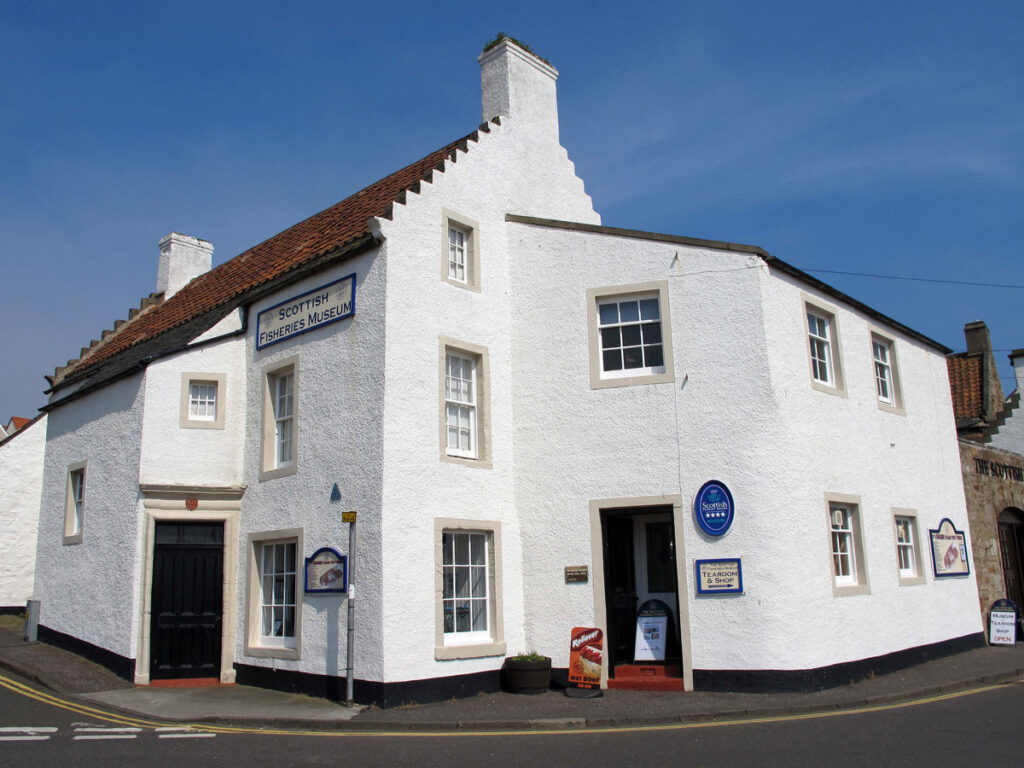
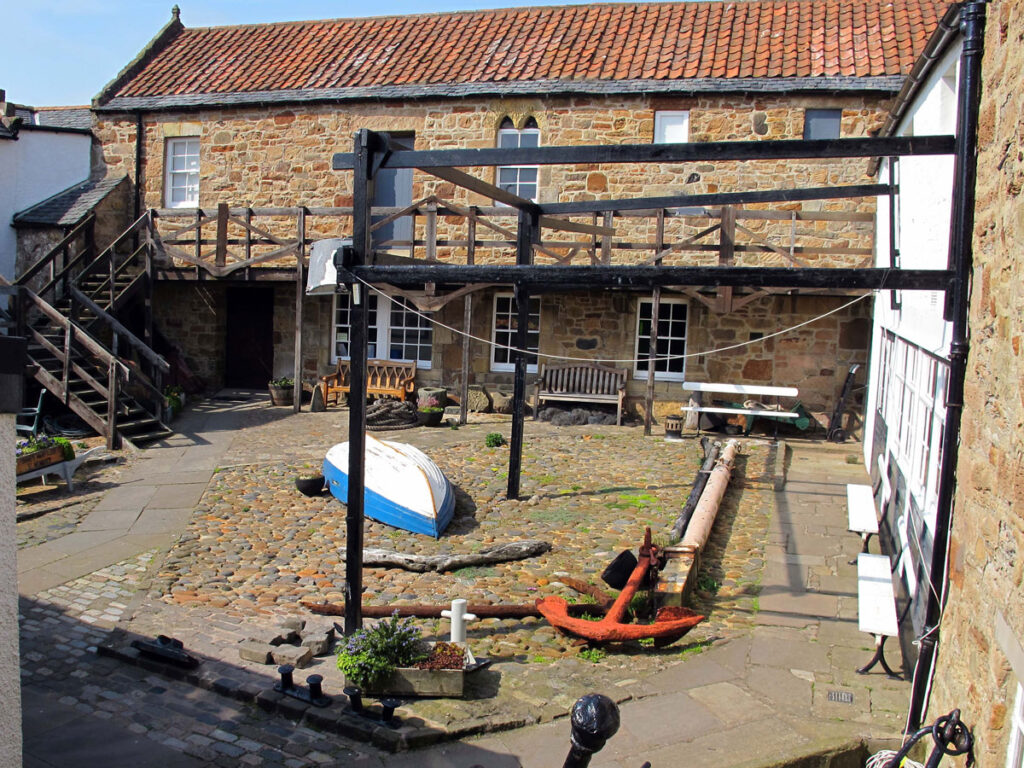
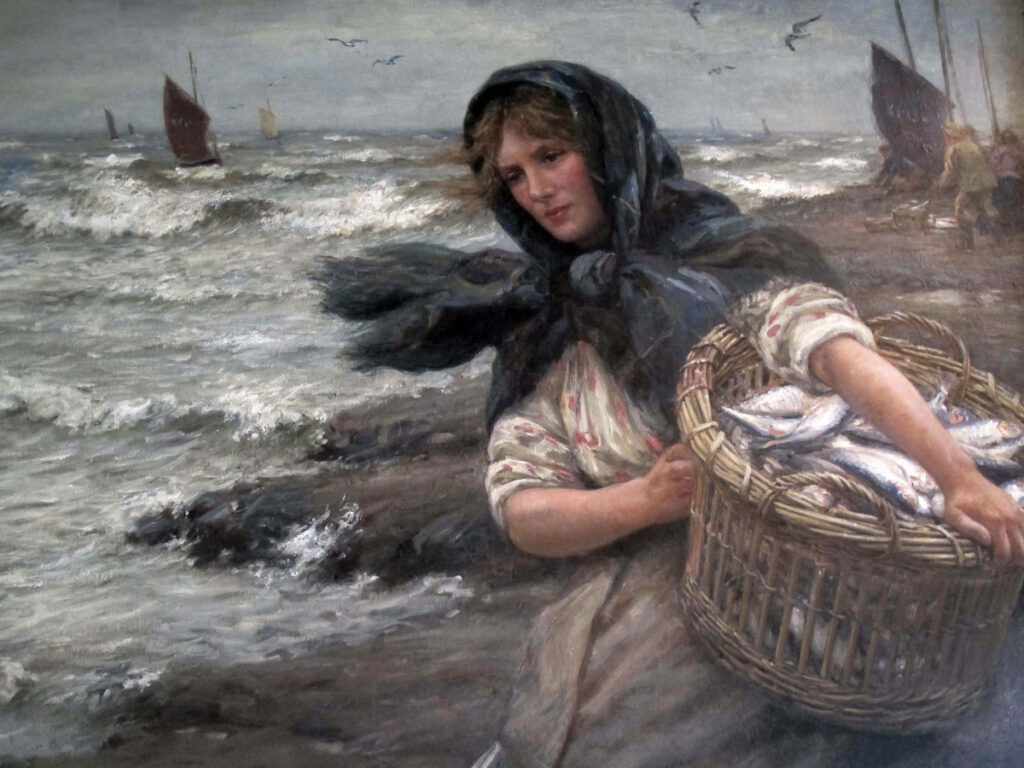
The quayside opposite the museum is the departure point for the boat to the Isle of May (which I’ll be describing separately), but if eating fish is more your thing than catching them, then after visiting the museum make sure that you allow enough time to visit the nearby Anstruther Fish Bar.
I say allow enough time because, with awards as long as your arm, this place is a bigger attraction than the museum, and you’ll need to be prepared to queue up whether it’s for the restaurant or the Take -Away.
In my opinion, the best place to eat your Fish Supper (as they call it up here), is on the harbourside where the benches just seem to have become an outdoor extension to this obligatory stop along the coast road through the village.

If you drive out through the village and keep to the coast rather than the main road, you’ll come to another little harbour at Cellardyke, which although these days is regarded as a part of Anstruther, has its own separate identity. If you miss the signs to Cellardyke, do yourself a favour and turn back because although it’s not the easiest of places to find, you’ll be glad you did.
In the past it was a busier fishing harbour than its larger neighbour, and though it may be difficult to imagine now, apparently over 200 fishing boats used this harbour until a storm in 1898 damaged it enough to force the boats down into the better and newer one at Anstruther.

So how did the name Cellardyke originate? Well, the story goes that the dykes (walls) that were used to hang the fishing nets over to dry, glistened in the sun with the scales of the silver darlings (herring) and so were called “Sil’erdykes”.
There’s no fishing nets left out to dry on the harbour these days but washing is. It’s this sort of thing that sets the village apart from its neighbours. The boats maybe gone but there still seems to be a sense of community here amongst the narrow streets of terraced houses.

The final fishing harbour on our East Neuk tour is the small village of Crail, which can be reached by joining the A917 from Cellardyke. Parking is encouraged in the village rather than the harbour which will give you the opportunity to check out the small Museum and Heritage Centre situated next to the Dutch styled Tolbooth. It won’t set your pulse racing but it also doubles up as a friendly and welcoming Visitor Centre.

It’s the harbour that most people come to see though and although all the East Neuk fishing harbours have their merits, Crail is definitely one of the most picturesque.
If you’re a lover of fresh crab or lobster then you’re in luck because it doesn’t come any fresher than if you buy it from the ‘Lobster Store’. From a hut on the quayside the Reilly family are happy to sell their daily catch to anyone who can’t resist the temptation.

The harbour is quite small compared to St. Monans, Pittenweem and Anstruther, but it’s big on character and a fitting place to finish our tour of the East Neuk fishing villages.

Originally posted 2019-03-06 22:14:22.
These villages are really lovely. Must get back over there this year to see them.
It wouldn’t take you long to get there either – and you could always take the boat over to the Isle of May – or perhaps not.
hee hee… behave yourself. When we lived in Newport On Tay, we often went over to the villages. They are so bonnie but we’ve not gone since we moved here.
I doubt that they would have changed much.
Yep, you’ve a pic there of Pittenweem and it reminded me exactly of a postcard I got from my pal who went there for a holiday aged 15……. I remember thinking it the first time I saw this post.
Pittenweem was where we chose to stay while visiting Fife, but I liked all the villages around here.
They are all lovely. Real step back in times. Way back we had a few meals in the Craw’s Nest, in Ansruther I remmeber It qs quite the place to go.
I’ve just checked it out and it looks as though it’s no longer there
Yeah. it was a lovely restaurant. A local institution back then. I think the quite right drink driving laws meant these places all became more reliant on local trade however. Also back in the day only hotels were allowed to serve alcohol in Scotland on Sundays so a place could have a hoel atached that often didn’t actually let any rooms. The entire landscape has changed.
I know what you mean. I booked one of the few places on the Isle of Lewis that served alcohol on Sunday. All thanks to the ‘Wee Free’ 🤨
Oh the wee frees up that way…??? Well……I shan’t start.
LOL
The other places that were open on Sunday during my underage drinking years were like ‘clubs,’ I don’t mean nightclubs, more working men’s clubs. . . .
for 16 we were terribly knowledgeable about under age drinking dens.
Where there’s a will, there’s a way. Have you managed to survive Storm Eowyn?
It was all hands to the mast yesterday dismantling, securing and cutting the nets of our dpwnstair’s neighbour’s trampoline yesterday after it
nearly blew through her windows. …. I know trampolines come in all shapes and sizes, this was a big rectangular one. But apart from that..yeah. You?
Strangely enough we had some freaky weather before Storm Eowyn arrived. On Friday we had an unexpected thunderstorm which made us jump but that was all. In Cornwall though there was a mini tornado that didn’t last long but was very intense. As for the storm itself, it passed through during the night with heavy rain and strong wind, but that’s nothing unusual, and certainly not as bad as I believe you’ve had up north.
Yeah, there’s been quite a battering upi here Looking on the bright side it provided plenty of windfall for he Mr to go out gathering up yesterday . . . .
I thought it might 😊
Glad to know you were okay down your way.
Yeah it even gave him the chance to squeeze behidn this high metal barrier down in the other half of our street to get his mitts on an old wooden chair frame that has been there and we have been wondering how best to get for months…….
LOL
The thing is that other half of the street is a nightmare. There is some dispute going on between the ‘cooncil’ as we call councils here and the luxury apartments and houses that are in the grounds of a former mansion….this area is full of them.. about who is responsible for this ancient boundary wall of that former mansion, that has collapsed…onto the very narrow pavement there where there is also a slope. add to that the fact that grounds of these luxury properties are only maintained where they can be seen byt he owners , so there’s now an archway of tree branches, some at eye height, others that hasve totally obscured the lighting. SO feeling it would just be our luck to crawl in behind that metal barrier and knock it onto a passing car, or the road and not be able to get it back up again, we have bided our time for 6 months… .
I take it that you’re not impressed with the cooncil or the owners of these luxury apartments then 😊
When you can’t hardly get up that bit of the street ona dark night? Too damn right. The thing is usually owners of luxury apartments pay a maintenance charge for things like the roof, the grounds, the trees, the walls or fences….. I don’t know if it is different there cos there’s also some houses.
Pity you missed ancient fishing village Lower Largo, conservation area, where they had steamers to Newhaven with connections into East Neuk and beyond before Forth road bridge. Birthplace of Alexander Selkirk, who provided inspiration for Daniel Defoe’s Robinson Crusoe. Beautiful railway viaduct where the railway brought visitors to sandy beaches.
Thank you for your comment John. It’s always good to find out more information. I did get to Lower Largo as it happens, but only for a fleeting visit as the weather wasn’t too great. I didn’t know anything about the steamers to Newhaven, but I did manage to see the birthplace of Alexander Selkirk 🙂
I’m struck by the similarities between these villages and some on the NE coast of England – Craster in particular. Hardly though, surprising given their proximity and shared roots in the fishing industry. I love the wellie garden and the story of St Fillan and his luminous arm!
Knowing how you like those fishing villages in the North-East I’m sure that you would like these too. Thanks for taking a look Sarah
What a lovely tour around these picturesque fishing villages, and such great photos. I love the idea of the wellie garden too, and I’m intrigued by the idea that a courtyard that saw medieval fishing activity has survived and is part of the museum. The church at St Monans really is close to the sea, isn’t it? Perilously close, I’d say. I’d warrant it wasn’t always as near to the wandering tides as it is now. But it looks lovely. And I love Saxon saints – fab story about St Fillans and his luminous arm! That looks an amazing cave, and it looks like the kind of place I should visit. One of my favourite places is Lindisfarne, and there are plenty of Irish saints there! Thanks for sharing your tour of these tucked away little villages, which are all new to me, and they’ll go on my list for next time I’m up that way. A great find.
Thanks for your lovely comments Alli. I’m glad you enjoyed the virtual tour. As for Lindisfarne what can I say? It’s one of my favourite places too.
This is a wonderful post. Fabulous photographs too – and I loved the Wellie Garden. It’s a part of the world friends and Mrs Britain have told me about, but I’ve never explored. I’m with you on those old saints, as well!
Thanks for your kind comments Mike. Fife may not have the majestic scenery of Western Scotland perhaps, but that doesn’t mean to say that it’s not worth visiting.
I think it is well worth visting and I say that to all visitors from abroad, who are more taken up with Highland Castles and Edinburgh.
You’re so right. Did I read somewhere that you’re from Dundee? Thanks for following by the way 🙂
Aye. I am I live in Broughty Ferry the poash bit that was once a fishing village. But honestly I have a lot of writer mates all over the world and when they come to Scotland, they ask me to look at their itinerary, which is just as well. One planned on getting off the plane in Edinburgh, hiring a car and driving down to Lindsfarne and then up to Inverness. All in the space of an afternoon. But there’s places I always put the word in for because Scotland though small is a very diverse place re sites. Glad you got the follow.
My current post is about a part of Scotland that people tend to ignore – the Firth of Clyde. I’ve done the first part, and I’m now doing the second one about Arran.
Visitors often underestimate the time it takes to get around Scotland, and it really shouldn’t be hurried.
My daughter is going up to London this weekend and taking somebody who has never been there before, and like I said to her – either do half as much as you think you were going to do or spend twice as long as you intended.
Do you mind me asking what you like to be called. My friends call me Malc, but I’ve been called all sorts, as you can imagine 🙂
oh, all good things I am sure. The prob with that woman and Scotland was she had no idea of the roads. Indeed she messaged me later, saying, ‘My Gaaawwwd, Shey how can you all drive on these roads? We were nearly killed ten times.’ (Yeah you can call me Shey.) I look at the fact we sometimes go walking in the Angus Glens..hey another nice area…, and it says like 30 miles away and then it takes 90 mins to drive there alone on your walk time. That is cos they are mainly tracks iwth passing places but on paper it looks great and paper was what she was on, comparing it to the States. Re anywhere we go..not the Glens.. but other places, we always leave free time rather than fill up every moment on paper beforehand. Places are meant to be savored. So you are spot on re London and you daughter. I will read your Clyde post later. I saw it and I thought that looks good. AND again you are right it is often ignored.
I’ve no Scotish blood, but It’s been lovely to talk to you Shey, and thanks for becoming a WordPress friend. I love the interaction with people like yourself 😊
Same here. Accordint to my ancestry my blood was never ever of one place.. Now I am away to read your other Scottish posts.
Thanks 🙂