Category Archives: Berlin

Memorial to the Murdered Jews of Europe

Memorial to the Murdered Jews of Europe

Berlin is a city that has seen many contentious projects over the years but The Memorial to the Murdered Jews of Europe has to be one of the most controversial of all. It wasn’t just because it covers part of the site where Nazi propaganda minister Joseph Goebbels had his office, but for a variety of other reasons.

The memorial was conceived by journalist Lea Rosh and designed by New Yorker Peter Eisenman. The area is about the size of three football pitches and just a few minutes away from the bunker where Hitler committed suicide on 30th April 1945. Being flattened during the war, the site is in an area of high real estate value, which for some was probably a lost opportunity to make a good deal of money, but the Berlin authorities did the brave thing and endorsed the project with the hope that it would help the city come to terms with its inauspicious past.

Built between April 2003 and December 2004, the monument consists of 2,711 slabs of concrete known as ‘Stelae’ arranged in a grid pattern on sloping ground which Eisenman wanted to be an “uneasy, confusing atmosphere”. Apparently, he got his idea from the overcrowded Jewish cemetery in Prague.

Continue reading

Originally posted 2018-07-09 17:24:32.

Alexanderplatz

Alexanderplatz

Alexanderplatz, or Alex, as it’s known to Berliners is a windswept pedestrianised plaza doubling up as a meeting point and transport hub in what used to be East Berlin.

It was the downtown centre for the locals when it was behind the Iron Curtain, and now one of the main focal points for the united Berlin of today – and no visit to the city would be complete without visiting Alex.

The square was the communist authority’s idea of a modern cityscape, and although it’s had its fair share of critics over the years, it wouldn’t surprise me if there wasn’t a fair number of people who wouldn’t want to see it change too much either.

Continue reading

Originally posted 2018-05-04 21:42:13.

The Fernsehturm

The Fernsehturm

At 368m, Berlin’s TV Tower is the tallest structure in Germany, so there’s no excuse for not seeing it. There’s an enclosed viewing platform at 203 m, and fortunately you don’t have to climb up the 986 steps because one of the two lifts will whisk you up there in just 40 seconds. It’s a good job the lifts are quick because they’re not very big and waiting times can be considerable.

Almost 1.2m visitors a year pay to come for a panoramic view of Berlin and if you don’t mind paying an extra premium you can have a fast track entry. Better still if you can get here for the 09.00 opening you won’t need to pay the extra and you won’t have to wait long either.

The prime reason for building the TV Tower wasn’t to give tourists a grandstand view of Berlin of course, but to provide radio and television transmissions, and also no doubt, to make a political statement that the GDR was capable of building structures every bit as impressive as those across the wall could – and in this instance, in my opinion, they were right.

Construction on the tower started in 1965 and took four years to build with the first broadcasts beginning on 3rd October 1969. There are some old film clips of its construction dotted around the tower which are well worth looking at if you have an interest in this sort of thing.

Most people come up here purely for the views though, and I learnt a long time ago that these high viewpoints are rarely worth the effort, time, and cost, if the conditions aren’t favourable. The trouble is that I don’t always listen to my own advice and came up here regardless.

If on the other hand, you’re luckier with the weather than I was, and the observation deck windows have been cleaned, then you’ll no doubt have some extraordinary views of this extraordinary city.

For all the latest information take a look at the official website.

https://tv-turm.de/en/homepage/

04-View-from-the-Panorama-Deck-of-the-Park-Inn
05-Festival-of-Lights

Originally posted 2018-05-03 16:49:01.

Marienviertel

Marienviertel

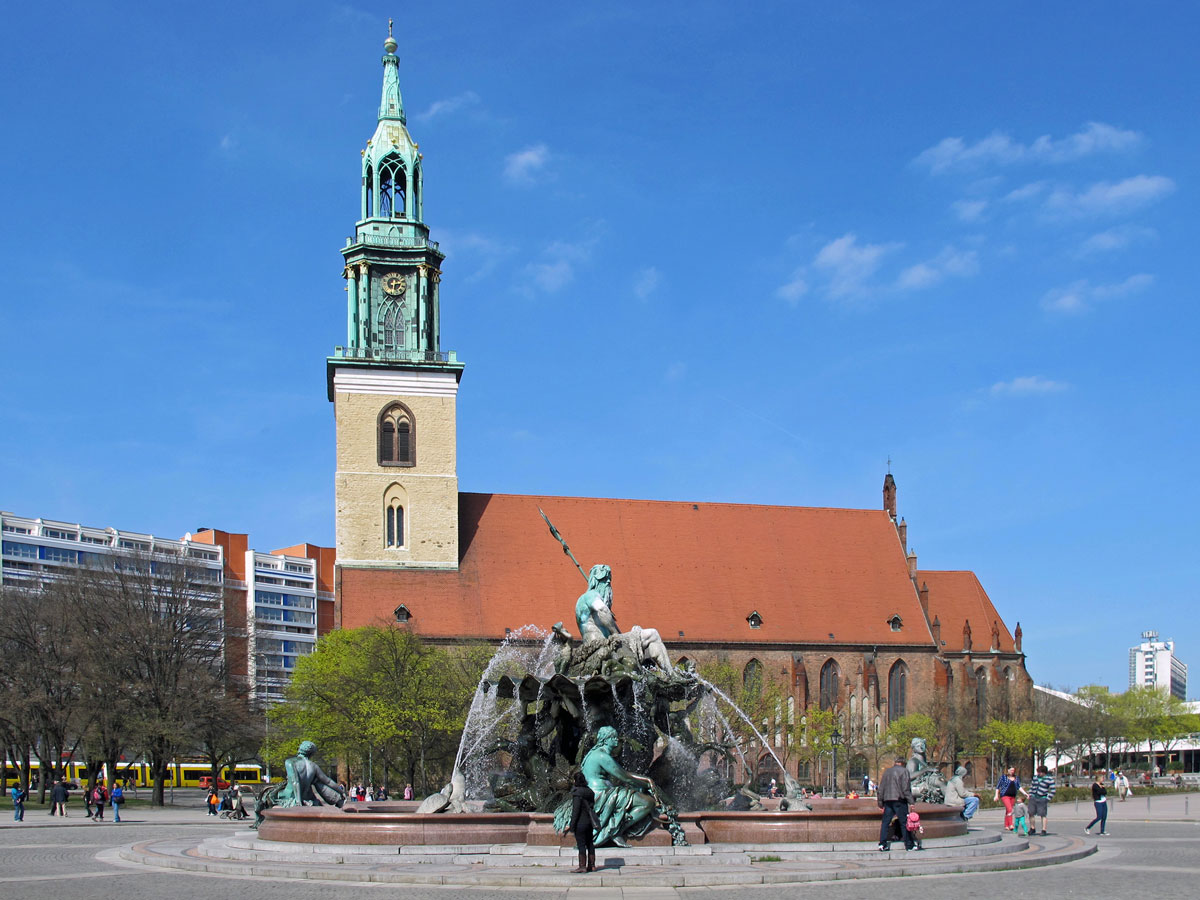
The area on the north-east side of the Spree around Nikolaiviertel and Spandauer Str was the oldest part of Berlin. I say was because the events of the Second World War virtually wiped the whole area off the face of the map. Very little remained intact, and although the Nikolaiviertel district was put back together in a way that only the communist authorities could have thought looked good, the wasteland that was once known as Marienviertel, has been left more or less as an open concrete space between the river and the TV Tower.

Marienviertel is no longer known by that name, but literally speaking it means St. Mary’s Quarter, which pays homage to Marienkirche or St. Mary’s Church.

The church was the only building to be re-constructed in the quarter after the bombing and is worth visiting if only for its historical connection. The original church was built in the 13th century and now stands isolated on the edge of an unnamed square and adjacent to Karl-Liebknecht Str.

Continue reading

Originally posted 2018-04-14 06:22:32.

Berlin Cathedral

Berlin Cathedral

Berlin’s protestant cathedral was only forty years old when it was bombed by the allies in 1944, and it wasn’t completely restored until 2002. It’s never even had a Bishop’s chair – or even a Bishop – and yet it should be on every visitor’s list of things to see in Berlin.

Situated in the oldest part of the city opposite the Lustgarten, this neo-renaissance building was built by the young Emperor Wilhelm II as his private church to compliment his family’s city palace across the road. It immediately had its critics when the building’s religious significance appeared to take second place to the importance of the Emperor and the Hohenzollern dynasty, but somehow, it’s this connection with the German Empire that makes it especially interesting.

From the outside it almost looks as though the intention was to create a church on the lines of St. Peter’s in Rome but being a protestant church, I suppose it was more likely to have been influenced by somewhere like St. Paul’s in London.

Continue reading

Originally posted 2018-03-31 06:30:47.

German History Museum

German History Museum


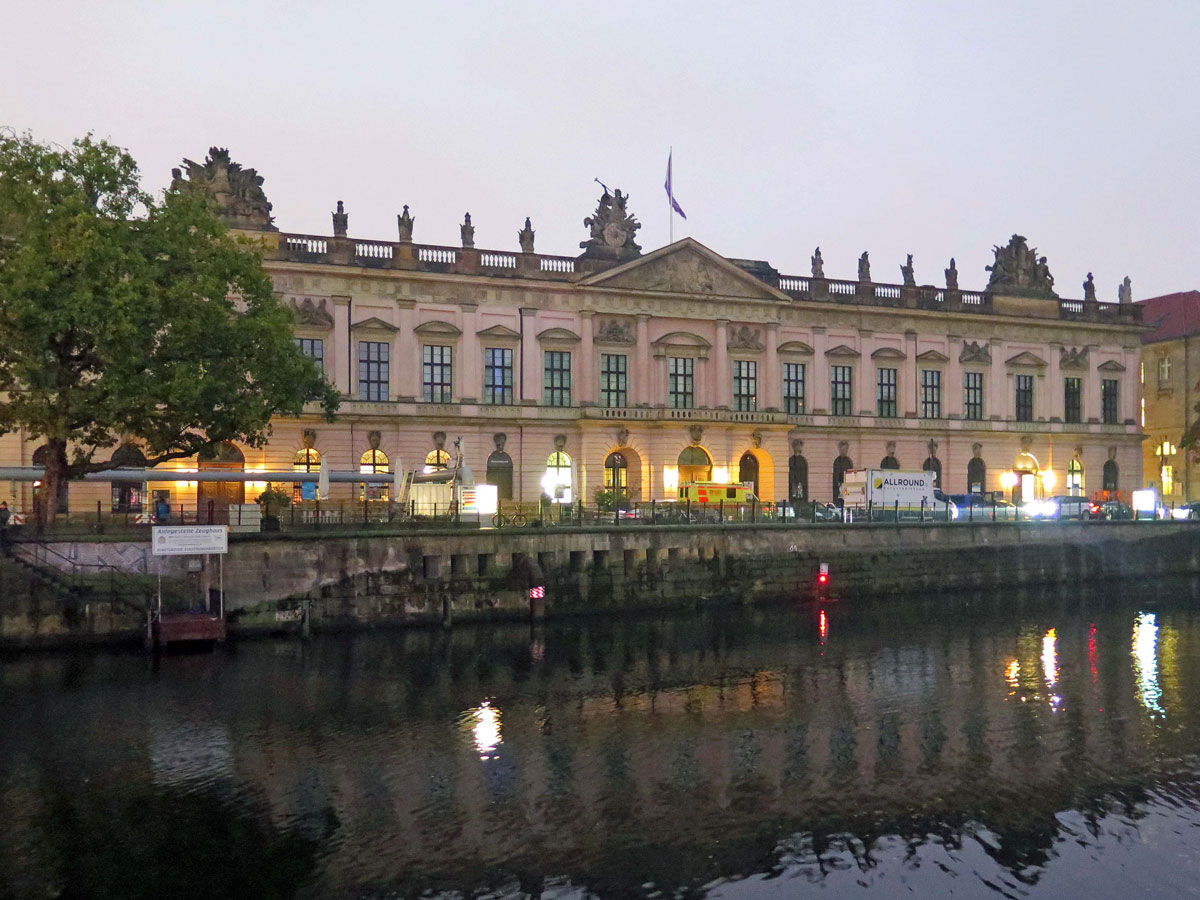
The German Historical Museum’s permanent exhibition is located in the early 18th cent Armoury building on Unter den Linden, with a modern extension housing temporary exhibitions in the Exhibition Hall at the rear.

The collection of Germany’s important historical artefacts has taken a few twists and turns along the way, but with reunification came the opportunity to present them all under one roof, and in 2006 after five years of renovation, the doors opened to the Armoury giving Germany a historical museum that it could be proud of.

As its name suggests, this baroque building was originally built to house the Prussian arsenal before being turned into an army museum. During the Nazi period, this museum was the location for an attempted assassination of Adolf Hitler.

Rudolph Christoph Freiherr von Gersdorff, an officer in the German army, intended a suicide bombing when he was giving a tour of the Armoury to Hitler, Goering, Himmler, and other top officials. He set the device to blow up ten minutes into the tour, but the plan failed because Hitler rushed through the museum in less than ten minutes! Apparently, Gersdorff only had seconds to spare before being able to diffuse the bomb and save his own skin. His attempt was kept secret and he carried on living until the age of 74 and died in 1980.

Continue reading

Originally posted 2018-03-12 16:54:18.

Humboldt University and Bebelplatz

Humboldt University and Bebelplatz


This famous university isn’t a visitor attraction in the true sense of the word, but its historical background makes it more than worthy of a review.

The main building is situated in Unter den Linden opposite Bebelplatz where the Old Library faces the Berlin State Opera House.

Outside the main building are two statues. One is of Wilhelm von Humboldt, the founder of the university in 1810, and the other one is of an explorer and natural scientist, Alexander von Humboldt, Wilhelm’s brother, who also happened to work at the university.

Along with his accomplices, Wilhelm adopted four classical faculties for Berlin University (as it was then called) – Law, theology, medicine, and philosophy. It was so successful that a total of 29 Nobel Prize winners passed through its doors, including Max Planck and Albert Einstein. Other historical figures who studied here were Otto von Bismarck and founders of the Marxist Theory Karl Marx and Friedrich Engels.

Continue reading

Originally posted 2018-03-06 16:20:40.

Federal Row – The Bundestag

Federal Row - The Bundestag


With the collapse of the Berlin Wall in 1989, and the subsequent re-unification of Germany in 1990, an opportunity arose to bring the Federal government back to where it belonged in Central Berlin.

I don’t suppose it took much deliberation as to where to locate the new parliament. The Reichstag may have been battered and bruised from the events of the 20th century, but it was still standing, and the wasteland that was left surrounding it created a blank canvas for developers who could no doubt envisage a new dawn for a new Germany in the new millennium.

Politics isn’t an exciting subject for many people, but rarely has politics been boring in Germany, and if you venture into this part of the city, which is more than possible, then it’s worth knowing a bit about what you’re looking at.

Continue reading

Originally posted 2018-02-22 14:20:06.

The Reichstag

The Reichstag


One of Berlin’s most famous landmarks is the Reichstag.

This iconic building has helped the German Bundestag become the most visited parliament in the world, partly because of its architecture, partly because of its accessibility, but mainly because of its history.

Kaiser Wilhelm II laid the final stone of this neoclassical building in 1894 and it has continued to play a pivotal role in German history ever since. Initially the parliament was really that in name only and the Kaiser was the man who dictated the terms, but in November 1918 Phillip Scheidemann announced from a window here at the Reichstag that the country was now to become a republic and the Weimar Republic was formed.

The republic was just fourteen years old when the Nazis came to power and the dubious Reichstag fire of 1933 helped change the course of history. The events that followed are obviously well documented elsewhere, but as World War II came to its final moments, one of the most memorable images of the conflict show the victorious Russian army raising the Soviet flag on top of the Reichstag. Even today it’s still possible to see bullet holes if you care to look for them.

Continue reading

Originally posted 2018-02-19 07:12:25.

Unofficial Memorial to Victims of the Berlin Wall

Unofficial Memorial to Victims of the Berlin Wall


Anyone who walks between the Brandenburg Gate and The Reichstag can’t fail to notice 14 white crosses spread along a fence next to the Tiergarten. These crosses are obviously a memorial to those who died trying to get across the Berlin Wall, but they’re not supposed to be here – but why not?

It’s not because the authorities don’t want the events publicised because there’s an official memorial on the banks of the River Spree behind the Reichstag.

The reason that they’re not wanted is down to the man who has chosen to erect his own personal memorial here – a man by the name of Gustav Rust. It’s more than possible you’ll bump into Herr Rust if you walk along Ebertstrasse because he seems to be here most of the time.

Continue reading

Originally posted 2018-02-21 08:26:42.

The Brandenburg Gate

The Brandenburg Gate


Ever since the Brandenburg Gate was built it has become a symbol of the city.

It was constructed as a symbol of peace – but then became a Prussian symbol, a Nazi symbol, and then a symbol of the division between East and West. Since reunification it has once again become a symbol of peace, and so I can’t think of a more fitting place to start a tour of Berlin.

It was constructed between 1781 and 1791 for the Prussian monarchy that lived in the Crown Prince’s Palace in Unter den Linden. Designed by Carl Gotthard Langhans the arch was modelled on the entrance to the Acropolis in Athens and topped by the Quadriga designed by Johann Gottfried Schadow.

In 1806 Napoleon defeated the European coalition which included Prussia and on entering Berlin he took the Quadriga back home to Paris as a souvenir.

After Napoleon’s defeat in 1814 it was returned to the Brandenburg Gate and was declared a symbol of victory, and as if to reinforce the point, the Prussian eagle and iron cross inside a laurel wreath was added to the Goddess of Victory’s staff.

Continue reading

Originally posted 2018-02-18 09:07:07.