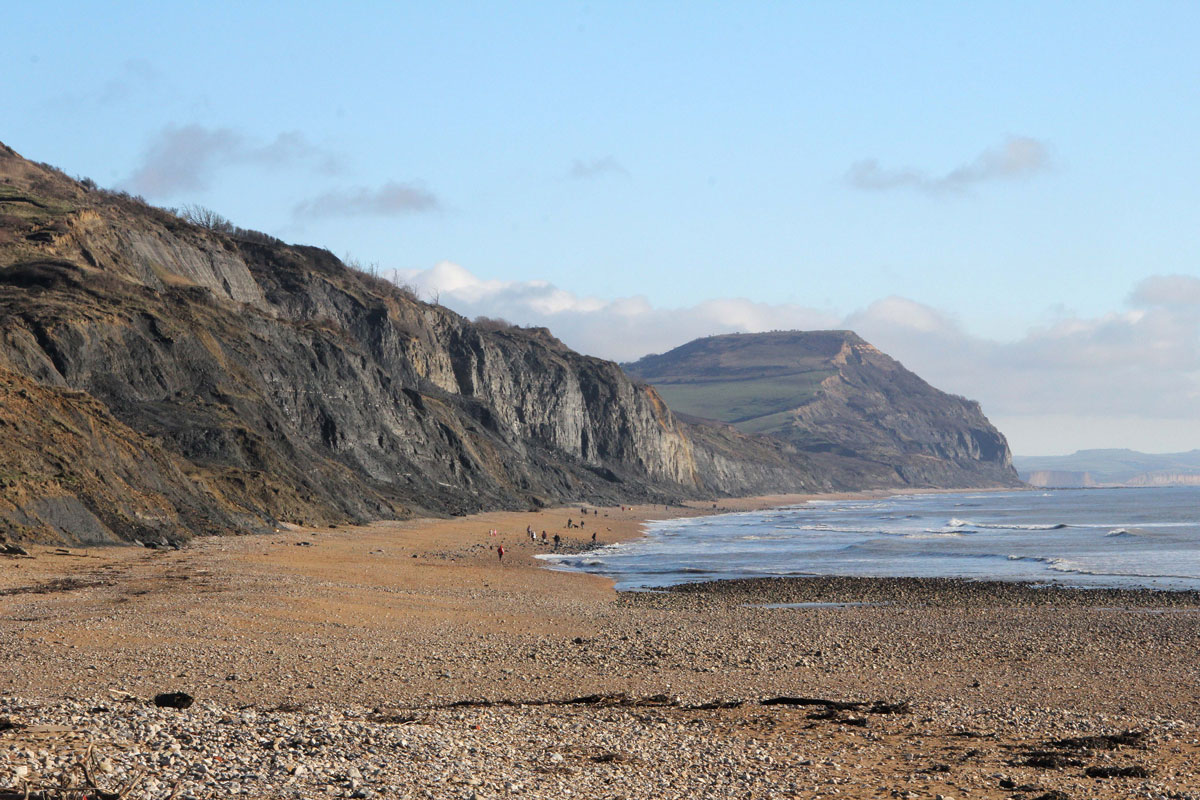
Golden Cap and Fossil Hunting at Charmouth
How do you drag kids away from their social media lives without annoying them? That’s a question that lots of parents must wrestle with these days, but thankfully it’s one I don’t have to, but if I did, I think that I would take them for a day out to somewhere like Charmouth.
As a kid, I always enjoyed rummaging around in rockpools seeing what I could find, and I also remember my first project at school was about dinosaurs and early life on earth; here at Charmouth, you can have the best of both worlds because there’s no better place in the country to go fossil hunting, and judging from the number of families who come here, it seems like I’m not the only one who finds this an enjoyable and stimulating day out.
The Dorset and East Devon coastline has been given World Heritage Status by UNESCO and is widely known as the Jurassic Coast. In actual fact, the 95 miles of coastline between Exmouth and Old Harry Rocks in Purbeck covers three different periods of Earth’s history – from the Triassic Period (250-200 million years ago) through the Jurassic Period (200-140m) to the Cretacious Period (140-65m) – a total of 185 million years.

The coastline around Lyme Regis and Charmouth was formed in the Jurassic Period around 195 million years ago. How the experts can be that precise I’m not sure, but it was at a time when large areas of England and Wales (and other parts of Europe) were submerged under the sea.
The rocks that we can see here today are rich in fossilised plants and animals that inhabited the earth around that time, and even if you think that it doesn’t sound very interesting, you may well change your mind when you discover your first fossil.
To get an overall view of this coastline it’s not a bad idea to visit Golden Cap, which at 627ft (191m), is the highest point on the South Coast of England.
The views from up here are impressive to say the least, and you don’t have to climb 600ft to get up here as there are National Trust car parks at Langdon Hill and Stonebarrow Hill which make it a bit easier, and neither are more than a 10 minute drive from Charmouth.
While you’re up here taking in the views it’s worth trying to get everything into perspective, geologically speaking as well as geographically: The Triassic to Cretacious Periods are actually the equivalent of the Middle Ages of life on earth (known as the Mesozoic Era). The science of the planet’s origins goes beyond the scope of this article, as well as my capabilities of fully understanding it – but suffice it to say that it’s generally acknowledged that the planet was born around 4,600 million years ago, so at least we can get a basic understanding of where this landscape fits into the geological jigsaw.


Seeing as we’re here to enjoy a day out on the beach hunting for fossils, rather than studying for a degree, the next port of call after taking in the views from Golden Cap should be the Charmouth Heritage Coast Centre. There’s a large car park nearby and the beach is right next door. Anything you want to make the day more enjoyable can be found in here – from information, amateur fossil collector’s kits, and fossils – both on display and for sale.


The beach is divided by the River Char into East Beach, which looks towards Golden Cap and the preferred beach for sunbathers, and West Beach which leads towards Lyme Regis and includes the famous Black Ven cliff, whose mudslides constantly bring new fossils down to the shore.

It was along this stretch of beach where the remarkable Mary Anning went fossil hunting with her family. When her father died in 1810, she was just 11 years old, but to help the family’s finances she carried on looking for fossils so that they could be sold to an ever-increasing number of wealthy tourists.
She never had any formal education but with her local knowledge, a scientific brain, and fierce determination, she became the “greatest fossilist who ever lived”.
She probably wouldn’t have known that her discoveries of some of the most important fossils found at the time were to become influential in a new way of thinking. She died in 1847, 12 years before Charles Darwin’s publication of On the origin of Species.
Some of her most notable finds can be seen in London’s Natural History Museum, and are a ‘must see’ if you ever get the opportunity.

For mere mortals like me though, it could be like looking for a needle in a haystack, but even though you might not find a complete Ichthyosaur or Plesiosaur like Mary Anning, there’s every chance that you’ll find an ammonite or two if you know what you’re doing.
Hammering away into the cliffs and bedrock is illegal, but the beach is probably the best source to find fossils anyway, especially on a falling tide, and particularly after a recent mudslide (which are not infrequent).


Whether you find any fossils of consequence or not, a visit to Charmouth will show that the earth’s past is every bit as interesting as today’s technological present, and with a bit of luck the kids might think so as well. Perhaps when they get home, they might start looking on the internet for pictures of a pterodactyl or brontosaurus instead of selfies of their friends on Instagram – but then again, perhaps not. Maybe that’s a bit too much to ask.

Originally posted 2019-04-06 15:53:18.
I would like to point out hammering of the cliffs isnt frowned upon. Its illegal sssi ruling states that you must not hammer at cliffs or bedrock (that means the floor or any rock outcrops attached to the floor ) u may break already loose rocks / boulders though… i wanted to point this out as u make it sound as if u can do it but probably shouldn’t where as anyone caught doing so would face legal action it is a criminal offence .. and as a serious and responsible fossil hunter I do wish people would really be made more aware of this .. not to mention the dangers of hammering at a cliff that could fall on them… always stay away from the cliffs !!!!!
And happy fossil hunting
Thanks for your comment Daniel. I’m not a serious fossil hunter but I do take the writing of my blogs seriously. Perhaps I should have chosen my words more carefully to let people understand that, as you quite rightly say, hammering away at the cliffs and bedrock is actually illegal. I’m more than happy to change the wording to make it absolutely clear, as like you, I would only ever pick a fossil up from the beach without hammering away at the cliffs and risking life and limb – not to mention damaging the environment itself. Let nature do the work I say.
Fascinating. Especially the how Mary Anning got her start bit.
If you ever get to the Natural History Museum in London, you’ll see some amazing fossils that Mary Anning discovered.
That would be grat. I was minded on one summer spent staying on the raf base in Little Rissington near Nourton on the Water . My mum’s borther was stationed there. And there was a quarry nearby where you got some amazong finds. So when i saw this post I had to read it!
It’s a fascinating subject delving into the days of the dinosaurs and such like. My very first project in infants school was all about dinosaurs and fossils.
Wonderful. I can’t remembr mine it was so uninspiring. And I wa sprob in all of p5 at the time.
Beautiful views and fascinating info, as always. We really must get down to these parts again some time soon, but meanwhile you’re right to point out the Mary Anning finds in the NHM which are a favourite of mine 🙂
Btw, when I do come I hope NOT to find too many ‘fossilised pants’ 😉 They sounds as if they could be a bit whiffy!!
LOL I need to employ you as my proof reader 🙂
Excellent. The intrepid and long-suffering Mrs Britain and I had a lovely walk round here – and inevitably featured it on ABAB. You were much braver than I was, in tackling all the technical stuff!
If you like reading about things that are no use whatsoever in today’s world you’ve come to the right place Mike. Thanks for passing by 🙂
Another great and informative post Malc – and what a stunning place! I spent a fair bit of time in Devon in my youth – but always on the North Coast – I blooming wish we’d gone here!
I agree with you about the coast line around our fair isles – it’s stunning and I’ve always loved it. I sometimes wonder if I was a mariner in a former life.
Thanks for your feedback Stuart. It’s always nice to hear your comments. There’s something alluring about the sea isn’t here? Maybe I was a mariner in a former life too.I live in a road called Mariners Way 🙂
That’s a sign! 😀
I may be biased, but I do believe that the coastline around the British Isles is what’s really inspiring,
Thanks for taking another look at my attempt to encourage people to see the world through my eyes. Your comments, Alli, are an inspiration to me as well, especially when I see words like entrepreneurial 🙂
I’ll have to dream up some more long words, then! I completely agree that the British coastline takes a lot of beating. Most of my Welsh castle wander this year will be coastal because most of the castles are by the sea, so I’m really looking forward to that. And I love seeing the world through your eyes – it’s a particularly nice view.
Oh, and a P.S. this time. I took Maddie (my daughter) down to Portsmouth Historic Dockyard on Friday. She was beside herself, completely besotted with the HMS Victory, and we were both quite deeply moved by the Mary Rose museum. She’s very keen on sea shanties, and we listened to an album by The Longest Johns all the way there and back. But guess what? She’s now nagging me to take her to the SS Great Britain. So that’s the next stop on the tall ship trail, just before we go to Wales in July. She can’t wait, and neither can I!
I shall be keen to follow your Welsh Castles tour this summer. I hope you get some really good weather, which will make it all the more enjoyable.
Also glad to hear you had a good time at Portsmouth. It’s a great day out isn’t it, but a day is not really long enough.
I’m chuffed that my article on the SS Great Britain has inspired you and Maddie to visit. I’m sure you’ll both enjoy it. Incidentally, you’ll probably want to explore the area without too much interference from people like me, but I know the area pretty well and there a few things that might be of interest that you might not know about. For example, there’s a Banksy wall mural around the corner, a great view of the Clifton Suspension Bridge not far away and a host of other things that might help you enjoy a great day out. Just let me know if you would like a bit more info.
You’re right, you do need more than a day at Portsmouth. We were there from opening to closing, and we did manage to do the two boats and a harbour tour on the water – which Maddie loved – but we would have also done the Warrior if we’d had more time. Still, it was an amazing day. I’ll definitely contact you before we go to the SS Great Britain, as it’ll be a great benefit to get some pointers from someone who knows the area well. Maddie’s a very talented artist too, so she’d appreciate seeing the Banksy. And she’s looking forward to my castle wander, being mostly coastal. And luckily she likes castles as well. Roll on July then! 🙂
Please don’t hesitate to contact me if you get to visit the SS Great Britain and want a bit of extra relevant info. A visit to anywhere needs a certain amount of time management to get the most out of the day and I understand that you won’t want to be swamped with a whole load of things that you’ll never be able to accomplish.
I’m looking forward to July as well now. I’ve visited a number of Welsh castles, but there are so many that I haven’t, and I’d be very surprised if you didn’t throw up a gem or two 🙂
I hope so. It’s the story of how they came to be – the welsh wars with Edward 1st that will form the backbone of the walk, with stories from the castles themselves along the way. I hope it’ll be entertaining and informative at the same time.
I’m planning on taking Maddie to the SS Great Britain the week before we go, after she’s broken up from school. So I won’t go before getting the lowdown from you. That’ll be really useful. Thanks again. 🙂
That sounds like an interesting theme with Edward I. I’m going to learn quite a lot from those posts. Looking forward to it.
Here’s a link to my introduction page on Bristol which you may like to have a look at before you go. You’ll notice that I haven’t done many posts yet. I started at the Floating Harbour leading up to the SS Great Britain which you’ve already seen of course. The SS Great Britain is located in the Floating Harbour so it may help give a bit of relevant background info.
https://www.easymalc.co.uk/bristol-2/
Thanks Malc, I’ll take a look. That’ll be a great help. 🙂
Another inspiring post, Malc. I also have a real love of, and interest in ancient and prehistoric sites, and being a coastal fan too this looks a fantastic place to go. And the idea of finding fossils like the entrepreneurial Mary Anning is a real pull – I’ve never found a fossil before. Your photos look so inviting too, and anyone would want to go there on seeing such beautiful scenery just waiting to be enjoyed. Thanks for sharing another unspoiled piece of England. 🙂
I understand there is a 95 mile marked walk along the Jurassic Coast (along with many shorter ones)… something that would appeal to me immensely. That aside, you omit one very critical piece of information from your discourse and that is whether or not the internet can be accessed as your hunt for fossils, or otherwise, on the beach!!!!! 🙂
Typical of you Albert 🙂 As if people like us would worry about accessing the internet on the beach 🙂
By the way, you can extend that 95 miles to include the rest of the south-west coast path from Minehead to Poole, a total of 630 miles!
LOL………. good to know about the extension to 630 miles…. I’ll certainly keep that in mind 🙂
You are at another of our favourite destinations. Great to read your experiences there.
Hope it brought back more memories for you Barbara 🙂