
Iceland's Golden Circle - Pt 1
Having spent our first day in Iceland exploring Reykjavik and trying to get my camera to tell the difference between a whale and a wave, it was time to start looking a bit further afield, and the obvious place to begin was the Golden Circle. Apparently, the name Golden Circle was conjured up by the marketing people to describe a circular tour from Reykjavik that encompasses some of the highlights of south-west Iceland. The three main sites are Thingvellir, Haukadalur and Gulfoss, which means Golden Waterfall, and from where this circular route gets its name.
If I was to do this trip today I think I would hire a car, but back in 2006 it made more sense to use an experienced tour company for this 150 mile round trip. The map below shows the officially recognised route of the Golden Circle, but our journey started with a slight variation. For some reason Google wouldn’t let me chart the exact route that we took out of Reykjavik from the Hotel Centrum (stop A and I on the map), and instead of taking the main 1 and 36 roads towards Thingvellir, we headed along the minor 435 road to Nesjavallavirkjun.
I suspect that many people miss out Nesjavallavirkjun (stop B), not just because they can’t pronounce it, but because it doesn’t fit in with the tourist industry’s idea of a convenient circular tour. Whatever the reason, I’m glad our driver took us over this barren landscape to Iceland’s second largest geothermal power plant because I found it extremely interesting, and a good introduction to what we were going to see on the rest of today’s trip.
Renewable energy is on the tip of everybody’s tongue these days, but Iceland, with access to an abundance of geothermal energy, was already ahead of the game. At the power plant, our small group were given a guided tour with an explanation as to how this energy is collected and used, and I think it’s worth going over some of the basics. Don’t worry, I don’t possess a degree in geophysics (or anything else for that matter), and if I can understand it, anybody can.

The name Geothermal comes from the Greek words geo (meaning earth) and thermal (meaning heat) and so geothermal literally means ‘heat generated within the earth’. Most people probably realise that the hottest part of the planet is at the core, which is around 1,800 miles below the crust, and the most dramatic display of that heat coming to the earth’s surface is when a volcano erupts and spews out molten rock in the form of lava. Iceland has something like 130 volcanos, and although regular volcanic activity has its drawbacks, it does have some benefits as well.
In between the earth’s crust and the core is an area geologists call the Mantle. It consists of a thick layer of very hot rock which is mostly solid, but not quite. The heat from this rock is used to create geothermal energy, but for this energy to be harnessed it needs to be hydrothermal, that is, in liquid form. Examples of this occurring naturally come in the form of geysers, hot springs, steam vents and bubbling mudpots, but most of the earth’s geothermal energy doesn’t come to the surface like that, and so the mantle has to be drilled into and injected with water to create steam. Fortunately, Iceland has a plentiful supply of easily accessible underground water, and this is where the Nesjavellir Geothermal Power Station comes in.
The plant became operational in 1990, and is located in an area where this geothermal energy can be relatively easy to tap in to. It only takes a small number of people to work at the plant to provide virtually all the hot water and electricity that the people of Reykjavik need – and when I say a small number, I mean small. Apart from the guide who showed us around I didn’t see another soul working there. How they manage to achieve it, I’m not sure, but the hot water is piped overground to the capital and the electricity required is generated by high pressure steam – and it doesn’t need the wind to blow or the sun to shine either, which was just as well on a day like today.
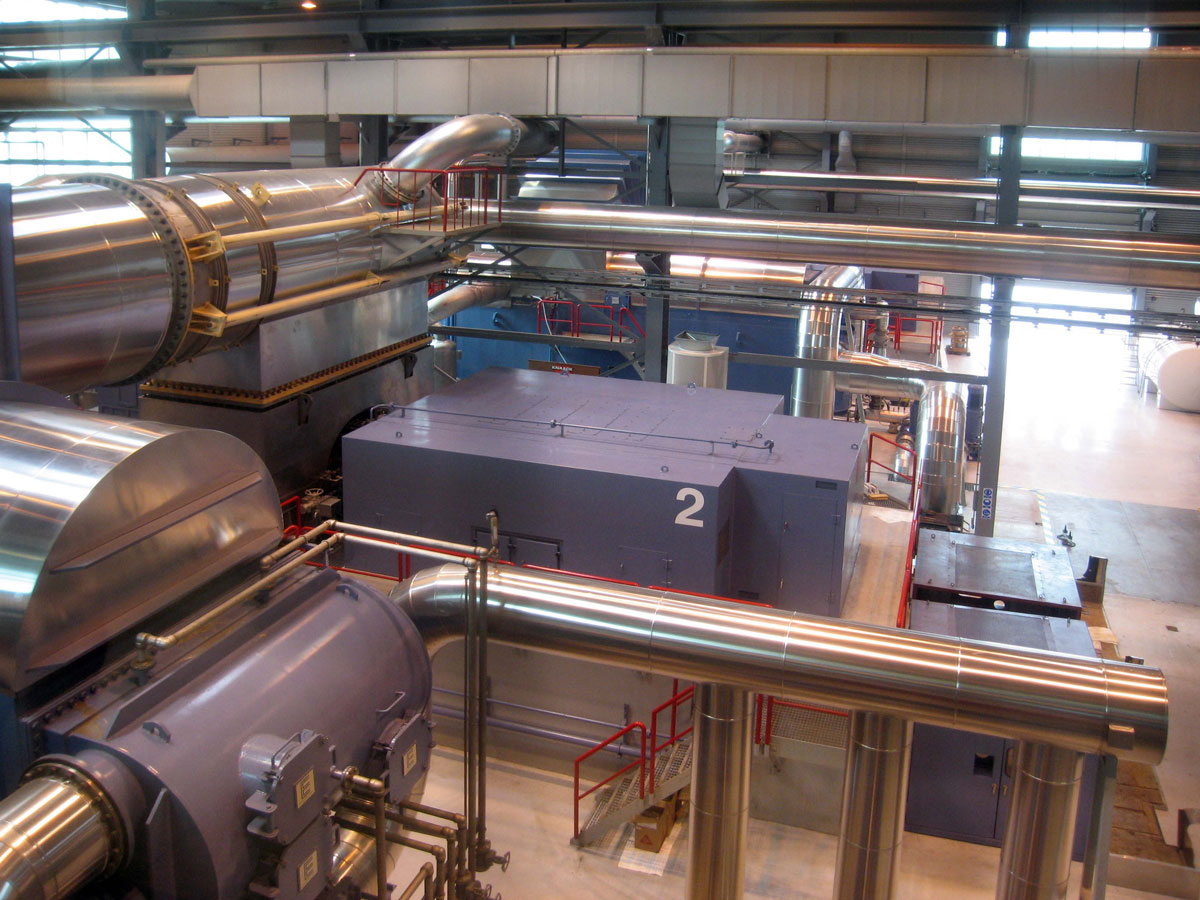
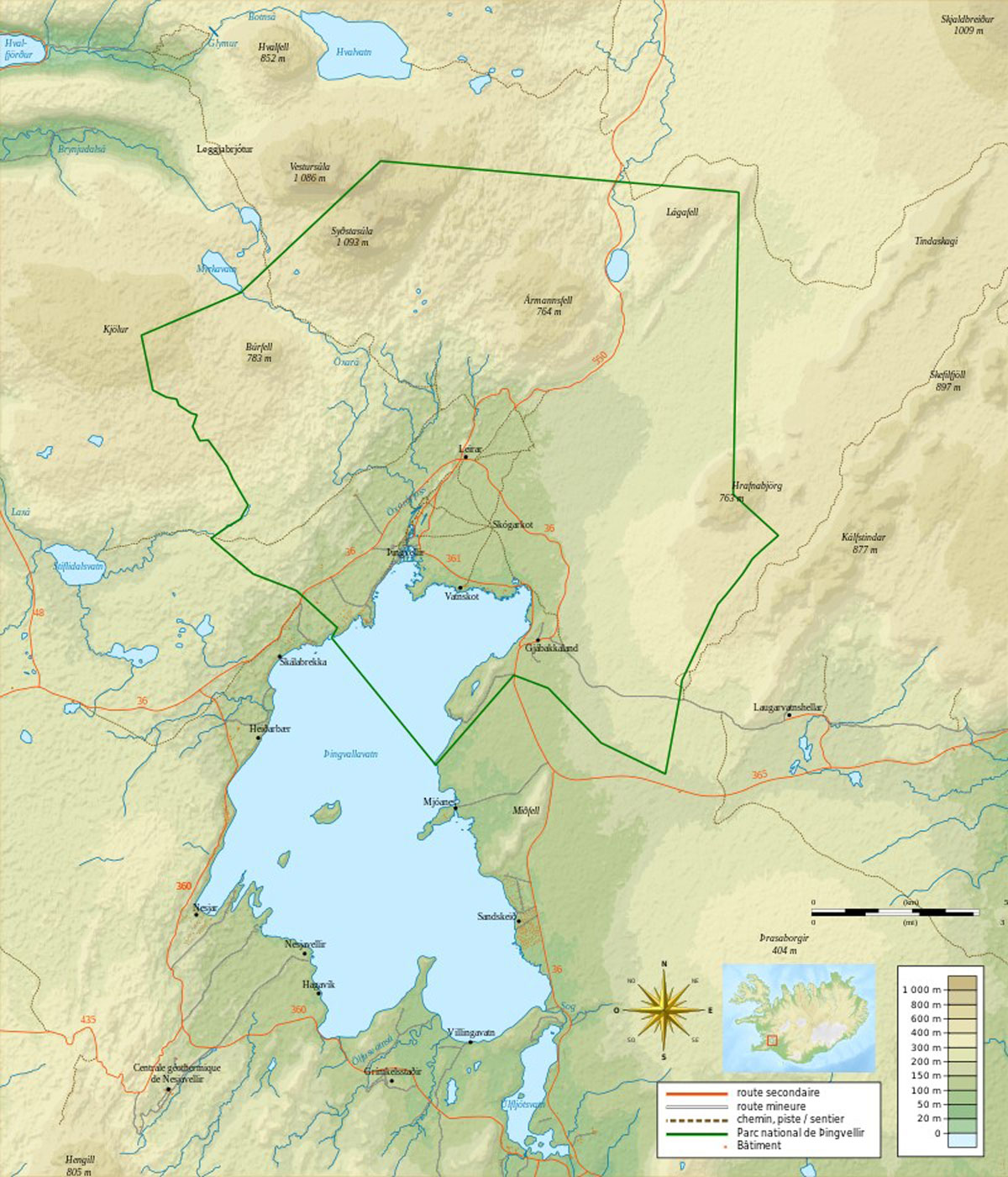
I have to be honest and say that I can’t remember sitting at home thinking that I must visit a power station when I’m in Iceland. In fact I’m pretty sure the thought never even entered my head, but in a way, I’m glad I have, but it was time to move on. The power plant is situated near the south-western corner of Iceland’s largest natural lake – Thingvellir, and on the other side of the lake is Thingvellir National Park (Stop C), the first of the three main sights around the Golden Circle.
The area became Iceland’s first National Park in 1930, and it was in recognition of its historical importance. I’ll be coming to that in a moment, but as we’ve just been discussing how geothermal energy is useful in providing heat, hot water and electricity, then I think it’s best to talk about the area’s geological significance first. Hopefully it’ll also help to explain why Iceland has so much volcanic and seismic activity that produces this thermal energy in the first place, and it’s really all down to the country’s location on the boundary of the Mid Atlantic Rift, which is where the North American and Eurasian tectonic plates meet.
Below is a map of the world’s tectonic plates, and if you look closely you’ll be able to see how the North American and Eurasian plates meet in Iceland.
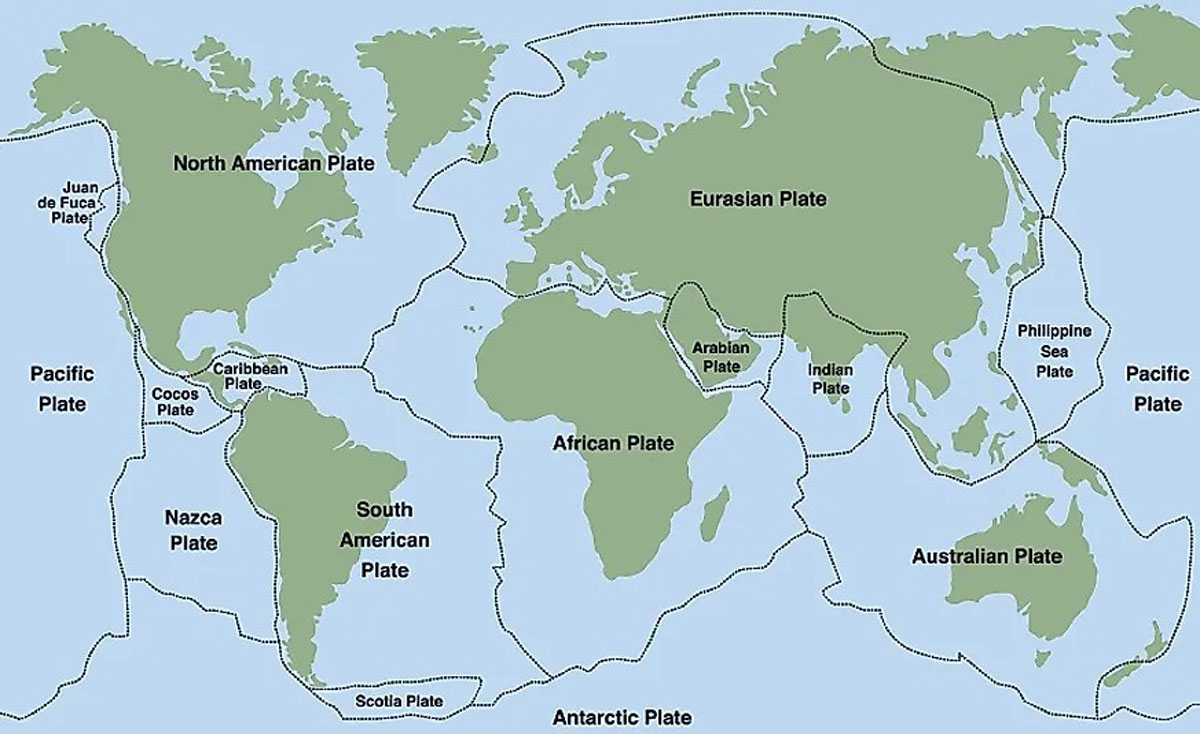
Tectonic plates are parts of the earth’s crust which float on top of the hot partially molten mantle. Sometimes they move past each other, sometimes they collide, and sometimes they move apart – and in Iceland’s case, by about 2 centimetres each year.
In fact, while we’re on the subject, if you’re a local pub quizmaster, you can ask the question “which capital city is in a different continent to the country where it’s the capital of ?” You already know the answer of course, because it’s Reykjavik, and that’s because it lies on the North American side of this tectonic divide.
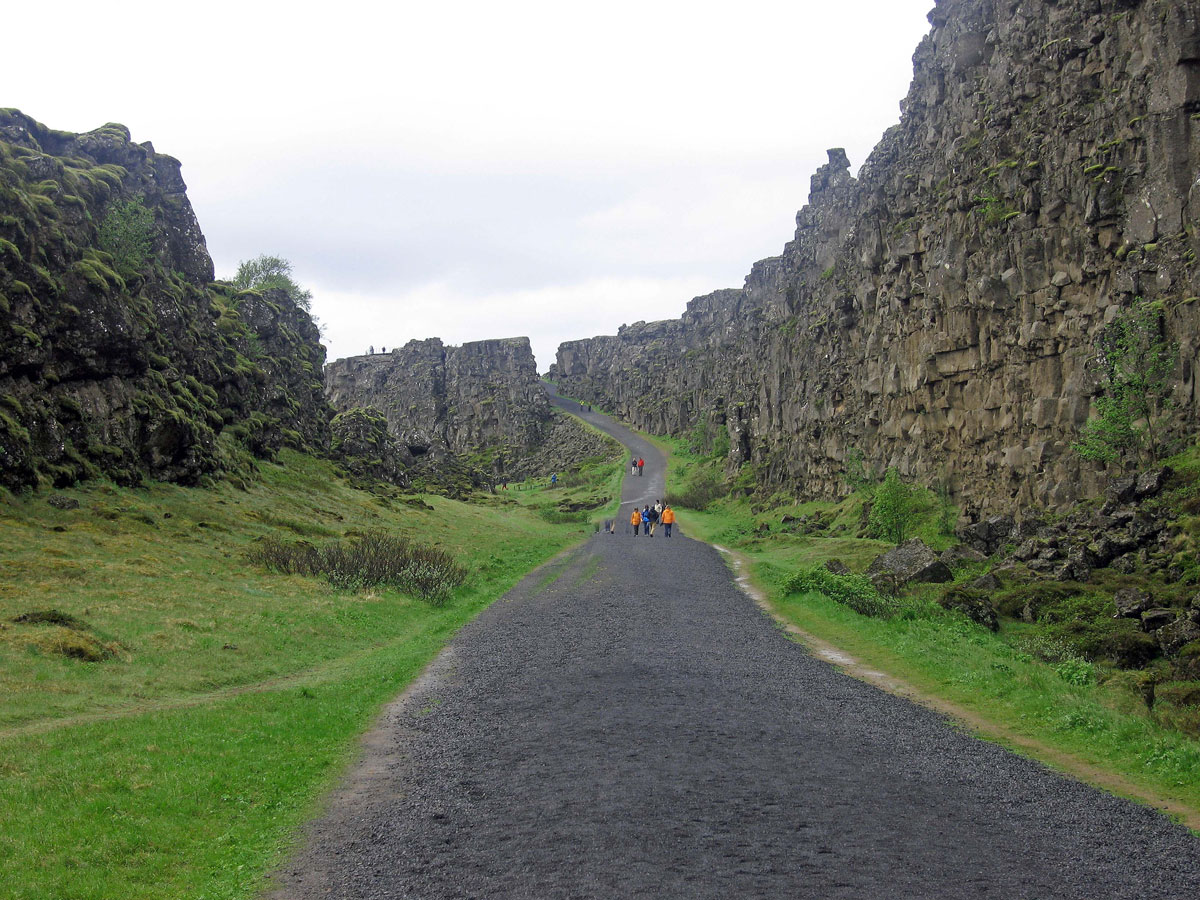
I don’t suppose you were expecting a science lecture when you started reading this post, and so I think it’s best if I explain where all this fits in to the grand scheme of things. Thingvellir is where you can see tangible evidence of where these plates are moving apart, and at Almannagja there’s a path that leads down through a chasm towards Oxarafoss Waterfall. On a nice day it would be a good walk, but unfortunately it wasn’t a nice day when we were here, but at least you can see how the two plates have been diverging over the years
As I mentioned earlier, Thingvellir was important to Icelanders for historical reasons, and when the National Park was created in 1930, it was to mark the 1000th anniversary of the Althing, or Icelandic Parliament.
Those of you who read my previous post, First Impressions of Iceland, may remember that Iceland’s first permanent settler was the Norwegian chieftain Ingolfr Arnarson, and it’s hardly surprising that his descendants became the country’s dominant family, but as more and more settlers arrived and the population grew, the newcomers wanted a say in how things were run, and in 930 a parliament was formed at Thingvellir.
The site was chosen for practical reasons, but the foundation of the parliament here is said to be the founding of Iceland, and even though the country’s legislative powers have fluctuated between Iceland, Norway, Denmark, and back to Iceland again since, the Althing is regarded by Icelanders as the oldest parliament in the world. The last session at Thingvellir was held in 1798 and is now, as you might expect, located in Reykjavik.

Thingvellir National Park was later expanded to include the rift valley and other natural features and was designated a UNESCO World Heritage Site in 2004.
To get a better idea of the area, I’ve included a YouTube drone video by Gutn Tog which is over 9 minutes long, but you don’t need to sit through it all to get the gist, and in the next Icelandic post we’re going to continue around the Golden Circle to show you that it’s not necessary to travel a long way out of Reykjavik to see some unbelievable landscapes.
As this will be my last post before Christmas I would just like to wish everyone a Merry Christmas and a Healthy, Happy and Peaceful New Year – and thank you for all your support during 2023.
POSTED – DECEMBER 2023
Originally posted 2023-12-19 08:15:46.
I found this post to be particularly fascinating because I am a big Viking fan and I am also very impressed with the ability to harness the power of the heat source, one of nature’s natural wonders. It is also very beautiful as well. I would not have expected it to be so green. The history is fascinating and I must say that they are way ahead of our technology in the US for creating such an amazing facility that basically runs itself. Thank you for these great shots and the history. I really enjoyed it.
Thank you so much for your comments. It’s always a bonus to know that someone else enjoys what I’ve written 😊
There was tonnes of spectacular footage on our telly last night covering the volcanic eruption and now that is proving to be another tourist drawcard. I am not sure I would be keen to get up so close to live volcano, but whatever floats your boat! 🙂 Merry Christmas to you and yours, Mel
Thanks Mel, and I hope you and your family have a great Christmas too. I love to look at your fantastic walks and fabulous photographs. Hope there’s more to come in 2024.
A stunning destination indeed and you have created a brilliant description as you have done always! Coincidentally Iceland is all over the news this morning as the eruption has c rested a 4 K fisure spitting out fire… cheers Malc for bringing to life one more interesting place to perhaps ponder a visit to. All the best!
Glad you ebjoyed it Francesc and thanks for your smashing comments again.. The eruption happened yesterday just before I posted, but it’s been simmering for weeks.
Always a pleasure Malc! And yes, we’ve been following the process for weeks. All the best to you.
All the best to you too my friend. It’s Christmas Day today in the Wright household as my daughter is spending Christmas in New York and so today’s the family get-together. It’s a bit wierd, but it’s better than not having a get-together at all 🙂
No, not weird at all Malc, it’s the holiday season, the actual date is not important, what is important is the family and friends who get together. Have a wonderful dinner and time with your daughter! And thank you so much! Happy Christmas to you and your family my friend!
😊🎄
Very interesting to read about the geothermal power plant but I’m afraid the rest of the ‘science lesson’ just went right over my head. This is no criticism of you Malc, more the fact that I hated science/geology when I was at school, could never get my head round any aspect of it and have no interest in it now. I’m looking forward to seeing some unbelievable landscapes in your next post though 🙂
Don’t worry Eunice. I’m sure you’re not alone in that respect, and I’ll see if I can find some pictures of Iceland that you will enjoy.
Extraordinary, isn’t it? Looking at that map of the tectonic plates I was surprised at how many of us live ‘close to the edge’. Interesting article, Malc. Wishing you a merry Christmas, in or out of the pub, and a healthy, happy 2024.
Thanks Jo. I don’t go to the pub very often these days, Most of them aren’t quite like they once were – and that’s if they haven’t closed down. I’m pleased that you found this one interesting, and I wish you and your family a very happy Christmas too.
Brilliant summary, Malc. I don’t know if your timing is auspicious or suspicious in light of the headline volcano news today. Happy Christmas nonetheless. I look forward to more Malcness in 2024.
Thanks Pat. It was a bit of both really. There’s been some seismic activity in the area for weeks now, and it sounded as though there was going to be a volcanic eruption, but when and how big was uncertain. It just so happened to be on the day I was posting the article.
Thanks for the Christmas wishes and I hope you have a great time over the holiday period.
Thank you, Malc, for the continuation of the Icelandic history, as always written with fascinating details, and photography. Of course, I remember the monument of the Norwegian chieftain, Ingolfr Arnarson, and the fact of Althing, Icelandic Parliament being the oldest in the world was something new to me. Thanks to your wonderful tour of the Iceland, I am not surprised about the National Park being designated a UNESCO World Heritage Site in 2004.
You would, Malc, make a brilliant geologist, but as you are a fountain of information without a degree, perhaps, time spend in the pub was not wasted.
Yesterday night, the Iceland’s volcano erupted spilling lava two mile long, and 200 meters tall, and 4000 people had to be evacuated just before Christmas. According to a cameraman it was a spectacular sight, the combination of red lava on snow. It is now just 80 meters tall but the pollution with gases might prevent people returning home soon.
Your posts, Malc, are always mind expanding, and I am looking forward to reading more this country interesting landscapes. Shame, that my traveling time is over, as boiling a bag of rice in a plastic cover in the hot water of the gazer would be most interesting event!
Joanna
I know that Iceland wasn’t on your bucket list Joanna, but by the time I’ve finished these posts perhaps you might see things differently. My travelling days are also virtually over which is why many of my posts are going back in time while I can still remember them 🙂
I think my body has suffered from having too many good times in the pub, but at least my long term memory is still intact ( but not my short memory I hasten t add). I’m obviously aware of the latest eruption in Iceland, and I think it’s been on the cards for a while, but let’s hope it doesn’t have the effect like it did back in 2010, although I have to say it did get me a free extra week’s holiday in Seville 🙂
I would never have thought of visiting a geothermal plant while in Iceland but I can see how it adds to an understanding of the country 🙂 As for Thingvellir, we went there with the VT Golden Circle tour but the rain was so dreadful I can’t claim to have actually seen it! So I enjoyed viewing it through your eyes and of course your always informative descriptions and explanations.
Thanks Sarah. I guessed you managed to do the Golden Circle tour but I think I remember you saying, or somebody did, that the weather wasn’t always kind to you, which is a shame, but that’s Iceland for you isn’t it?
That must have been some spectacle for Regina when she drew the curtains back this morning.
Indeed, that eruption looks pretty spectacular, and scary for those living nearby! I wrote a blog post about our Golden Circle which may be what you’re thinking of, and of course there were plenty of photos on the VT FB page at the time.
It’s all coming back to me now 🙂
I can see exactly why this is a UNESCO World Heritage site, Malc. The fractured landscape is phenomenal! I knew about the parliament, but seeing the place where it all happened is a different thing altogether. I’d loved to have been on that tour bus with you to see it ‘in the flesh’, and to have visited the power station. A genius way of harnessing natural energy, and with so few people needed at the plant too. The good thing about visiting places like this is that it gets people thinking about where their energy comes from and how, with a little effort and imagination, we really can live in harmony with nature. And that path in the chasm looks incredibly inviting. We’d be literally walking through part of the history of the Earth itself. Wonderful. I want to go! 🙂
P.S. Thanks so much for our beautiful ecard. I’ve yet to send mine as I’m desperately trying to finish my own Christmas blog post as well as finishing all the seasonal preparation running around. So please, bear with me… 🙂
The whole earth science thing is something I could really get into, and if I could have my time all over again I think I would like to have been a geologist. How Earth was formed, what it comprises of, and how the mix of rocks, water and air managed to produce plants and animals that could survive is something I wish I coulf really understand. Then we have to face up to whether Darwin’s theory was correct or not, but it doesn’t stop there though does it? If only I hadn’t kept going to the pub instead 🙂
Anyway, thanks for the thanks for the card, and I hope you get your blog ready in time. I’m sure it’s going to be worth waiting for – and of course I’ll bear with you Alli 🙂
Me too, I find the history of the Earth itself really fascinating. Mind you, going to the pub has its merits too. 😀
There’s been the odd eruption when I’ve got home on occasions though. By the way, I’ve tried to comment on your latest blog but it’s not showing up. I’ve tried twice and I’ll try again. If you can read them just delets the ones you don’t want.
Oh very good! So the pub and Earth’s geology aren’t entirely unrelated then! 😀
You could say that 🙂