
Iceland's Golden Circle - Pt 2 Gulfoss and Geysirs
If you followed Pt 1 of our Golden Circle tour, you may remember that we visited the Nesjavellir Geothermal Power Station before driving on to Thingvellir National Park, where we could see how the North American and Eurasian tectonic plates are gradually pulling Iceland apart.
This fault line is responsible for the large number of earthquakes and volcanic eruptions that frequently occur in Iceland, but we’re now on our way to an area that will show us in graphic detail how these seismic events affect the landscape in other ways and why the power station is located where it is.
Part of the journey from Thingvellir meant driving along a gravel road (which has since been tarmacked) to the Gulfoss Waterfall (D on map). There is no shortage of waterfalls in Iceland but this one is special. Apparently, the River Hvita (when it’s not iced up) plunges downhill at an average rate of 5,000 cubic feet per second. I forgot to bring my cubic measuring stick with me to see if it’s true or not, but let’s just say it’s one extraordinary spectacle, and it’s not hard to believe that during the 20th century there was talk of harnessing its power for hydroelectricity. Fortunately it didn’t materialize and is now one of Iceland’s main tourist attractions.

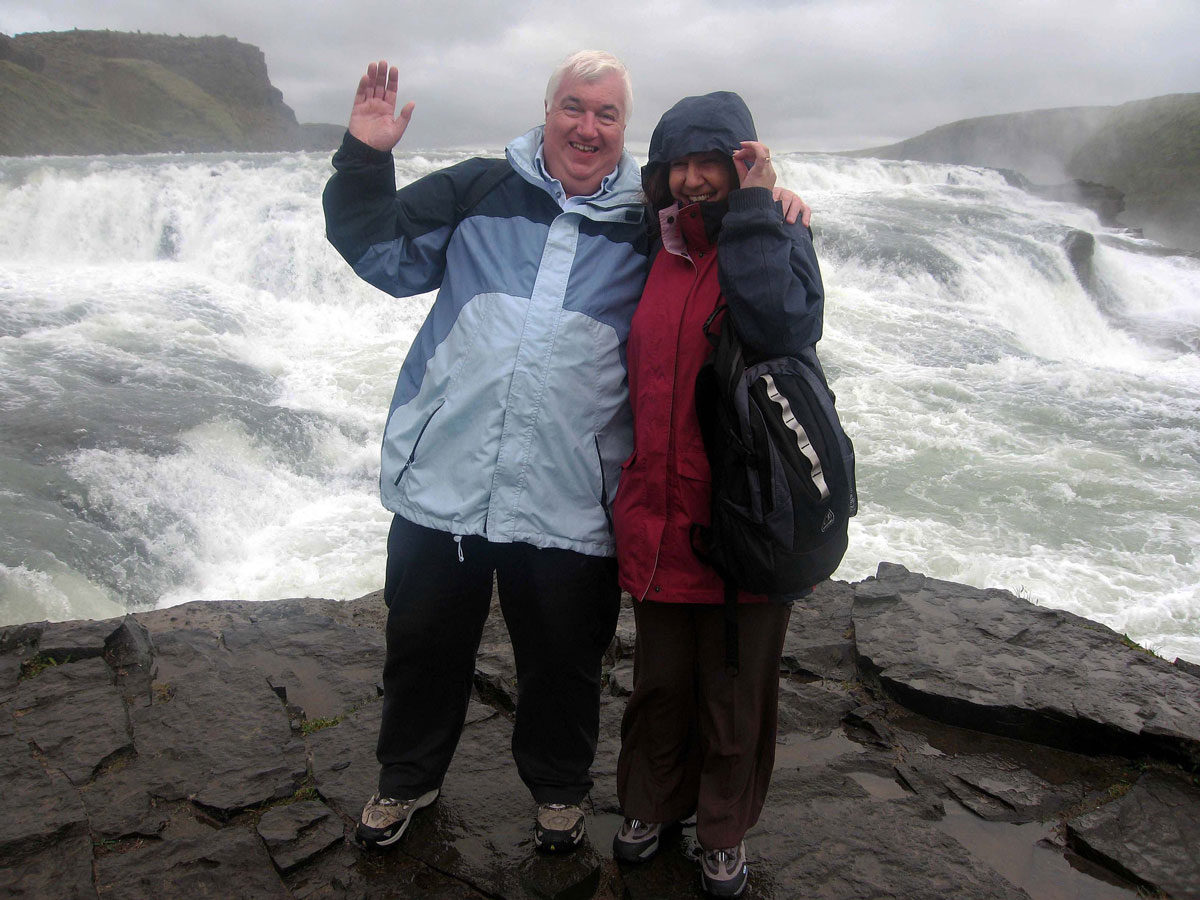
What it does show, if proof was ever needed, is that there’s no shortage of water in Iceland, and after a bowl of Icelandic soup in the Gulfoss Café we were off again. I’m not sure what the ingredients were in the ‘special’ soup by the way, and I thought it was best I didn’t ask, but I was so hungry I couldn’t have cared less if it was a bowl of volcanic ash mixed with steaming hot liquid from a bubbling mudpot – a concoction which, as you might have guessed, conveniently allows me to introduce you to our next stop on the itinerary – the ‘Haukadalur Valley’, an area famous for its geothermal hot springs (E).
These hot springs are an indication of seismic activity in the area, and is why the power station can harness the hot water and steam for the people of Reykjavik, but in order to know what we’re looking at in this unusual landscape, it’s worth understanding where this energy comes from.
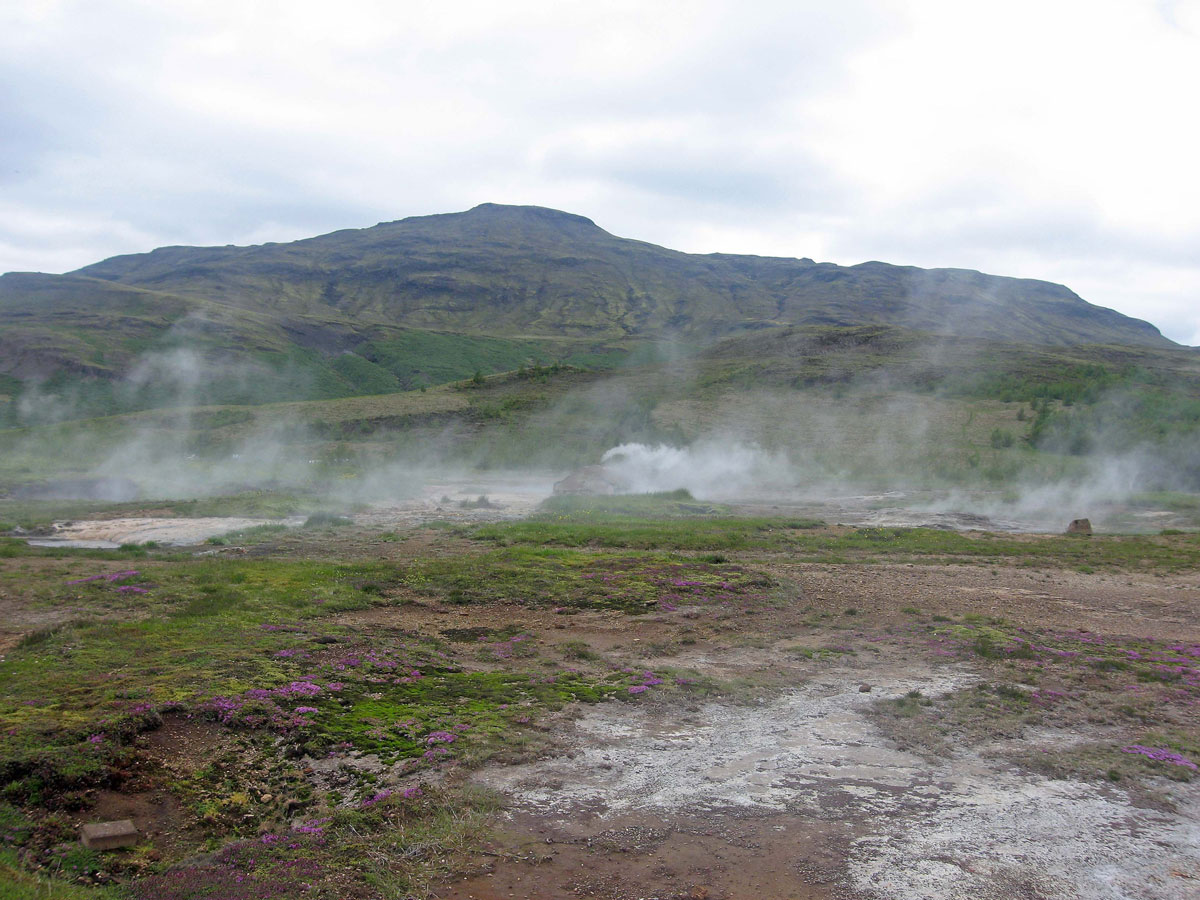
As I’ve already explained, the earth is hottest at its core, and as the magma passes up through the mantle to the earth’s crust, it gradually cools down. However, when groundwater seeps down through fractures in the crust, it gets heated by the hot rocks and magma underneath, and a steep rise in temperature within a relatively shallow depth can lead to activity on the surface.
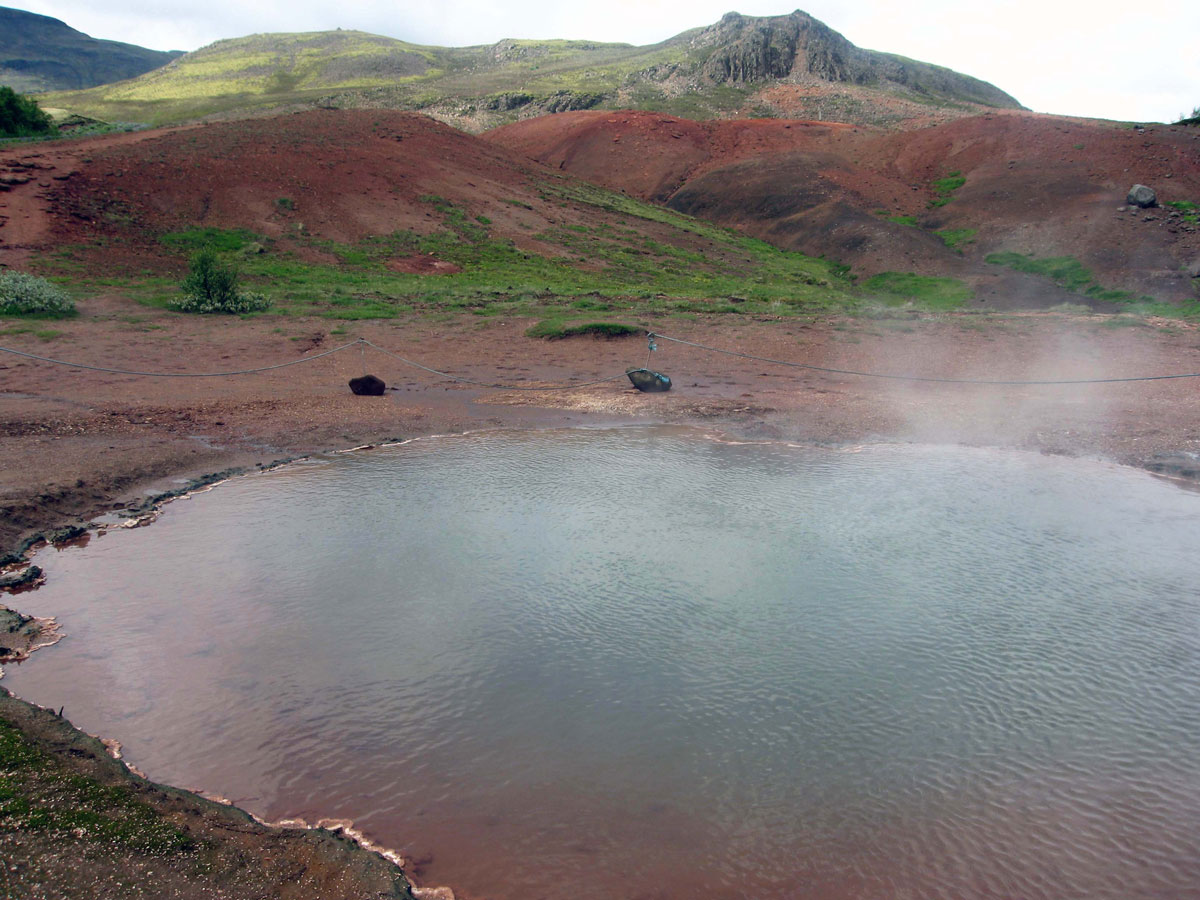
This activity can be seen in a number of ways: If the hot water returns directly to the surface, it forms what we know as hot springs, but if the hot water turns to steam first, it is ejected (along with other gases) through vents called fumaroles, and as the heated water rises it can dissolve minerals in the surrounding rock, which after reaching the surface and cooling down, leaves a deposit of the minerals that it’s gathered up along the way.
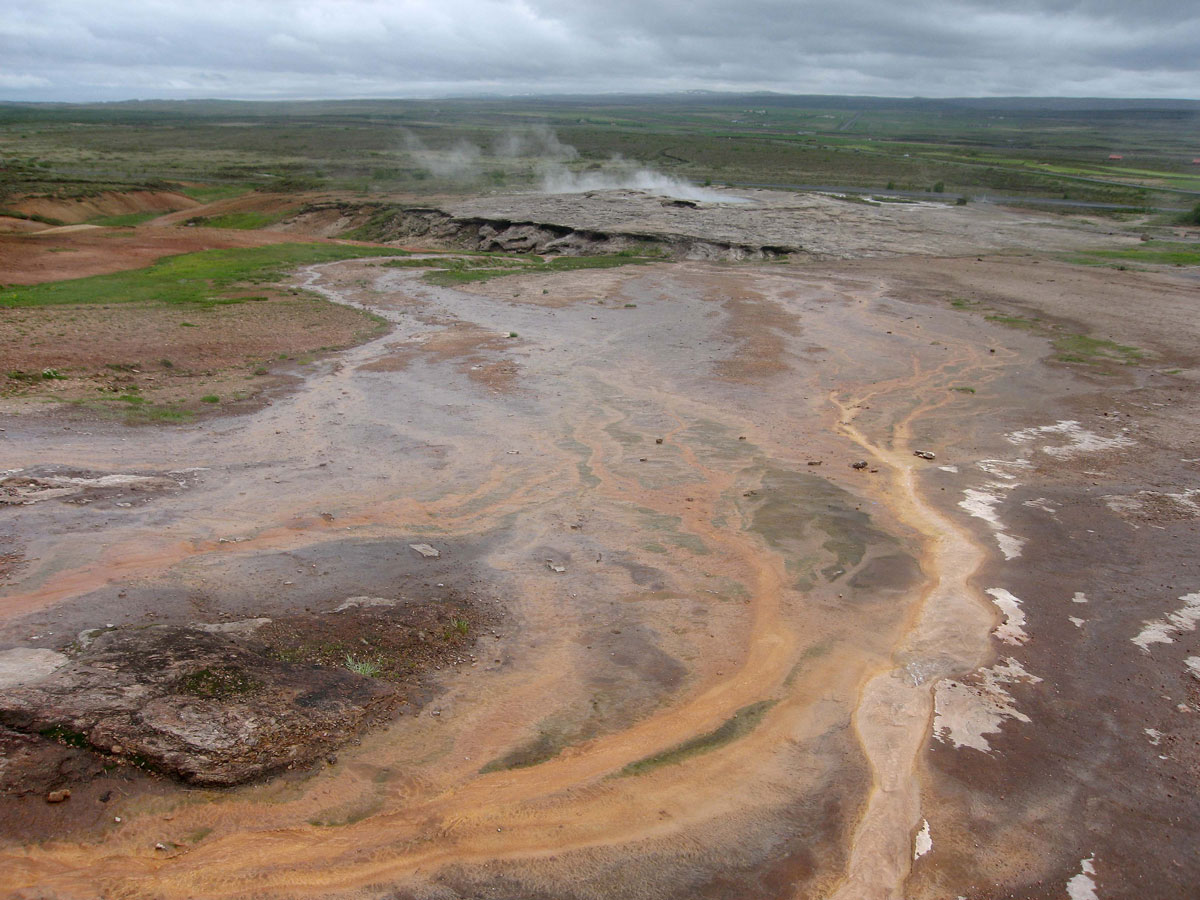
The third way that this activity can manifest itself is the most dramatic of all. It happens when hot water and steam gets trapped in hollows underground, and when the pressure builds up it is released by a sudden gush of hot water and steam high into the air. These eruptions are called geysers, a name which comes from the Icelandic verb, geysa, meaning to gush, and the very first geyser to be named as such was the one here at Haukadalur.
Geysir (as it’s officially spelt) has been gushing, on and off, for around 10,000 years, but the predictability of its eruptions has been sporadic. At one time, it was erupting up to eight times a day, and in 1845 reached a record height of 560 feet. At the time we were here it was down to twice a day but still spouting hot water 230 ft into the air. Unfortunately, we never had the chance of seeing it, and I believe that if you were to come here now, you would have no chance at all, as it has been dormant for quite a while – but for how long is anybody’s guess.
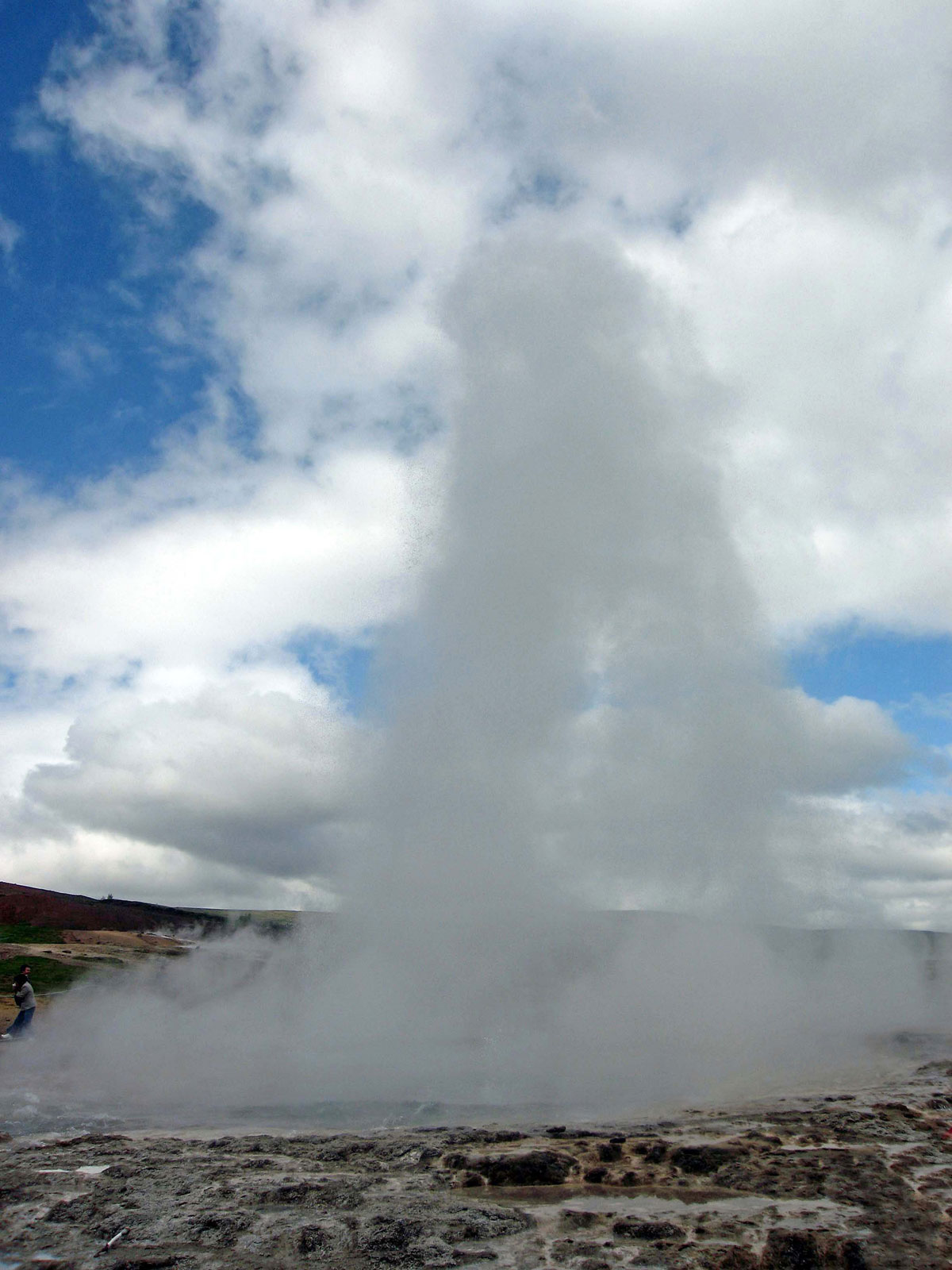
Fortunately, Haukadalur has another geyser – Strokkur – which is far more reliable. Lying just a short distance away from Geysir, this fountain-type geyser erupts every 5-10 minutes and reaches on average anything between 45-65 feet high, but sometimes as high as 130 feet. I didn’t have a camera that took videos at the time and so I ran off several pictures of the sequence. The one below shows it at more or less the maximum height. Better still though, is a YouTube video by William Burnett that shows Strokkur’s spectacle when it erupts.
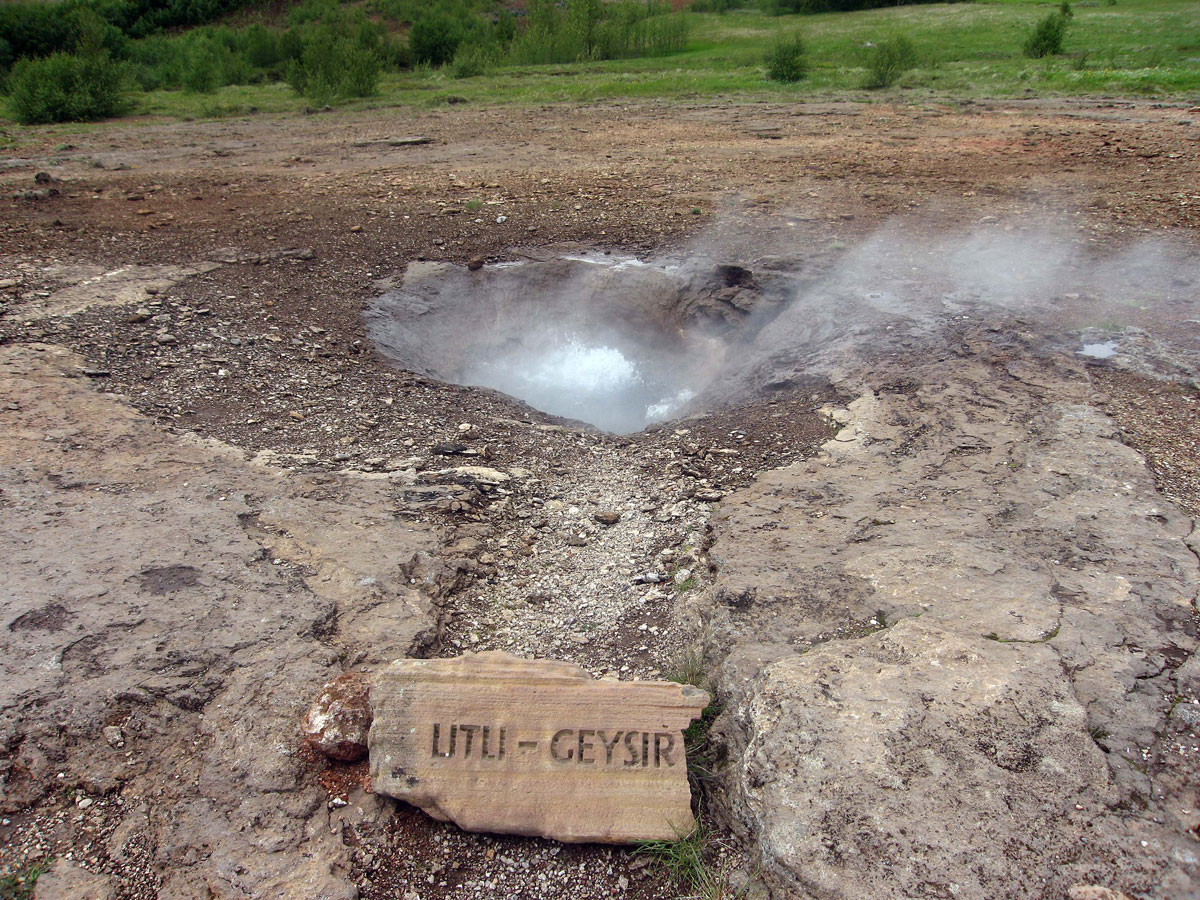
There are around another thirty smaller geysers and hot pools in the valley including Litli Geysir (Little Geyser) and Blesi Blue Pool. I could have spent hours wandering around here studying mud pots and such like, but there were still more things to see around the Golden Circle, and in Pt 3, I’ll be describing what they were. If I haven’t blinded you with science too much, I hope you’ll join me one more time for what will probably be the last post on the Golden Circle.

POSTED – JANUARY 2024
Originally posted 2024-01-06 11:43:16.
I had no idea there were geysers in Iceland. It’s such a unique country.
It certainly is. Thanks for commenting.
Iceland is an amazing place to see and explore, one I have yet to visit myself. It’s quite amazing how you can easily find wide-open spaces and vast areas of untouched wilderness in Iceland. Not to mention the fact, that abundant natural beauty is around every corner with unparalleled scenery unlike anywhere else. Thanks for sharing, and have a good day 🙂 Aiva xx
If I’m honest I never expected Iceland to be as different as it is, so if you like travel as much as I know you do, then Iceland is a must place to visit – and thank you for your comment 🙂
Your vivid descriptions really bring the breathtaking landscapes to life, especially the stunning Gulfoss Waterfall and the fascinating geothermal activity at Haukadalur. It’s amazing how nature’s power is showcased in such dramatic ways. I love how you captured the anticipation of witnessing Strokkur’s eruptions! Can’t wait to read Pt 3 and see what other wonders await on your adventure! 🌍✨
Thank you so much. Pt 3 has already been done and you can see it here https://www.easymalc.co.uk/icelands-golden-circle-pt-3-the-end-of-the-tour-and-the-reykjanes-peninsula/
Absolutely Beautiful Pictures, Video and Great Post
Thank you. Your comment is really appreciated
Thank you very much for this interesting post/pictures concerning Iceland. I have just read “The sealswoman’s gift” by Sally Magnusson (also about Iceland in the 17th century)
Thank you for your kind word. It’s much appreciated. Wasn’t Sally Magnusson the daughter of Magnus Magnusson?
I can see where getting to close to some of these enormous “Jaw-Dropping” experiences could be very dangerous, but what a force of nature to be both appreciated and seen. Thank you so much for sharing your lovely photos. My husband and I have been fascinated with Iceland since we started watching Viking shows. Much appreciated my new friend.
I can’t promise to enthrall you with posts all the time, but I’m so pleased that you’ve joind my list of followers – and it’s all thanks to Francesc encouraging me to write a post for his ‘Features’ page. I’ve taken a quick look at your own blog and will be back to take a more in-depth look soon. A big thank you from Easymalc 😊
Amazing nature. I’m impressed!
I agree. It is impressive. Thanks for commenting.
Wow, the falls and the whole area look fabulous!
It certainly is and thanks for commenting. Your phoyography looks impressive to say the least
Wow, this place is really nature at its most feral, doesn’t it? I can imagine if you were standing there like those people in the video that close to a geyser it must almost feel as though you’re looking back in time to an earlier stage of the earth’s development, because really you’re witnessing the ongoing effects of the planet’s formation. I think I’d feel rather humbled by that, and very small. The Blesi Blue Pool looks surreal, stunningly beautiful but somehow otherworldly. I’d love to see that. Do you know what makes it blue? And it looks as though it’s lit from below. The River Hvita looks equally impressive and dramatic. Good job you were wearing waterproofs standing so near the crashing torrent – there must have been a fair bit of spray, and I can almost hear the noise the racing water must have made. What a wonderful experience this trip must have been. I definitely want to go:-)
Yes Alli, we did stand that close and watch the spectacle erupt. They have a rope around it to keep people away from danger, but it would be easy enough to ignore it if you’re daft enough. As for the Blesi Blue Pool, it apparently gets its colour from the sun reflecting off of the silica in the water, but as the sun was nowhere to be seen that day, I’m not quite so sure. There are two Blesi pools. The other one isn’t so appealing to look at, but they’re connected and look like a pair of eyes. In part 3 I may extend the Golden Circle to include the Blue Lagoon.
I agree, the explanation for the blueness of the Blesi pool doesn’t seem to fit. Maybe it’s something less, well, earthly. So there’s a real blue lagoon then? That’s something to look foward to seeing. 🙂
Yes. The Blue Lagoon is quite famous, but it’s out of bounds at the moment due to the volcanic activity in the area 🙂
I’ve seen Gullfoss and Geysir twice. The first time was in the winter, when the spray from the waterfalls had made the paths so icy I didn’t dare get close. And the second was during the VT meet when we had horrendous weather for our Golden Circle tour and I didn’t get further than the viewing platform outside the visitor centre 😆 So how lovely to see your closer photos of it in full force! Loads of informative details too, as always from you.
Thanks Sarah. It’s a shame that you didn’t get to see these places in decent weather, and I have to confess that it wasn’t that brilliant when we were there either 🙂
That’s Iceland for you! I’d love to visit again but if I do it would probably be to a different area, maybe the north.
They reckon it takes around a week to travel on the circular road around the island. Whether it takes longer in the winter I’m not sure 🙂
It’s one of those places that everyone wants to go, and me with my awkward head on, thinks not me. But then, every time I read an article like this I wonder why I haven’t. There can’t be many more fascinating places on this planet, can there?
It’s different that’s for sure Jo. I’m pretty sure you would enjoy it here, but you don’t come for the weather
No, you come in spite of the weather.
Very true 🙂
Amazing. And so interesting the way you write, that I learned lots, saw lots and smiled lots. The vid is quite something…..
Thank you Shey. You’ve made my day 🙂
You’re very welcome. Always a joy to read your posts.
You’re a star 🌠
And you are too kind.
Amazing and quite interesting to visit, although not for me. Your post is, as usual, brilliant!
Thanks Francesc. At least you can enjoy Iceland from the comfort of your armchair 🙂
And a great pic of you there!
LOL There’s never been a great pic of me Francesc.
Come on mate, you looked smashing good! All the best!
I am not having you on, it was a nice pic!
Just in case you’re cross-eyed, I’m the one on the left 🙂
A more interesting and exotic version of Rotorua 😉 Iceland does appeal to the traveller in me. Maybe one day, and in the meantime I can enjoy reading all about it. Thanks, Malc, for another in depth post on Iceland.
Thank you Suzanne. I’m not sure where you live exactly, but would I be right in saying that Rotorua is on North Island but most seismic activity occurs on South Island? You’re probably going to tell me that an earthquake can happen anywhere now 🙂
Thank you, Malc, for the fascinating post that left me spellbound at the nature’s power and beauty. As there is no chance for me to travel to Iceland, your post fulfill all my desires and questions! You have, Malc, as I wrote before,
a knack to explain the complex in a clear way, and easy to understand the geological issues.
Thank you for expanding my knowledge, Malc!
Joanna
Thank you so much Joanna. Topics like these can be difficult to understand for most of us and I do my best to put them in a way that makes sense. Everything in the natural world stems from what has gone before, and is one of the reasons that I find the make-up of our planet so engaging.
Amazing, Malc. This particular area reminds of Yellowstone NP in the US. Volcanoes will certainly keep you on your toes.
You’re right of course Pat. Yellowstone is a famous area regarding this sort of activity.
As always you shared a fabulous post, which makes me want to visit those cold regions, a desire I’ve never had before ❣️
The video was amazing
It always pleases me to hear that I’ve sparked an interest in a post I’ve written Luisa, and I agree with you that the video is a good one. It shows exactly what happens when the hot water and steam gushes up through the surface. Before it erupts you wonder exactly what is about to happen.
…. … that’s what I asked myself, before that explosive surprise
Thanks a lot for your kind reply, dear Malc
It definitely wasn’t a let down 🙂 🌋
👍🙏❤️
An interesting post Malc and not too scientific for me to get me non-scientific head round 🙂 The Gulfoss waterfall looks quite spectacular and I like the Blue Pool, it reminds me of a lake I went to in the Italian Dolomites where the natural chemicals in the water turn it turquoise blue.
Nature can be amazing Eunice can’t it? I’m glad that you found this post not too overwhelming because it all fits together like a jigsaw really, and when there’s another volcanic eruption on Iceland you’ll know why 🙂
I’ve just watched the video again, it’s amazing, and I like how the water is sucked back down the hole afterwards 🙂
It’s quite a jaw-dropping experience 🙂