
Tallinn - Pt 3 Snow, The Singing Revolution - and More Snow
If you’re not interested in the history of Estonia and the other Baltic States you’re probably better off skipping this post, but on the other hand, if you want to find out why these nations became concerned when Russia invaded Ukraine, then you just may want to read on.
After my tour of Toompea in perfect conditions yesterday, I spent the evening deciding whether it was worth attempting to take a ferry trip to Helsinki today. I felt it was doable if I got my act together and so I made sure that I got up bright and early this morning in anticipation of giving it a go, but when I drew back the curtains I could see that it was chucking it down with snow. In my mind’s eye, I had visions of sailing across the Gulf of Finland under a bright blue sky; this wasn’t what I had in mind at all, so I decided to give it a miss and go for Plan B instead – and there was always tomorrow anyway.
Plan B involved using the Hop-on Hop-off bus tour, which coming from England as I do, sounds mad because back home a few flakes of snow means all the bus services grinding to a halt, and to be honest, as I trudged across the snow to the bus stop in Viru Square, I wasn’t convinced this was going to happen either.
When I arrived at the bus stop for the first Red tour at 10 o’clock, there was nobody here and there was snow piled up all around it. 10 o’clock came – and went – with no sign of any potential passengers or bus. It was looking ominous, and I didn’t really have a Plan C. Then suddenly, out of the blue came the big red bus – which promptly went straight past.
It pulled in just a bit further up the road at a bus stop which had obviously replaced the one I’d been stood at, but if I got my ice skates on, I might just be able to catch it. Fortunately, unlike bus drivers back home who watch you race up to the bus stop and then pull away just as you get there, Estonian bus drivers are more considerate and he waited for me. I clambered upstairs and said hello to two English ladies who were also daft enough to be on here. They say that mad dogs and Englishmen go out in the mid-day sun but, but they also go out in the bleak mid-winter as well. There wasn’t going to be any hopping on and off for me today in this weather, but at least the bus wasn’t open-top.
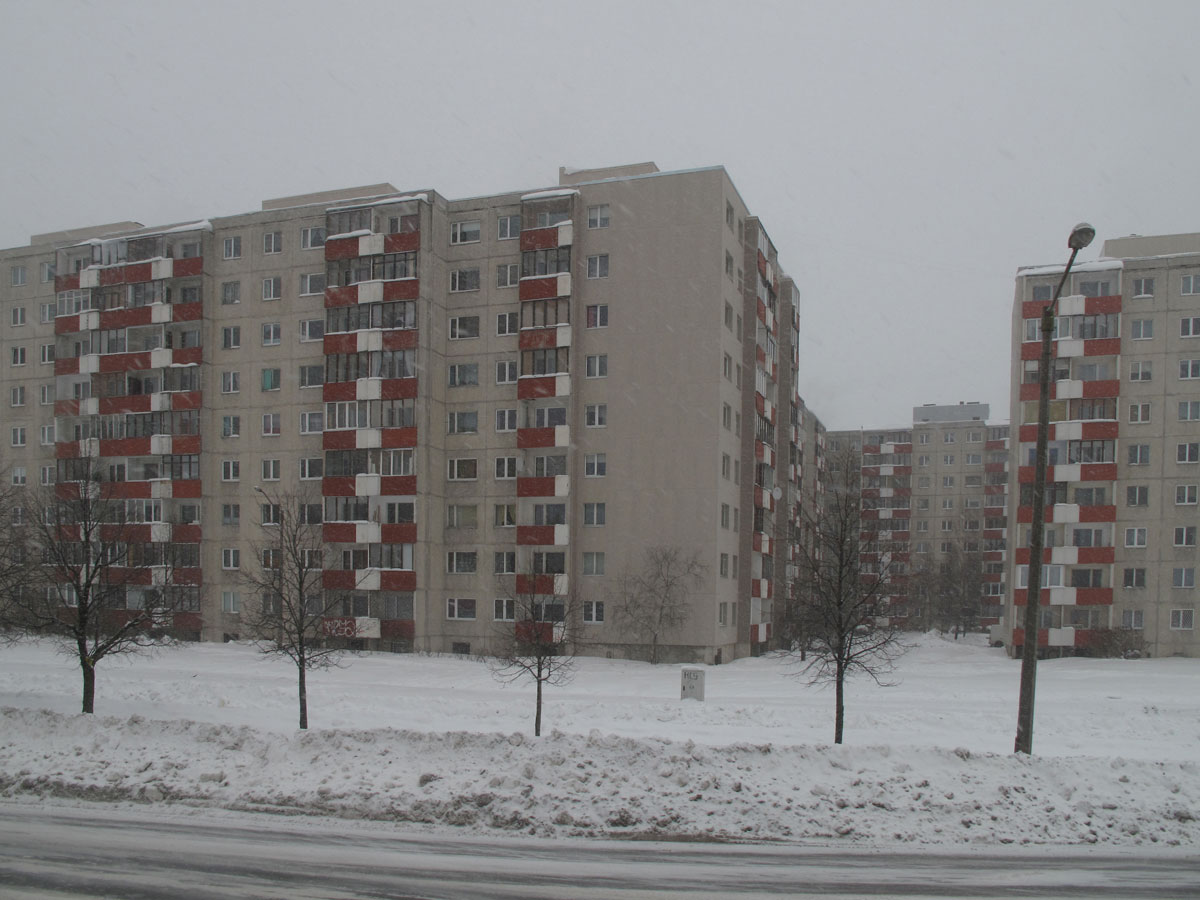
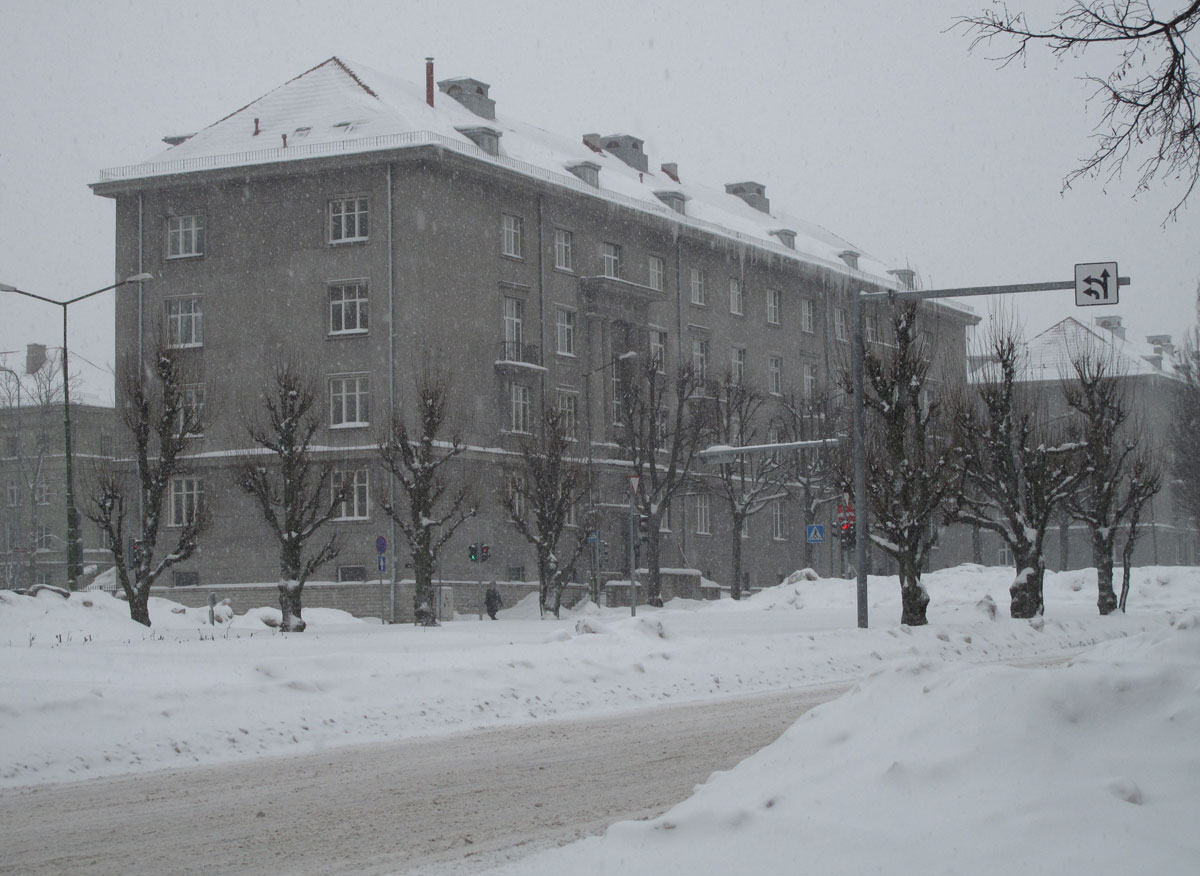
The bus company at the time was called Tallinn City Tour, but I think another company operates the service now, so it’s more than possible that the routes are different. There were three routes in total – Red, Green and Blue: They were all an hour long and you could hop on and off of all of them if you wanted. The Red Tour was a drive around the inner city excluding the Old Town. The points of interest were a mixed bag of museums and such like but it has to be said that the route itself wasn’t like the picturesque Old Town I saw yesterday because quite a bit of it looked as though we were still in the Soviet Union.
The tour ended back up at Viru Square, and it was the same bus that was going to do the Green Tour next, so the three of us stayed on. We were joined by an Englishman who wasted no time in telling us that he’d been all around the world – as if we cared, and as the bus moved off, I wasted no time in grabbing the earphones – not to turn the English commentary about the tour on, but to turn the bloke’s commentary about his travels off.
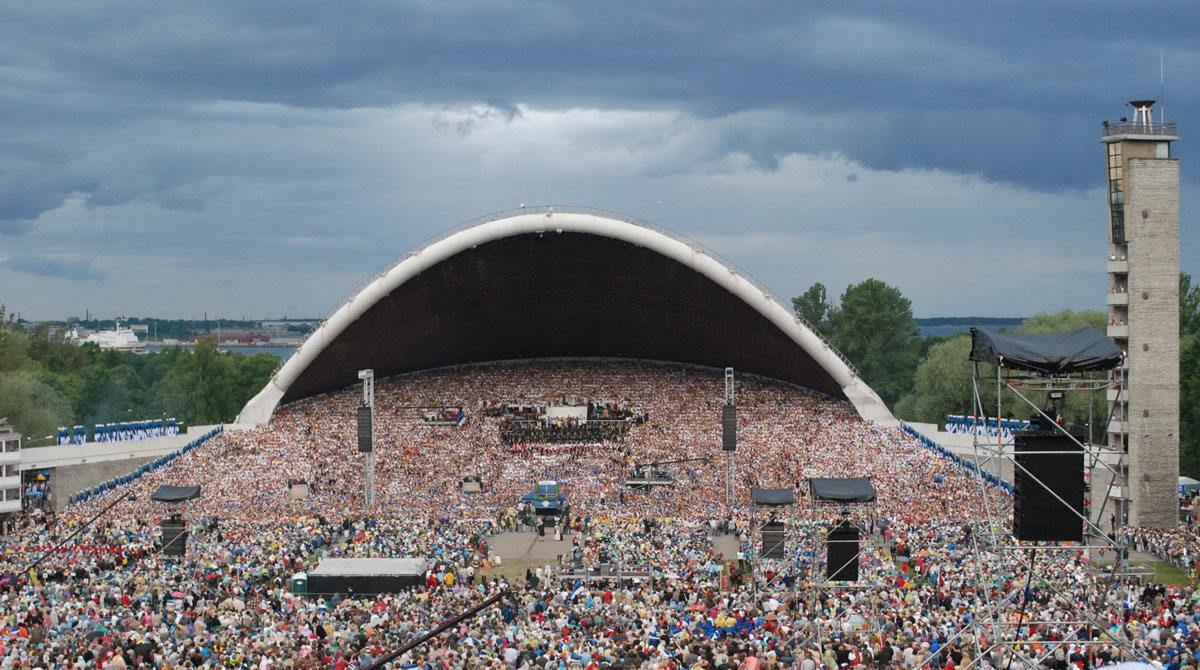
It was snowing really hard when the bus left Viru Square, but the driver seemed quite unfazed about it as we headed towards the first stop, and at a better time, I would have got off to take a closer look. The Song Festival Grounds may not sound over-exciting but it has to be one of the most iconic venues in the Baltic States, and this is where the story begins about the Soviet occupation of Estonia that lasted from 1944 to 1991.
Some of you may know about, or even remember, the Singing Revolution, and the Song Festival Grounds are where it all started. Traditional Estonian folk music dates back to the 12th century, but more importantly, it was brought back into the country’s psyche during the 19th century when Estonia was part of the Russian Empire. Like most nations who find themselves being ruled by someone else, there was a growing desire for the country to govern themselves, and when Johann Voldemar Jannsen established an Estonian song festival in 1869, it gave people a new sense of national pride, and a period known as the Age of Awakening was born. Since then, a festival has been held every five years, but it was during the Soviet era that the song festival took on even more significance.
In Pt 1 of this series of posts about Tallinn I touched on the tussle between Nazi Germany and the Soviet Union and how it affected the Baltic States. At the end of WWII, it was the Soviets who ended up in control, but their presence was not universally welcome – in fact it wasn’t welcome at all, and what follows is a story about a remarkable uprising by a nation that eventually brought freedom to all the Baltic States by using music as a weapon rather than guns.
It didn’t quite start like that, because remembering what it was like when the Soviets were here in 1940, a band of insurgents known as the Forest Brothers took to the woods when the Red Army returned in 1944 and fought a covert guerilla campaign – and they had every justification.
The Soviets wasted no time in relocating thousands of Russians to Estonia, and the Russification of Estonia had begun: Farms were taken from their owners and collectivized, dissidents were sent off to the gulag in Siberia, and everyday life had to conform to the regime’s strict controls – but there was one thing they had little control over – the power of music. It may sound a bit trite to think of music as having any impact in a situation like this but it did.
The Soviet indoctrination of Estonia may have been tightly controlled, but for all its faults, Russia, whether under a Tsar or a dictator, has always had a passion for culture – and that includes music. Consequently, the Estonian Song Festival was one thing that was allowed to continue, even if only to show the world how happy Estonians were under Soviet occupation – except that they weren’t. If the occupiers thought they had scored a propaganda goal with this gesture they were wrong because they had kicked the ball into their own net.
In 1944, a song made during the Great Awakening was set to new music and called Mu isamaa on minu arm (The Land of my Fathers, the Land that I love) and it was sung at the end of the 1947 song festival – in Estonian. The Soviet authorities were oblivious to what the song meant to Estonian people and it wasn’t long before it became the unofficial national anthem.
The clip below is over six minutes long, but if you only watch some of it you’ll begin to understand the song’s significance.
1969 saw the centenary of the first festival, but by now the undemocratic government were insisting that songs celebrating communism, Lenin and Marx were at the forefront of the choir’s repertoire: A few Estonian songs were allowed, but traditional costumes and the unofficial national anthem were forbidden. The end of the centenary festival didn’t go quite according to how it was supposed to though: The 30,000 strong choir refused to leave the stage and spontaneously started to sing Land of My Fathers without any accompaniment or leader. They were ordered to leave the stage, but instead of complying, sang it again when they were joined by the song’s composer.
The festival kept going throughout the years of occupation – and so did the Estonian spirit, but in 1985 a gap in the Iron Curtain started to appear. The Cold War had left the Soviet Union at a disadvantage where the arms race was concerned, and when the politburo elected Mikhail Gorbachev as general secretary of the communist party he withdrew troops from Afghanistan and held talks with the United States to limit the amount of nuclear weapons. Although Gorbachev was still committed to Marxist-Leninist ideas, he realised that significant reforms were needed in order to preserve the Soviet way of life, and introduced two new policies which were to have a profound effect: Glasnost (openness) allowed more freedom of speech, and perestroika (restructuring) enabled the government to operate more efficiently with a view to improving the economy. This change in direction not only improved the life of everyday Russian people, but also emboldened the satellite Soviet republics to seek a more independent future.
A trickle of protests gradually gathered momentum until they became a flood. I don’t suppose Gorbachev saw his changes manifesting themselves in this way, but the Jeannie was now out of the bottle. In Estonia, discreet protest rallies were held by different sections of society about different issues and at first the numbers were small enough not to upset the authorities, but they gradually got bigger, and at one rally in Tallinn the numbers got so large that the crowd decided to march off to the Festival Grounds where an estimated 100,000 people eventually assembled. One of those who went along was a motorcyclist carrying the banned Estonian flag, and for the next week thousands of people turned up to sing along with their blue, black and white flag they had kept hidden for 50 years. The Singing Revolution had begun.
If I stopped telling the story here, it wouldn’t be complete, so please bear with me while I tell you what happened next.
Concerns about Russian reprisals were very real, and the different Estonian political parties were not in total agreement on how best to proceed, but in September 1988 the Popular Front organized a mass rally at the Festival Grounds where a reputed 300,000 people turned up, which if correct, was a third of the Estonian population, but whatever the true number was, it was a clear sign to Moscow that Estonians were not prepared to live under communism any longer.
It wasn’t just Estonia and the other occupied nations who weren’t happy about the outcome of the Potsdam Agreement in 1945, but for the sake of expediency at the time, and the promise by Stalin that free elections would be granted, Roosevelt and Churchill signed it, but now that there were chinks in the Soviet armour, the Molotov/Ribbentrop pact was challenged as being illegal, and on the 23rd August 1989 (the 50th anniversary of the signing of the pact), an estimated 2 million Estonians, Latvians and Lithuanians formed a 600km chain from Tallinn to Riga and Vilnius.
The Baltic Way (as it became known) was a powerful symbol of solidarity but the struggle wasn’t over yet. Bearing in mind the Soviet Union’s previous response to uprisings in Hungary and Czechoslovakia, there was obvious concern when Russian immigrants living in Estonia started gathering at Toompea Castle to prevent the country claiming independence. Estonia of course had no army, police force or even money, but a crowd flocked to the parliament building and locked the protestors inside the castle perimeter. In the end, the protestors were allowed out and no real violence occurred. Once again, the Lithuanian people had won the day and the boyant victors burst into song.
It wasn’t quite so peaceful in Latvia and Lithuania, and even Gorbachev got arrested in Moscow, which meant that Russian hardliners would soon be back in Estonia, and so a resolution was quickly passed in parliament for all Estonians, including communists, to be independent.
The TV Tower was an obvious target for a military takeover, and so a human chain was formed to protect it from the expected Russian arrival, but as the defenders had no weapons, their protection was limited. The troops entered the tower easily enough, but on the 22nd floor were two men who had got there first. They warned that with the push of a button on the Freon fire extinguisher the tower would fill with gas, killing everyone inside. It was all a bluff, but it gave the attackers time to think, especially as back home there was another revolution taking place with Boris Yeltsin about to proclaim Russia as a republic. They did what any sensible person would do; they packed up and went home. Within days, the Soviet Union had collapsed – and Estonia was finally a free and independent nation.
If this part of Estonia’s history resonates with you then I highly recommend you watch the excellent film called, unsurprisingly, The Singing Revolution, and you can watch a trailer below.
There was no singing taking place at the Song Festival Grounds today and the bus proceeded to drive alongside Tallinn Bay to Pirita. The name comes from the Birgitta Convent which was destroyed by Ivan the Terrible in 1577. The remains are still here, but for everyday Estonians the 2km sandy beach has facilities that you would expect such as a promenade, recreational areas for outdoor leisure, and a marina built for the 1980 Moscow Summer Olympics. The bus then took us up through a pine forest to the Botanical Garden (!) and the TV Tower. There was no point in getting off anywhere along this route today, but it would be a good place to come in the summer.
Back at Viru Square, the two girls stayed on the bus (presumably because the Blue Tour included a couple of shopping centres) but it was time for me to brave the elements and explore a bit more of the Old Town.
From the bus stop I walked up Viru Street where I was approached by a female asking if I would like to visit her beauty salon for a massage: She wasn’t one of those beautiful young blond Estonian girls that make it another reason to visit Tallinn, but a Babushka in a fur hat and coat with a physique that wouldn’t look out of place in a sumo wrestling ring, and what’s more, she had a face that looked as though she’d been chewing a wasp. I’m not sure what sort of massage she had in mind, but whatever it was, I wasn’t convinced that I would come out feeling better than I did when I went in and so I politely declined the offer and continued on up to the Town Hall Square and Pikk Jalg.
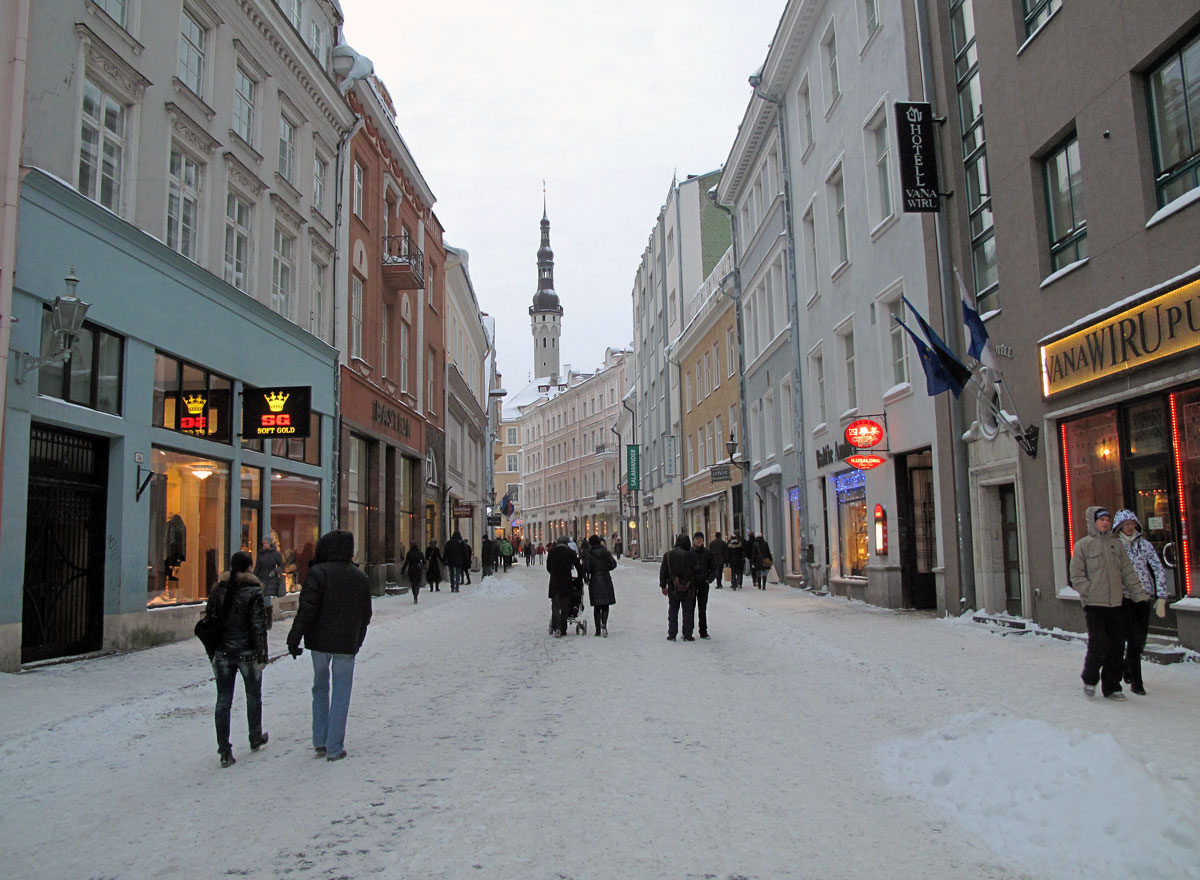
You may remember from my previous post about Toompea, that I had already covered a part of Pikk Jalg, but today I wanted to walk in the opposite direction along this medieval street that was built to link the harbour with the market place in Town Hall Square. As you can imagine, there were plenty of fine buildings that would at one time have been home to city merchants and craft guilds. I would have dearly liked to have spent more time studying all these different architectural styles if the weather hadn’t been so grim, but in the end I skipped past most of them with not much more than just a cursory glance.
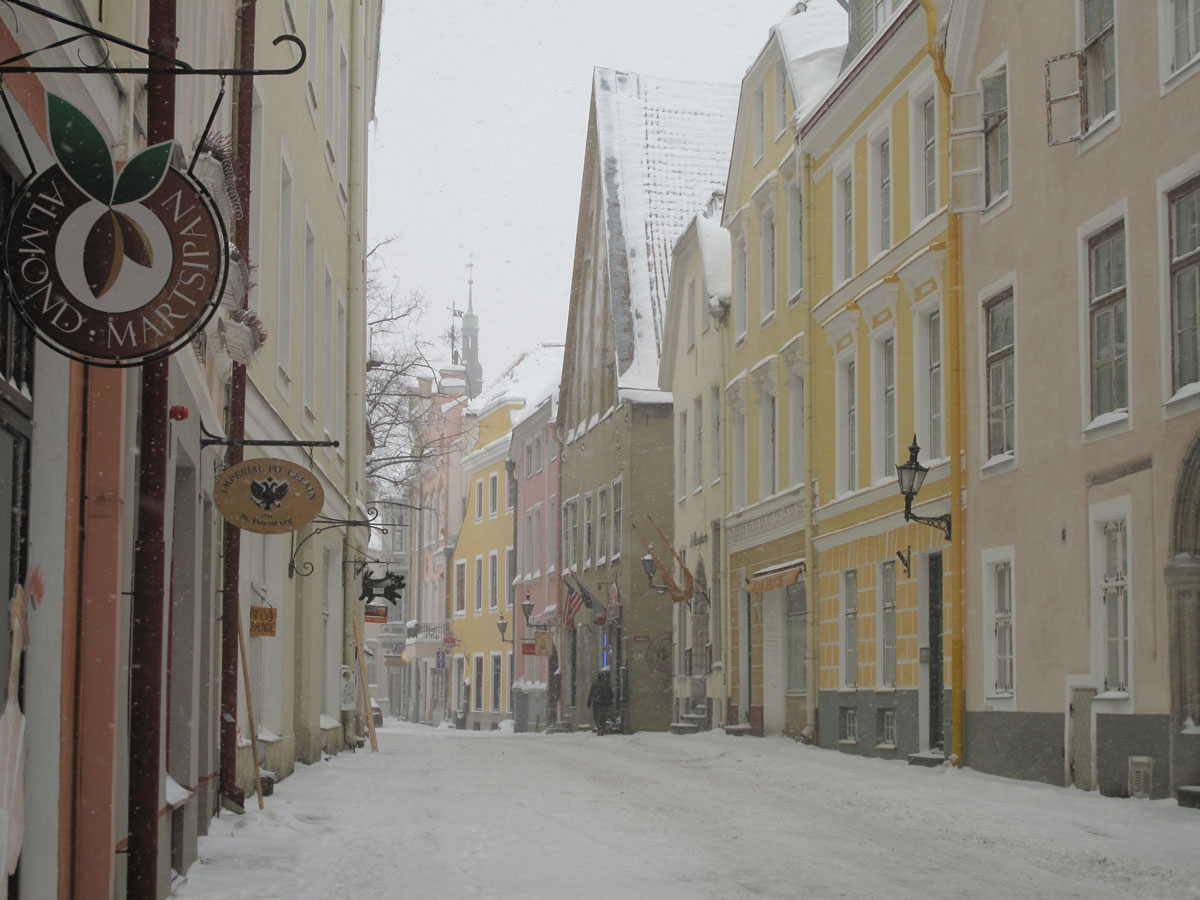
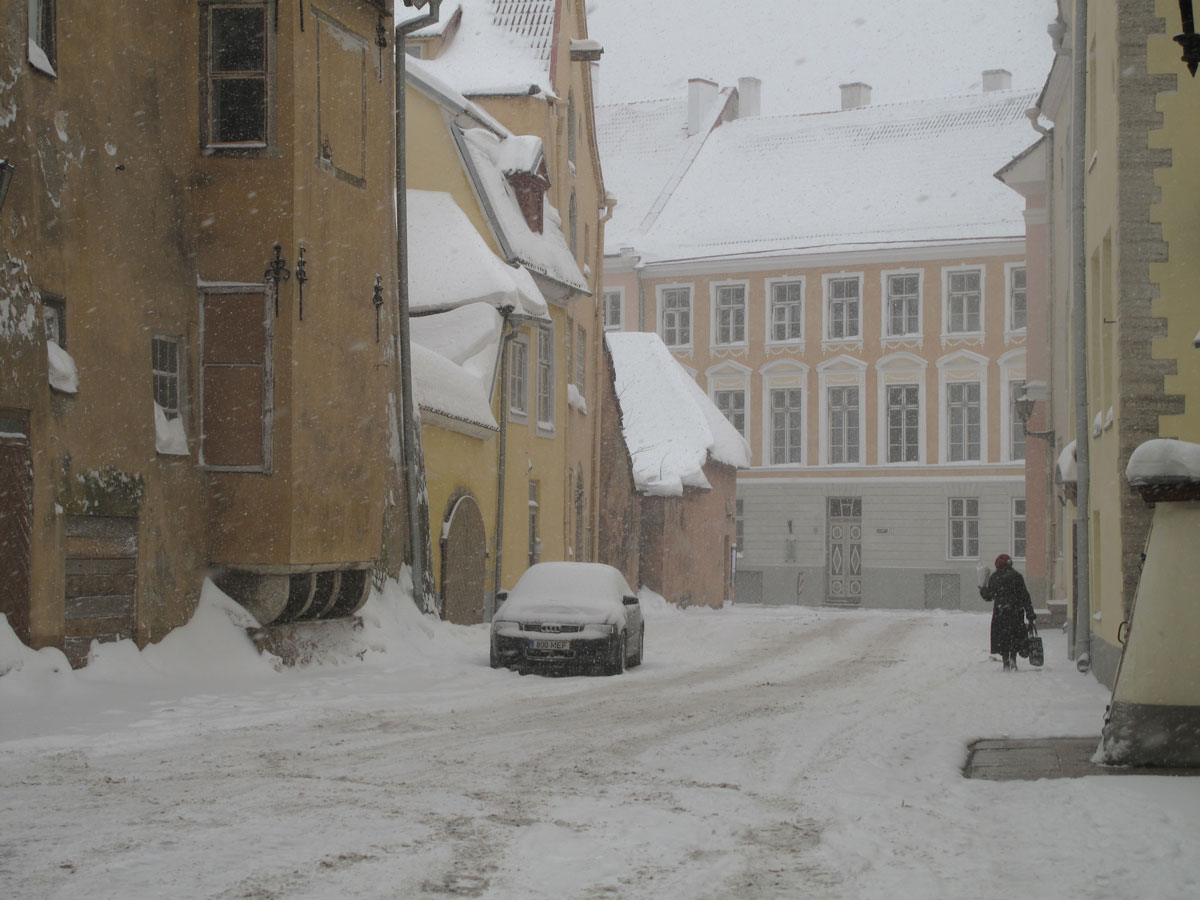
One place I didn’t skip past though was the convivial Hell Hunt, a rustic bar and welcome pit stop. After quaffing down a local beer to go with my dish of deep fried savoury cheese balls I faced the elements again, where just down the road was a place that wasn’t quite so friendly – the former KGB’s prison cells. Although it’s a museum nowadays, I had no intentions of going in even if it was open, as I’ve seen far too many of these places elsewhere in the past.
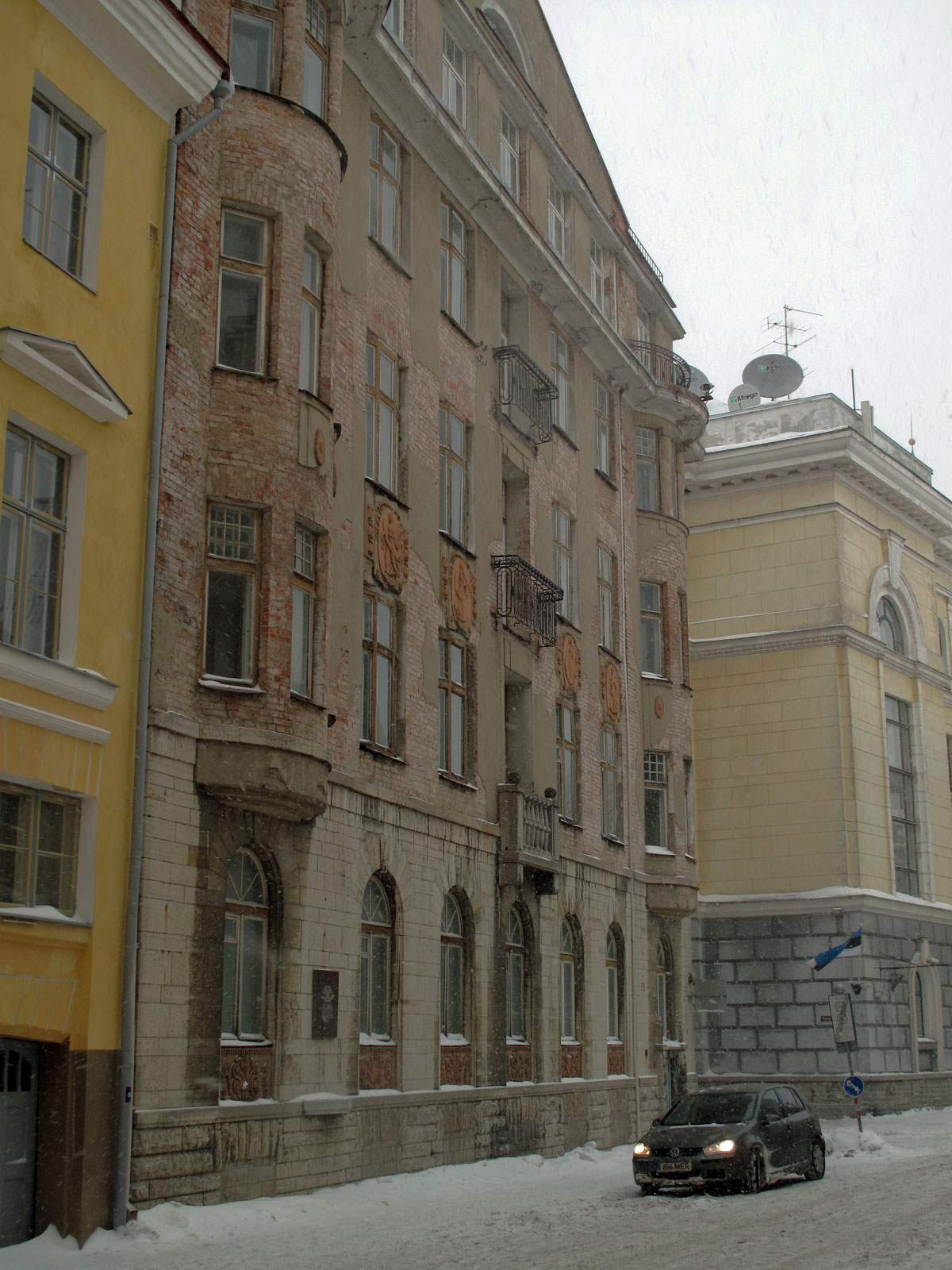
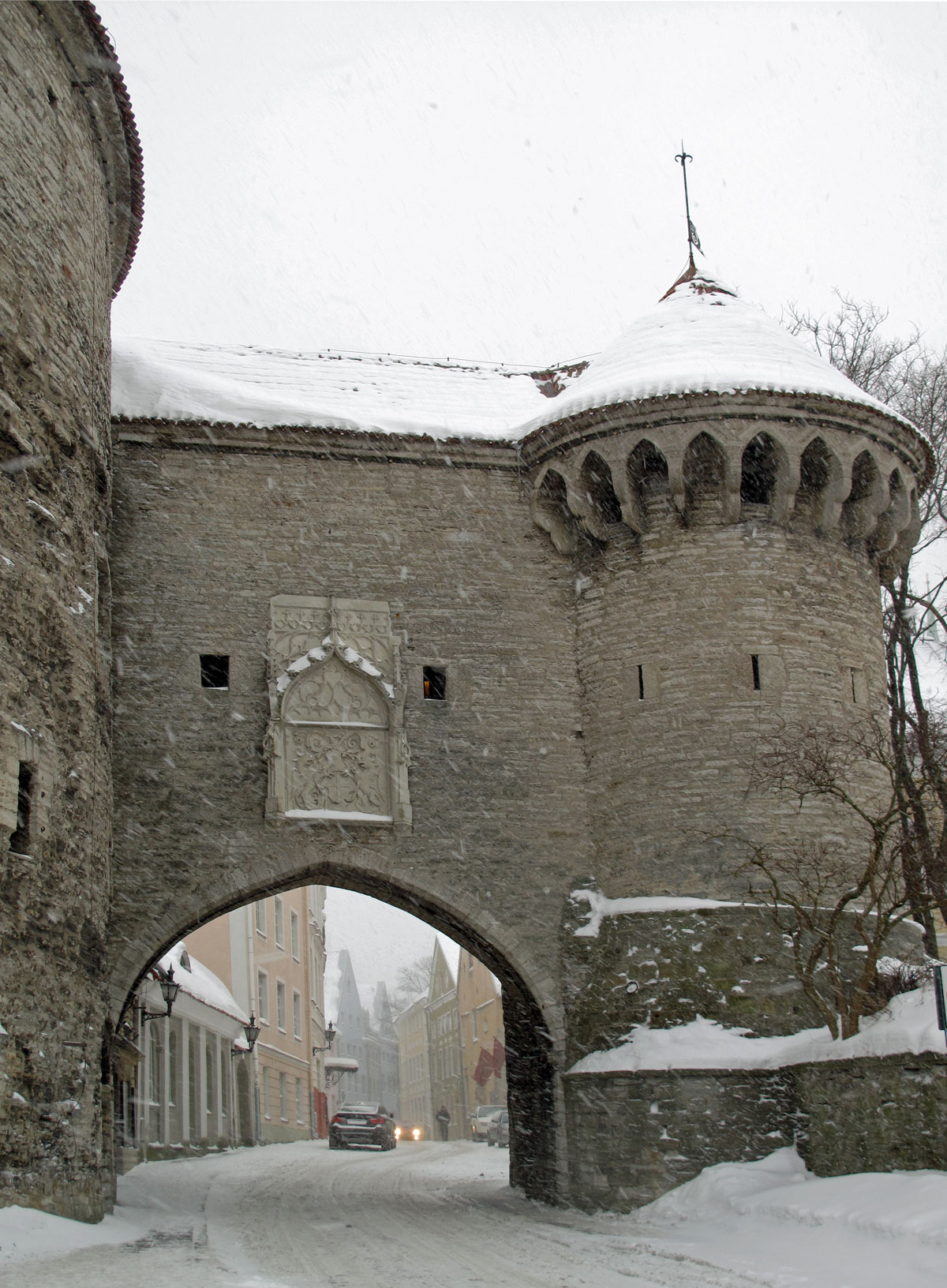
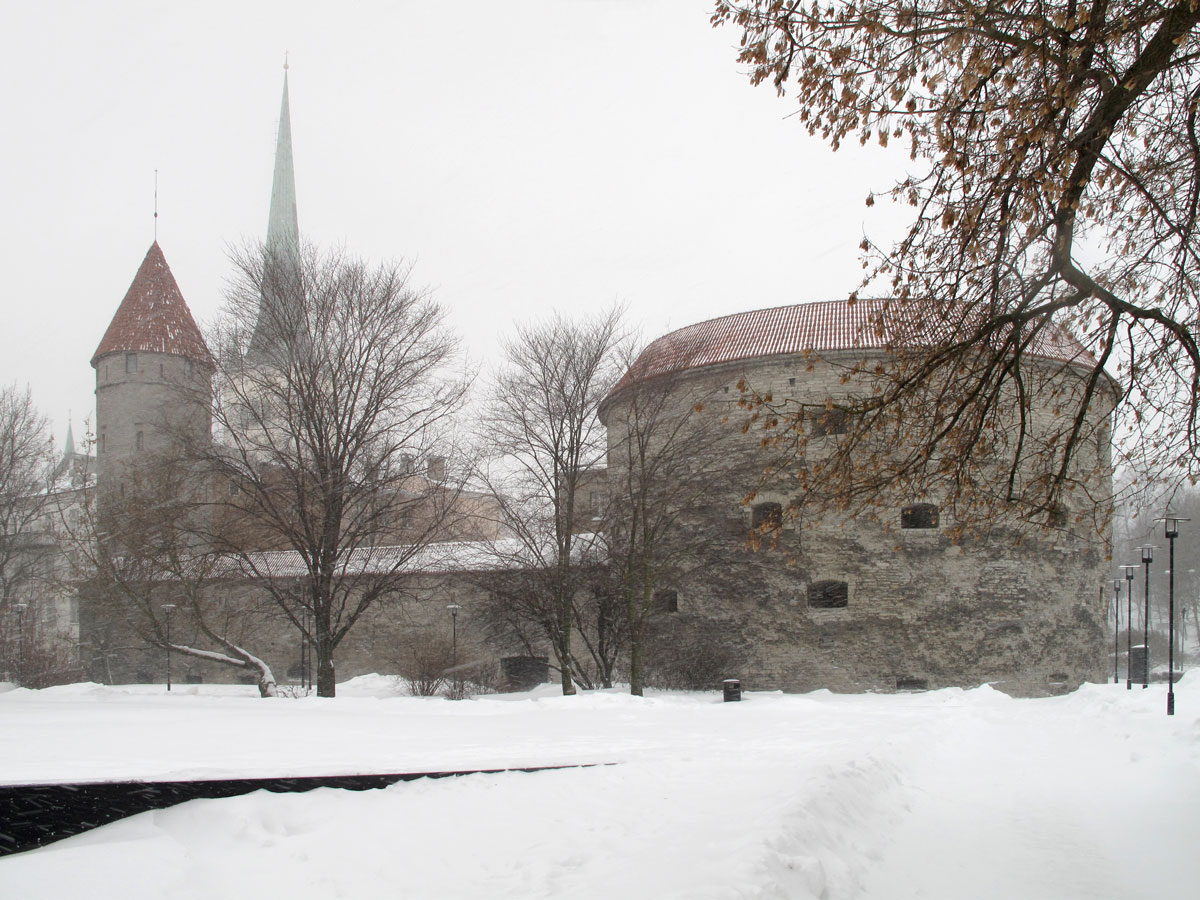
Pikk Jalg ends at the Great Coast Gate and Fat Margaret, which is a four storey cannon tower that was part of the medieval walls. These days it harbours the Estonian Maritime Museum, and at any other time would have been on my list of places to visit, but it has to be remembered that sunset comes early in wintertime this far north and there was still a fair bit of walking left to do.
Nearby in a small parkland is the Broken Line monument which commemorates the 852 people who died aboard the ‘Estonia’ ferry en route from Tallinn to Stockholm in September 1994. I remember the incident well and just hoped it wasn’t an omen for my proposed trip to Helsinki tomorrow.
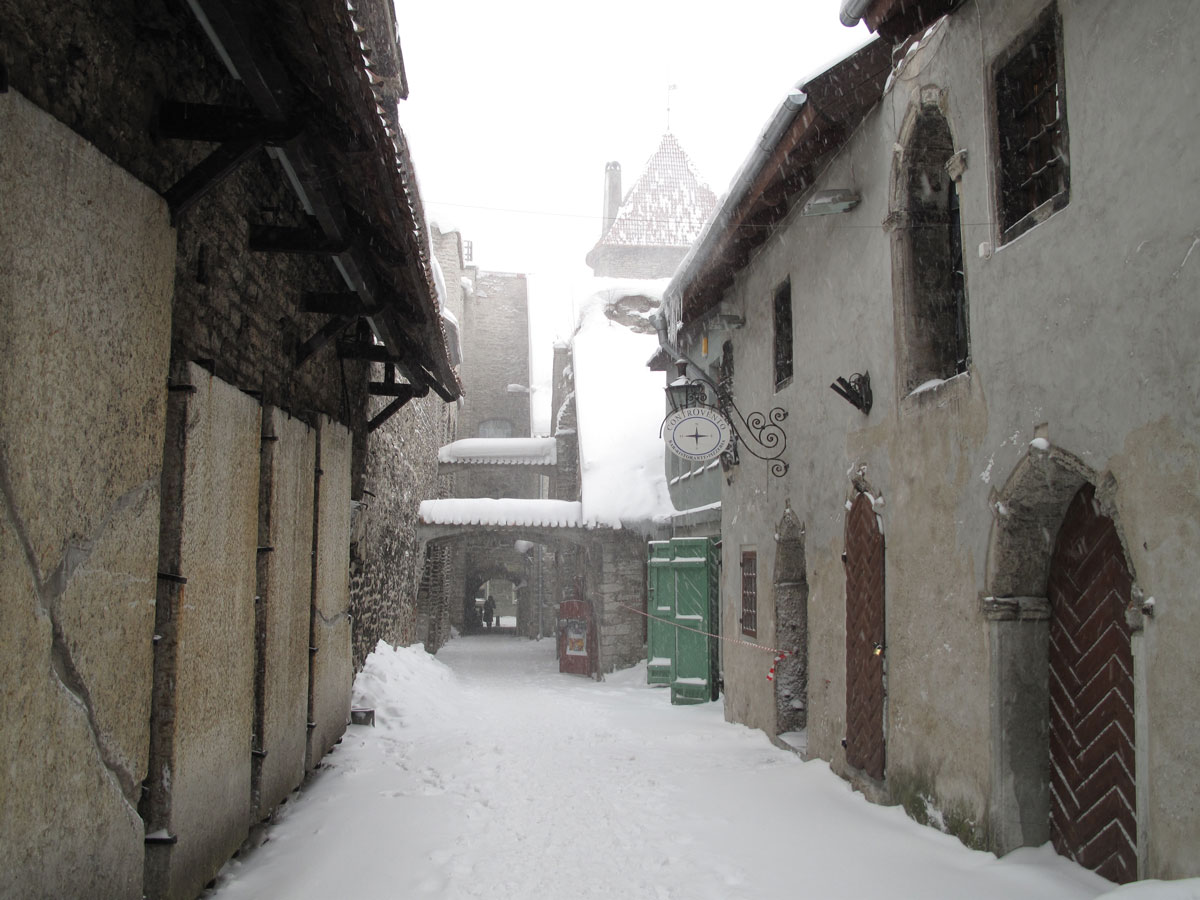
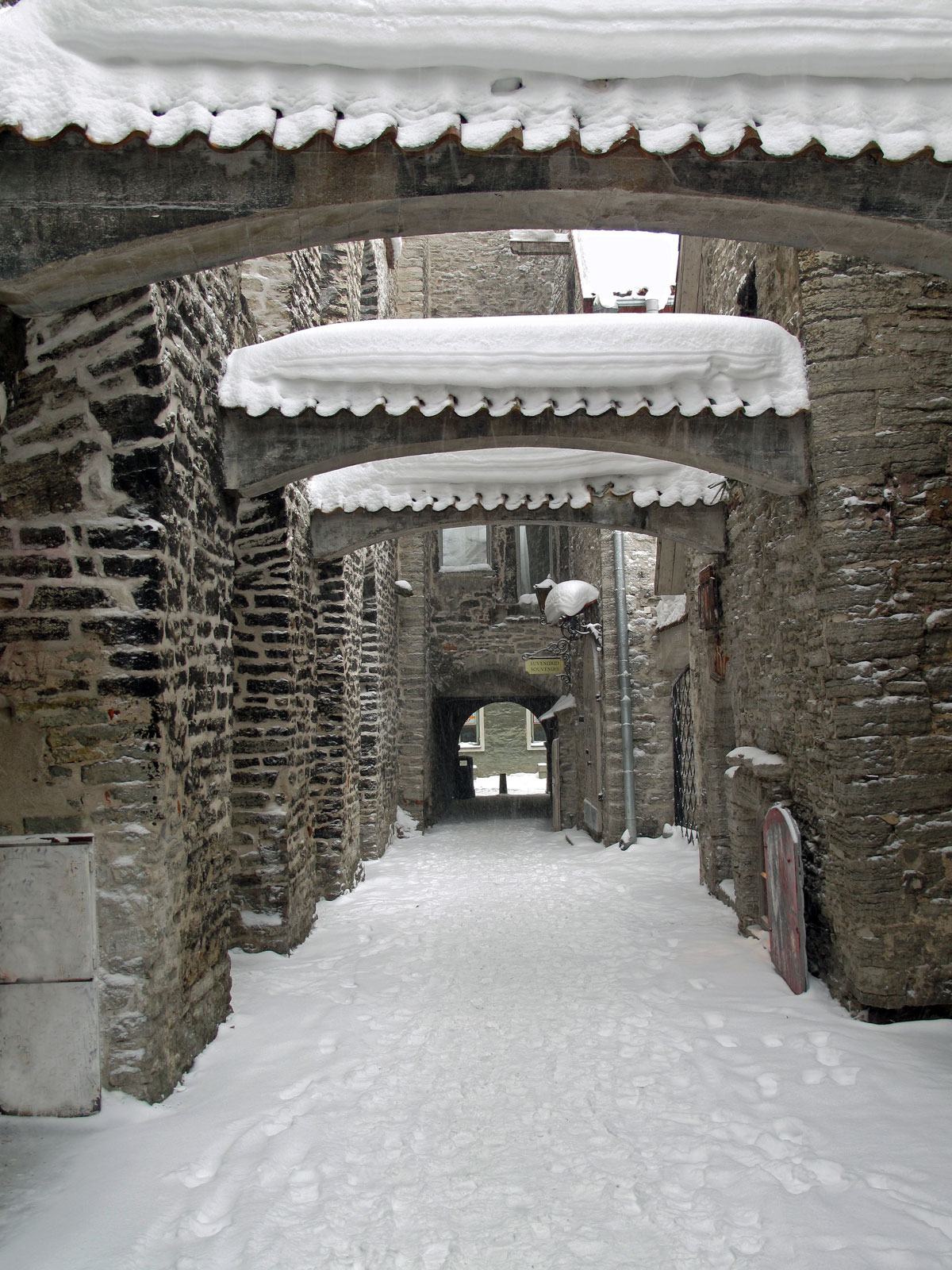
I wandered through some back streets to Vene which means ‘Russian’ in Estonian, and sure enough there was a Russian Orthodox church along here which I dived into, not just to take a look at their impressive collection of icons, but to get some respite from the snow which has been relentless ever since I left the hotel this morning. Next, I turned off left and under an arch into St Catherine’s Passage, an interesting and atmospheric alleyway that includes St Catherine’s Guild, an association of artisans which encourages anyone and everyone to drop in and see them at work – and purchase something as well if you haven’t got the brass neck to walk out without opening your wallet.
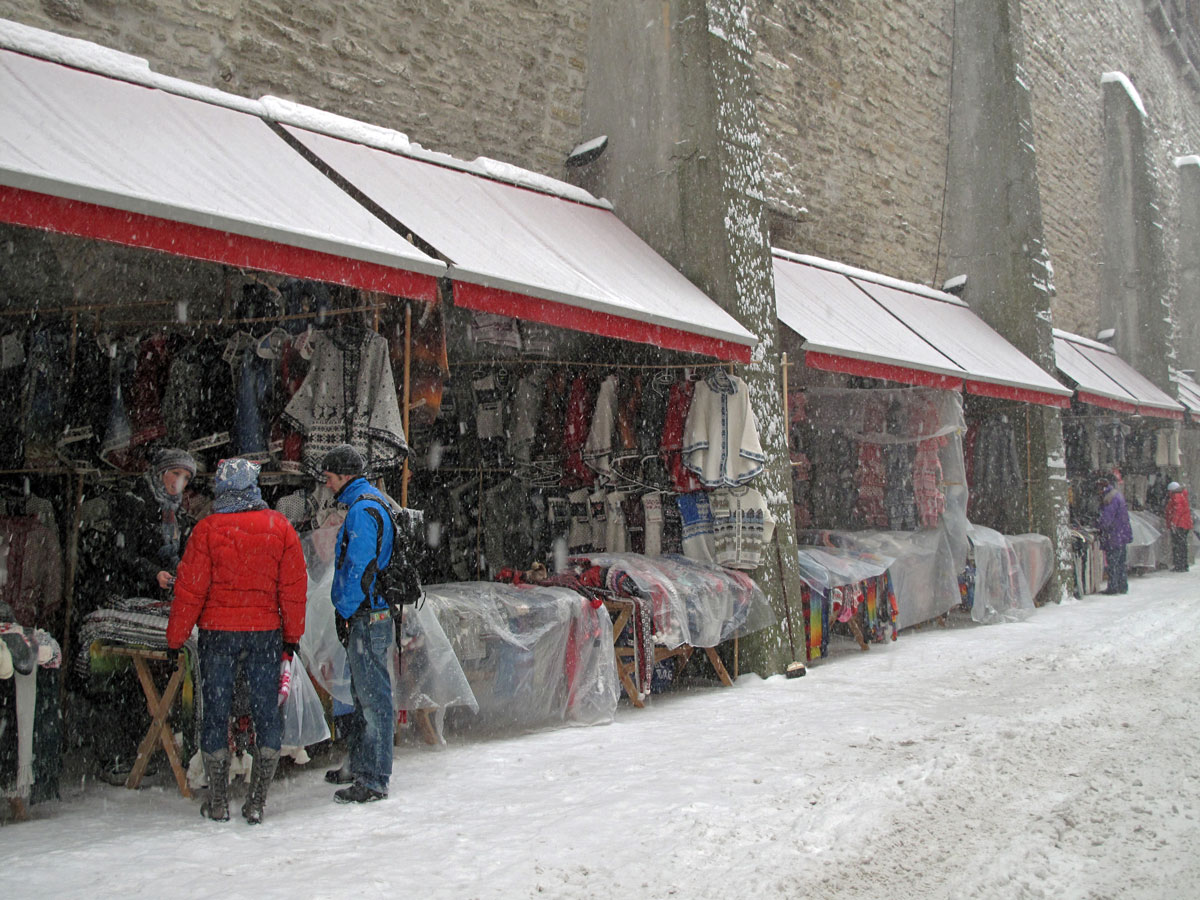
Walking through to the end of the passageway, I found myself at Muurivahe and a different type of trader. Muurivahe translates as Sweater Market but I didn’t see anyone sweating here today. The stalls are operated by babushkas trying to flog a variety of knitted jumpers. No doubt they’ve been stood out here all day, so they deserve to sell a few, and to be honest if they can’t sell any on a day like this then I reckon they’re in the wrong job.
At the end of the road I was back in Viru Street where I started out after the bus tours. Fortunately, the masseuse was nowhere to be seen; I say fortunately, because by now I was struggling to walk and might have been tempted to take up the offer. I crossed over to Tammsaare Park, but instead of heading directly back to the hotel, I took a slight detour to the Solaris Centre.
At first glance, the Solaris looks just like any other shopping centre, but this new addition to modern Tallinn incorporates a concert hall, multiplex cinema, dance academy and arts centre, but I haven’t come here for any of that – I’ve come to see what’s wrong with me, because there’s an exhibition on called Bodies Revealed. I wasn’t even sure if I really wanted to see it, but in the end I plucked up the courage to go and take a look.
As the title suggests, the exhibition portrays real human bodies that are prevented from decaying by means of plastination. I wasn’t aware at the time about the ethical questions surrounding the subjects on display, but now that I’ve learnt more about it I can understand why. For me, it was just a case of being intrigued at what arteries, veins, lungs and other body tissues really looked like. There were even foetuses in various stages of development. I won’t go into any more details, but would I want to see it again? No! but other people may well find it easier to accept, but I can’t help wondering where the bodies came from.
It was now time to hobble back through the snow to the warmth and comfort of the hotel, wondering whether tomorrow would allow me to take the ferry to Helsinki – or whether I’ll be ending up as an exhibit in the Bodies Revealed exhibition. Watch this space!
POSTED – JANUARY 2025
Originally posted 2025-01-06 16:42:28.
Nice to be back in the blogsphere. Apologies, but when you published this post I – and all the other Templetons – had gone down will full-blown influenza and we were all bed and house-ridden. I didn’t even have the energy to read or think, let alone operate a computer. We’re still recovering, but at least we’re feeling vaguely human now.
Better late than never though, and I very much enjoyed this instalment of your Tallinn trip. I’d never heard of the Singing Revolution, but what a remarkable story. It really does show the power of song and what can be achieved when people come together. The Festival Ground is massive – and so many people! I found the video quite poignant, as I love choral music anyway, but this was something else and you can see the passion on the conductor’s face.
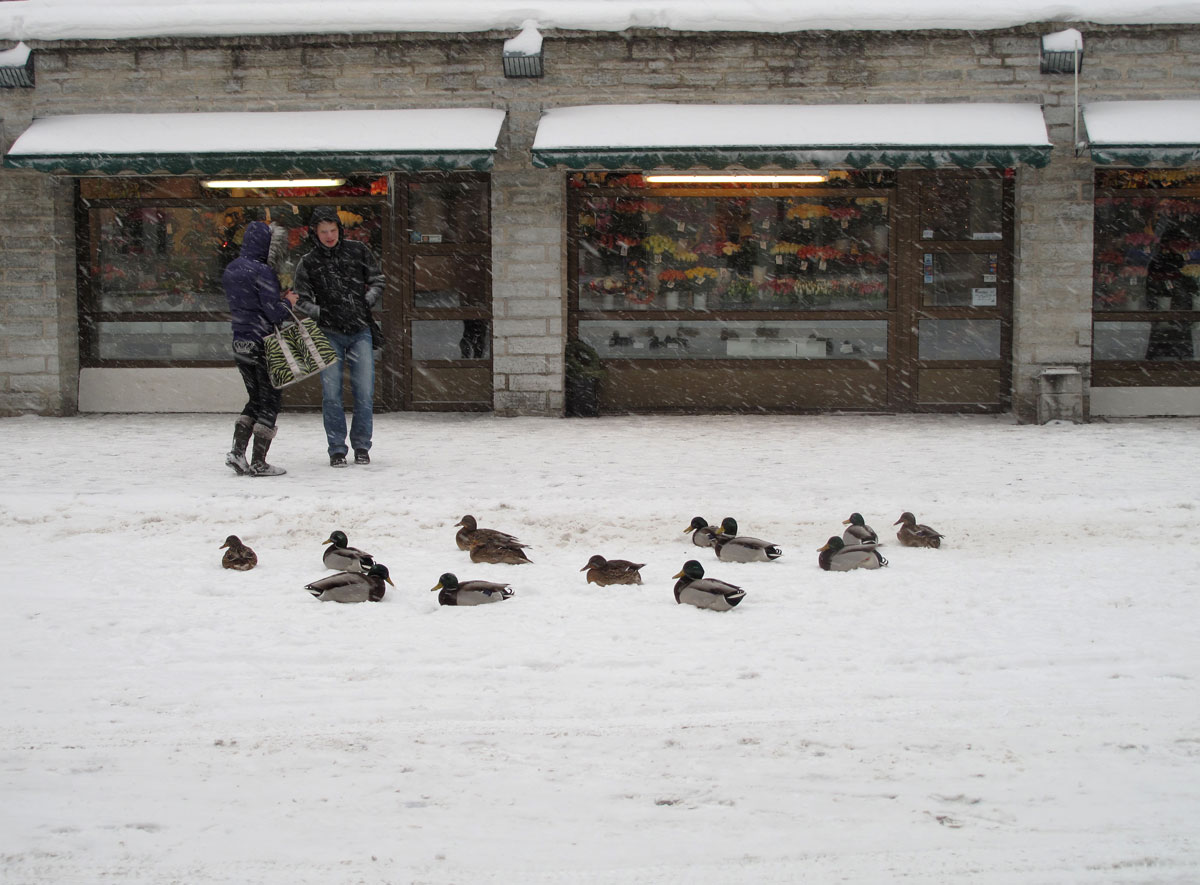
Those Muurivahe ladies must be hardy souls, selling their knitted wares in such harsh conditions. But I think I’d have to give the Bodies Revealed exhibition a miss. I’m far too squeamish, and yes, I’d also be wondering how they acquired the bodies. Love the last photo with the hardy ducks!
Another fascinating and enlightening post, Malc, and I’ll catch up with your trip to Helsinki tomorrow. 🙂
I’m sorry to hear that you’ve all gone down with the flu Alli. So many people have caught it this year and it’s not a pleasant thing to have is it ? Once you’ve had the flu you understand when it’s only a cold that you’ve got, but I’m glad to hear that you’re on the way up now.
The Singing Revolution is quite a story isn’t it, and one that should be more widely known. The film is a documentary and available to rent should you ever want to know more. As for the Bodies Revealed exhibition, I must admit I had reservations about seeing it but curiosity got the better of me.
Thanks for commenting and hope you’re feeling much better. It’s not a good time of year and yesterday was Blue Monday, unless you’re a Trump supporter of course 🙂
Oh yes, I knew it was ‘flu as I’ve had it before – back when Maddie was only 3! It also floored me for two weeks back then, and left me feeling as though I’d been run over by a steamroller, just like now. It’s taking a while to feel anything like normal again, so I guess I’ll just have to give it time…
I may well take a look at the Singing Revolution documentary. It does seem fascinating, and rather a different kind of political story.
I hadn’t realised it was Blue Monday yesterday – topical for me, at least, but as you say, a rather different mood for anyone living in the curious world of Trumpington! 😉
Just go with the flow Alli!
I know, trouble is I’m not a very good patient. I get bored, and believe me, I’m bored of this now! 😉
It’s wonderful to hear a tale of passive resistance that paid off, Malc. We’ve lived through some extraordinary times, haven’t we, and been lucky in where we were born? It’s quite a story!
I always count my lucky stars that I was born when and where I was but times are changing.
I don’t think there’s any doubt, Malc….
I’m quite a deep thinker Jo and I suspect that my thoughts about how things are going to change may be at odds with what a lot of others think.
I have a husband who’s a deep thinker, too, Malc, and his thoughts are often best kept to himself. I skate along the surface of life, trying to keep a happy face.
I have a wife who is more like you Jo 😉
I knew the history but it’s still very interesting to have it summarised like this. Did you see the TV Tower on your tour? It’s worth a visit (though not in those conditions) and has a memorial to the people who defended it that day and another to the Baltic Way. I read that they held off the attackers by jamming the lift with a match!
I didn’t Sarah. I just saw it from the bus. I don’t think it would have been too easy to get back into town from there as there wasn’t another bus after the one I was on. I’m not even sure if it was open to the public at that time of the year. It sounds as though I missed a bit of a treat from what you’re saying though.
Thank you, Malc, for the brilliant reminder of life under the occupation of Russia! As far as history documentaries go, yours are excellent, combining well-researched facts with humor and professional photography. The inclusion of music was very interesting because it isn’t known to people outside Estonia. I admire your bravery in seeing the exhibition of preserved bodies with skin removed! I learned so much, Malc, from your post and I am looking forward to the next installment!
Joanna
PS Apologies for being late reading your wonderful post due to being away from home.
Thanks Joanna. Your lovely comments are always welcome whenever they come, but like I’ve said on numerous occasions, I’m grateful that anyone likes or comments on my posts at all, so there’s absolutely no reason to apologise. Do you mind me asking if you are still having your home decorated then ?
Not really as this Christmas was not as happy as it used to be. If you mean if my home is being still renovated, yes it is and it won’t be finished before spring.
Joanna
Yes! I meant being renovated, so presumably you’re still at your daughter’s house then.
Yes, I am, and having a cold with all the trimmings!
Joanna
I’m sorry you’re suffering again at the moment. I can see why you’re looking forward to spring now. Take care!
What a story about the festival. The power of music. What a post, full stop. From photptgrahs to prose. Thank you.
And thank you Shey for your wonderful response as always
Listen, this is a great post. Uplifting to read. And wonderful to see. A reminder of why where we are from is so important.
And you’re a great one for reading between the lines Shey. I think you know what I’m getting at 😊
Ditto re the lines .. . . . . . . .
I enjoyed this one Malc and reading through it has provided a welcome break from struggling to write a blog post of my own. WordPress isn’t playing ball with my photos – I’ve even bought a new mouse thinking that was the problem but it isn’t. Looks like I’ll have to contact the W/P help bods to see if they can solve it. I think you should have gone for the massage with the Babushka, it would have made interesting reading😀 The ducks in the street look odd but still cute.
I think I would have preferred smoothing the ducks Eunice 😊
Brilliantly told, Malc.
Thanks Pat. That’s made my day 😊
Quite welcome, Malc.
As always your post is absolutely fascinating.
I found the historical information really interesting and the descriptions captivating. The photos and videos are simply fabulous.
Superbly laid out, this rich article took me on a stunning virtual tour and brought back fond memories of my trip to Tallinn years ago in late spring. However I did not meet any masseuses offering their services! 😉
It is always a real pleasure to read your posts!
Ah! thank you Luisa. You’re a true blogging friend. I can’t thank you enough 💙
You are so very welcome my dear Malc. 🤗
It’s my pleasure as always