
Greenwich - A Place of Time and Space
At one time I hated clocks. The sound of an alarm going off is one of the worst sounds known to mankind, and although it may not be a scientific fact, have you ever noticed how the more time you need, the quicker the time goes? As somebody who was only interested in the time when the barman was calling last orders, I thought that clocks were the worst invention ever – and a complete waste of time. But help was at hand for my chronophobia, and a cure came in the form of a visit to the Royal Observatory at Greenwich.
In a world where time is now measured by atomic clocks, I discovered how clocks work, the correlation between time and space, why Greenwich was chosen as the centre of the universe for measuring time, and why it was even necessary to know about time at all.

The picture above shows the Shepherd Gate Clock which was the first clock to show Greenwich Mean Time to the public. It hangs on the wall outside the entrance gate to the Royal Observatory and was made by Charles Shepherd in 1852. It’s one of the earliest examples of an electric clock, but of course people have been trying to work out what time of day it is for a lot longer than that.
Ancient civilizations had crude ways of finding out roughly what time of the day it was but the earliest known timekeeping devices were sundials used in Egypt around 3500 BC, and in some ways nothing has changed much since then. The earth still revolves around the sun, and the moon still revolves around the earth. For our ancestors this was probably good enough, but as time moved on and civilizations became more advanced, then better accuracy was needed.
The picture below shows the Sundial Pillar at Seven Dials in Covent Garden London. Despite its name there are only six sundials on the top of the pillar.

In order to travel around, it was helpful for our predecessors to know where they actually were in the first place, and thanks to the Ancient Greeks’ discovery of astronomy, it was possible to solve the problem – or at least most of it. By measuring the apparent movement of the sun and stars they were able to work out the Earth’s size, and then by plotting co-ordinates in relation to the equator, they could determine their approximate location. These co-ordinates were measured as segments of a circle in degrees, minutes and seconds, either in degrees north or degrees south for Latitude, or in degrees east or degrees west for Longtitude. How these people worked all this out back then I have absolutely no idea, especially when you realise that there were plenty of people who thought that the world was flat.
The equator, being a fixed point halfway between the North and South Poles, meant that working out positions of Latitude were fairly straightforward, but finding the Longtitude position wasn’t quite so easy – and this is where Greenwich came into the equation.

There were attempts to fathom out a Longtitude position by using arbitrary locations as a starting point, but that’s all well and good on land. The Age of Discovery in the 15th century meant that navigational aids at sea became crucial to the nations involved in exploration – and one of those nations was England.
It was obvious that whichever country could solve the Longtitude problem first would have an advantage over its competitors. Exploration had been a risky business, but if a more reliable means of navigating the seas could be found then colonising new lands could bring untold wealth to those who solved the problem, and King Charles II was one of those people who was keen to find the answer.
He had been convinced that the solution lay in the stars, and so he called upon the astronomer John Flamsteed to help him find it. The astronomer’s immediate response was to tell the king that there was nowhere near enough astronomical knowledge available, and so Charles wasted no time in rectifying the situation by founding an observatory and making Flamsteed its first Astronomer Royal.
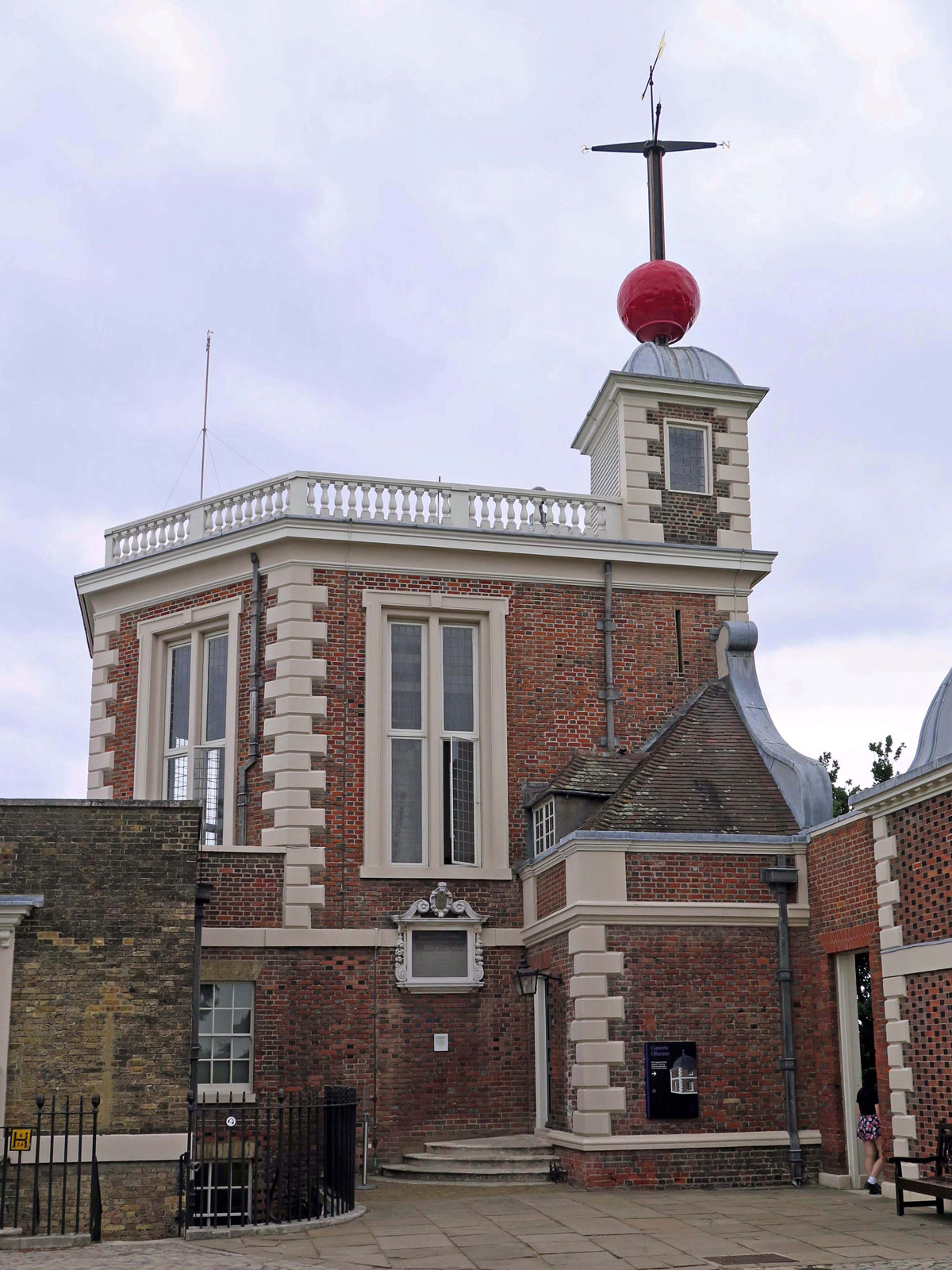
The site chosen for this new observatory was here at Greenwich, which had been in royal hands since the time of Henry V. In fact Henry VIII and his two daughters, Mary and Elizabeth, were all born in the Palace of Placentia, which was located where the Old Royal Naval College now stands. At the top of the hill overlooking the palace was Greenwich Castle, a hunting lodge where Henry was said to enjoy the company of his mistresses – and this was where the observatory, called Flamsteed House, was built.
The most celebrated architect of the day, Sir Christopher Wren, was also a professor of astronomy himself, so who better to design the new observatory? It was on his recommendation that it should be built in the royal park at the top of the hill on the former castle’s foundations, and on the 10th of August 1675 John Flamsteed laid the foundation stone.

Wren’s design of Flamsteed House included a basement for household utilities, a ground floor for living accommodation and an octagonal ‘Star Room’ above, where Flamsteed would carry out his astronomy work.
The Octagon Room, as it’s now called, had tall windows which were able to accommodate the long refracting telescopes that he used to observe the stars, comets, eclipses and movement of the planets. Before Flamsteed could start charting the stars however, he needed to confirm that the earth rotated at a constant rate, and so the king enlisted the help of Thomas Tompion, today regarded as “the Father of English Clockmaking”.
Two clocks were installed, both with a 13ft long pendulum which, for the day, were accurate enough to help Flamsteed make the assumption that the earth did in fact rotate at an even rate: We’ve since realised that it’s not strictly true, but with the aid of a sextant, there was enough information to develop a formula for the “Equation of time” – or in other words, the relationship between time and space (or at least the sun).
In the picture below, the clocks are on the left under the painting of Charles II and the pendulums are hidden in the wall behind.

Finding a connection between time and space was only part of the solution to finding an answer to the problem of locating an east/west position, as Flamsteed was to quickly find out.
The task that King Charles had set him was to basically draw up a map of the heavens that could be used for astronomical navigation. To achieve that, Flamsteed needed to observe the stars by setting up his telescope along a north-south line (or meridian), and then as the stars and planets appeared to move around the sky he could plot the position of each one to the meridian by using Tompion’s timepieces to measure intervals of the earth’s rotation. By comparing literally thousands of observations he could then build up an accurate map of the night sky.
If all this wasn’t complicated enough, there was another spanner thrown into the works. Flamsteed House did not run along a true north/south axis but was 13½ degrees to the west. Whether this could have been foreseen I don’t know, but in Wren’s defence he had been given a tight budget to work with and it would have made sense to build the observatory on the castle’s former foundations at the time. Unfortunately for Flamsteed what this meant was that for the next 43 years he did all his night-time observations from a shed at the bottom of the garden.
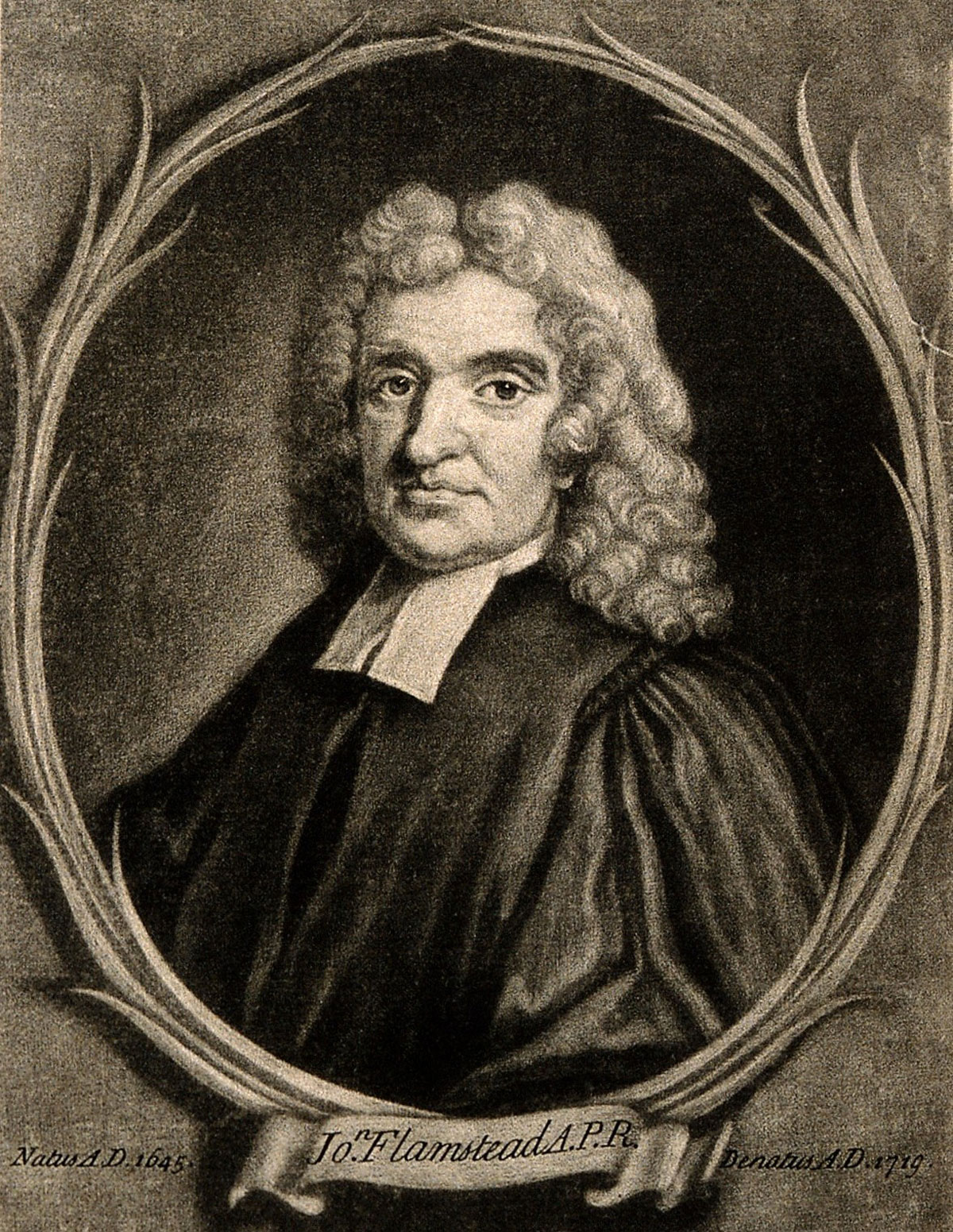
Flamsteed produced a total of twenty six maps of the constellations, but being a perfectionist, he never made them available to the general public. After his death in 1719, it fell upon his wife to publish them, firstly as a three volume book in 1725, and then as the Atlas Coelestis in 1729.
His successor was Edmond Halley, the man who predicted the reappearance and timing of the comet that bears his name. The first thing he noticed, and he didn’t need a telescope to see it, was that the brick wall that Flamsteed used as his meridian was slipping downhill into the Royal Park. Instead of trying to repair it, he built another one that would accommodate his own new astronomical quadrant, and positioned it in line with Flamsteed’s meridian, but slightly to the east. His quadrant can still be seen in the Transit Room in the Meridian Building.

The third Astronomer Royal was a man called James Bradley. He is remembered for making two important discoveries: The Aberration of Light which, without getting too technical, means that there is a difference between the apparent position of a star or planet and its true position; and the other observation he made was that of Nutation, which in simple terms means that the Earth wobbles on its own axis due to the gravitational pull of the moon.
Now all this may mean little to you and me, but from an astronomer’s point of view it meant quite a lot, and in 1749 Bradley was given funds from the Board of Ordnance to set up another observatory next to Halley’s Quadrant Room. His principle instrument was an 8ft transit telescope, and it was from this location that the Greenwich Meridian became the official Prime Meridian where every Longtitude measurement was taken from. In the first Ordnance Survey map of 1801 the new Meridian became Longtitude 0° and although, as I’ll explain in a moment, the Prime Meridian moved again, the Ordnance Survey still uses Bradley’s Meridian today.
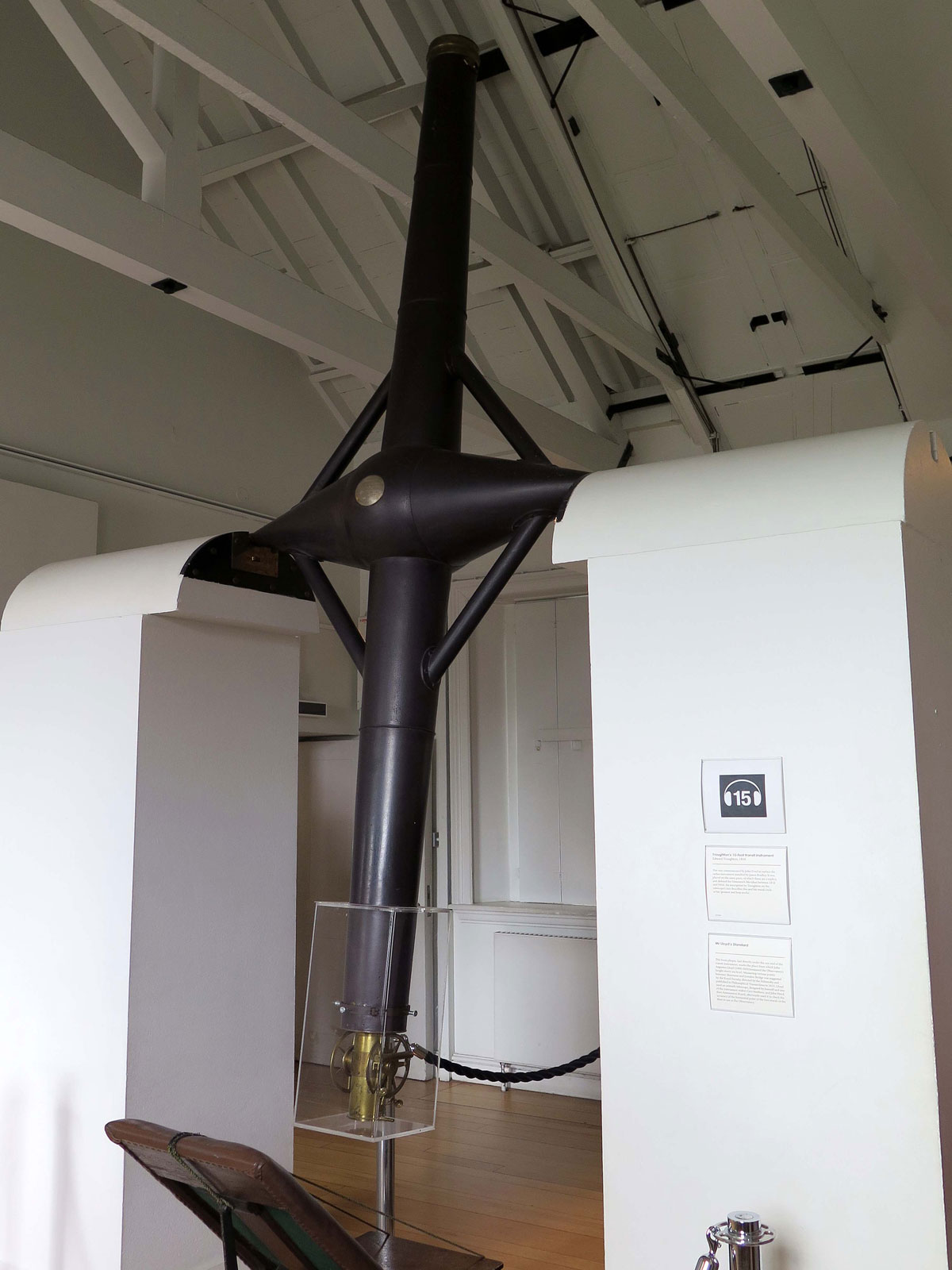
Sir George Biddell Airy, the 7th Astronomer Royal, was another man with a fantastic scientific and mathematical brain that goes far beyond my comprehension. In 1884 He built a new Transit Circle next to Bradley’s telescope, and while he was searching for Neptune, working out the density of the earth, and fathering nine children, he was inadvertently creating the Prime Meridian that is still the one we think of as the Prime Meridian today.
As our knowledge of the universe expands, then it’s only to be expected that ideas change, and thanks to satellites and current thinking, the true Prime Meridian is reckoned to be 102.5 metres west of the Airy Transit Circle and is known as the IERS Reference Meridian. IERS stands for the International Earth Rotation and Reference Systems Service if you really must know and is where the Global Positioning System (GPS) takes its readings from. Don’t bother looking for it though, because as nothing in the universe is ever truly constant, it keeps moving around.

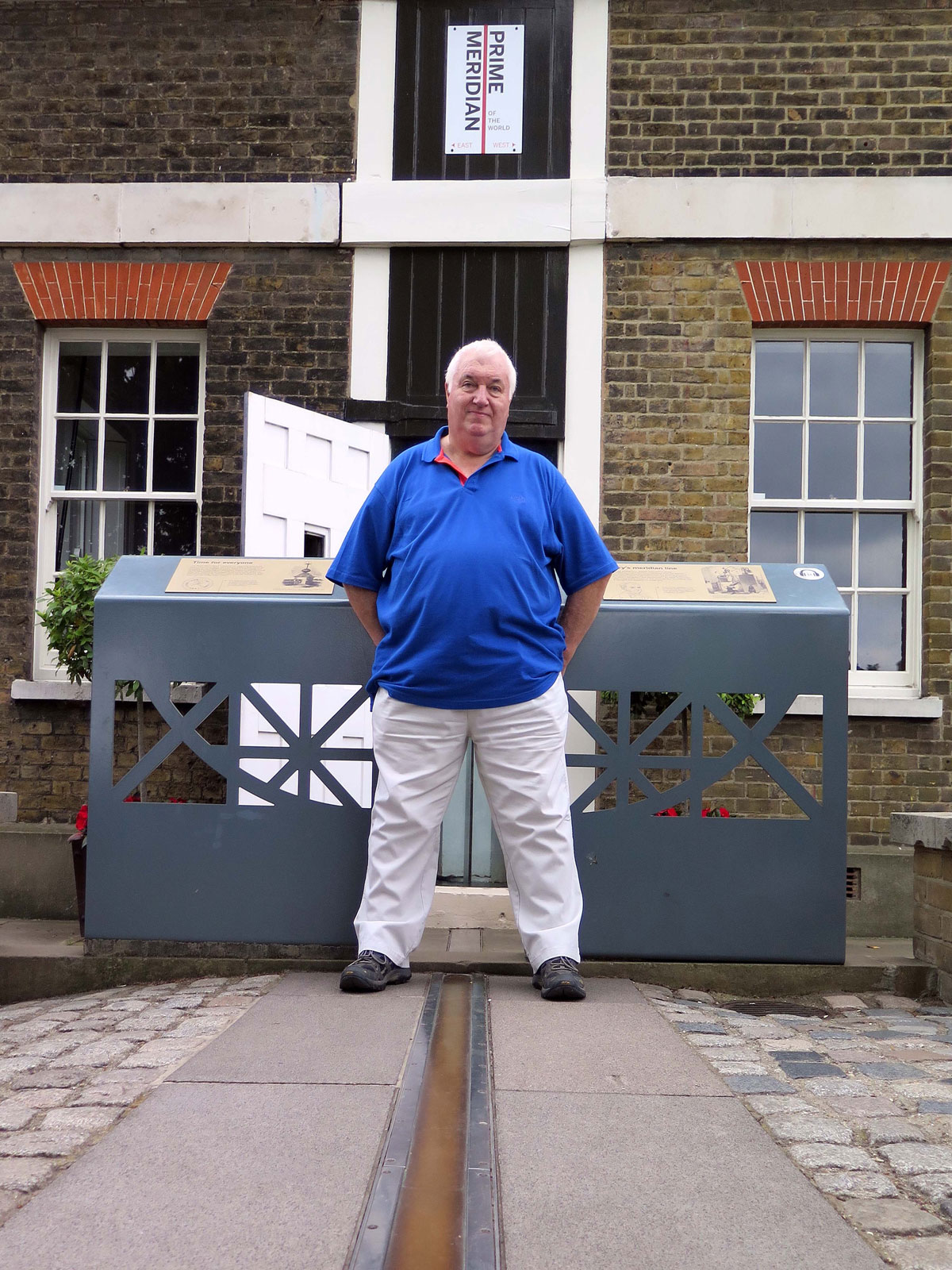
So far, I’ve only talked about the astronomical progress made in finding a solution to the Longtitude problem, but if you remember, the main reason for solving it was to help marine navigation.
After Sir Cloudesley Shovell’s Association came to grief on the Scilly Isles in 1707, parliament appointed a ‘Board of Longtitude’ which offered a reward for anyone who could come up with the answer. Up to £20,000 was offered to any person who could find a way of determining Longtitude at sea. As you can imagine, the competition attracted a large amount of crackpots, but a clockmaker named John Harrison was convinced he could come up with the answer without having to don a Sou-Wester to bolster his bank balance – and it was the John Harrison Gallery that turned me into a potential horologist.
Using the knowledge that the 360° circumference of the earth rotates every 24 hours, and therefore one hour of time was the same as 15° in rotation (or 15° in Longtitude), he started work on building his first marine chronometer.
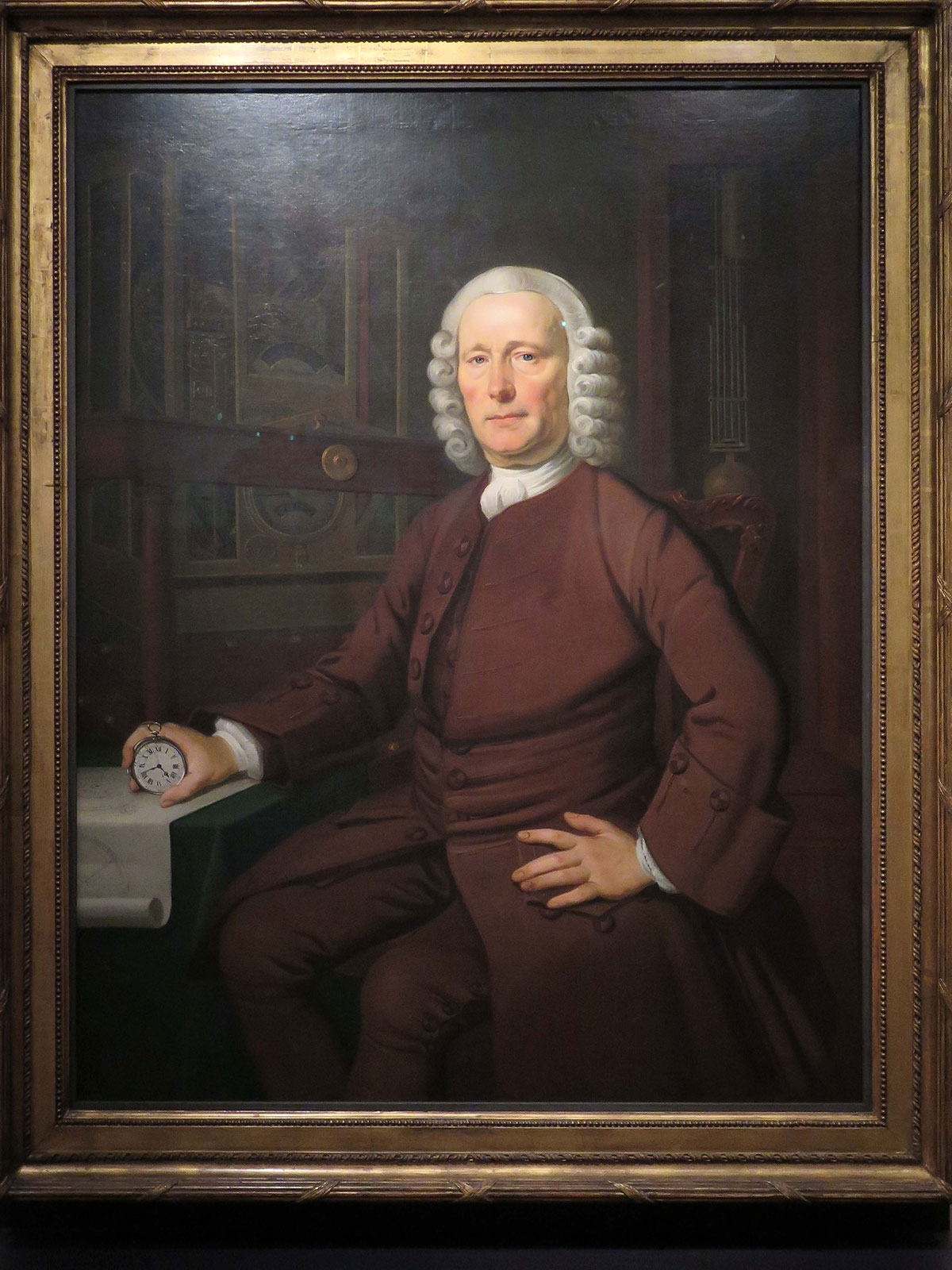
Building a clock that was seaworthy was different to building a conventional clock – it had to withstand motion and different temperatures for a start, and in 1730, after four years of working out how to deal with these problems he came to Greenwich looking for financial support to help him build it.
After working on it for six years, H1, as it was to become known, was ready for sea trials, and although it never reached the criteria that had been set out, the Board was impressed enough with his efforts to loan Harrison £250 to make another attempt.

Harrison soon realised that H2 had design faults, and so he started work on H3. After years of building and rebuilding it, the Board (who had still been supporting him financially) began running out of patience. His own patience finally paid off though because the breakthrough finally came in 1753 when he commissioned a watchmaker to make a smaller version of H3, and it was then that he realised that for the last 27 years he had been heading down the wrong path, as the small timepiece was to prove more stable at sea than a large clock could ever be.
Harrison knew that he had found the answer, but he had run out of time where the Board of Longtitude was concerned. While Harrison was tampering with his clocks and watches, astronomical solutions had been gaining momentum with new lunar tables and improved measuring instruments. Consequently, the Board refused to give him any money towards H4.
Even so, sea trials in 1763 proved that Harrison had finally cracked the Longtitude solution, but the Board were so fed up with him by now that they refused to pay him the reward. He may not have won the Longtitude prize but the world still recognises John Harrison as the man who solved the Longtitude problem.


The story isn’t quite finished yet though: There was another problem to overcome. Up until the 19th century, towns had their own local time due to their position in relation to the sun. For example, Bristol is 11 minutes behind Greenwich, and above the city’s Corn Exchange is a clock that still has two minute hands – one in red showing Greenwich Mean Time (GMT) and one in black showing Bristol Time.
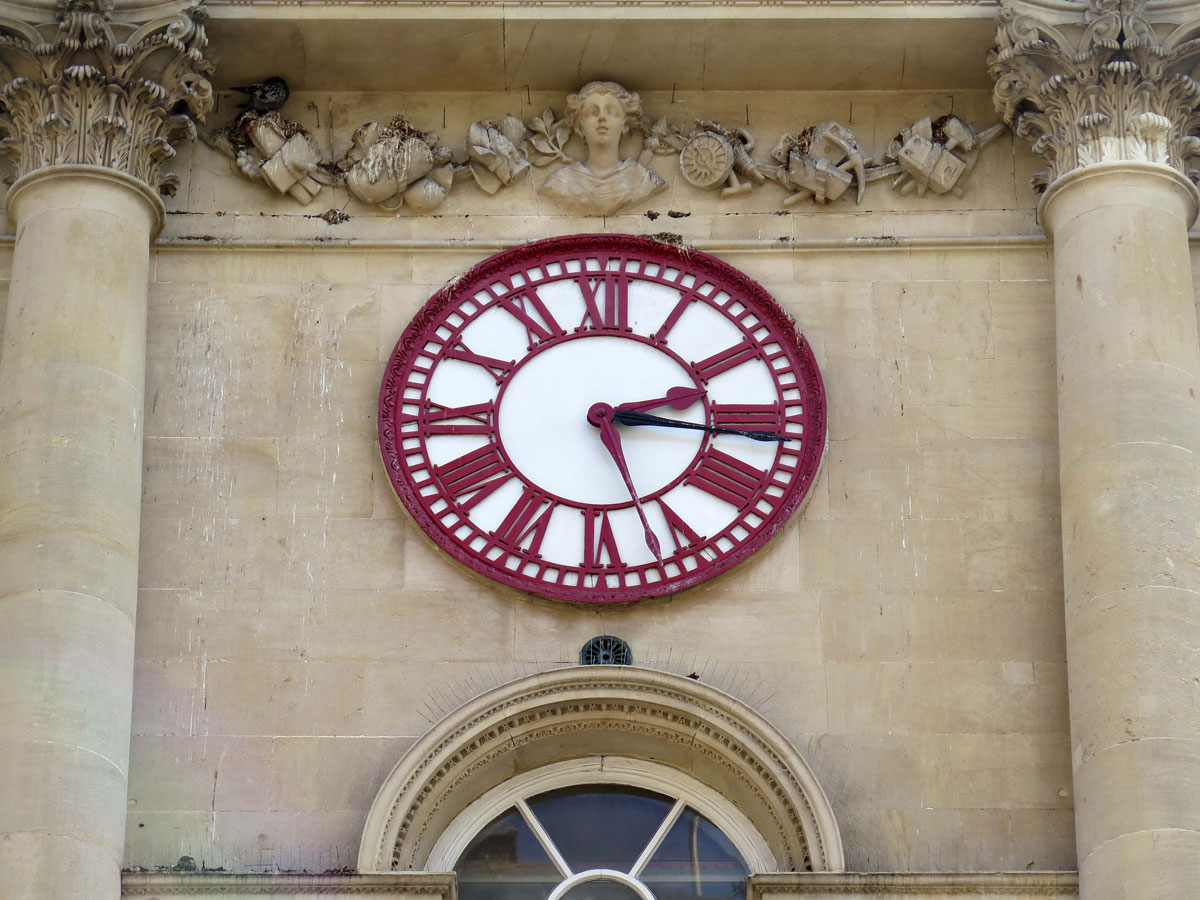
None of this mattered too much before the introduction of rail travel, but when people could start traveling faster than the sun it created a logistical nightmare where timetables were concerned. Matters didn’t improve with the invention of telecommunications either, and it was obvious that what the country (and the world) needed was a standard system of timekeeping – and there was nowhere better to tackle the problem than the place where precision timekeeping had been an integral part of positional astronomy – Greenwich.
In 1833 the observatory set a large red Time Ball on the top of Flamsteed House which acted as a visual signal for navigators on the Thames to set their marine chronometers to. Every day at 12.55 the Time Ball would rise half way up its mast, and 3 minutes later would continue to the top: At 1pm exactly the ball would drop back down again, giving the signal that it was precisely 1pm at Greenwich. If, like me, you were wondering as to why they didn’t choose midday to drop the ball, apparently it was because the astronomers were too busy looking through their telescopes at the sun – so now you know. Although it’s not needed for practical purposes anymore, the Time Ball still operates at 1pm every day.
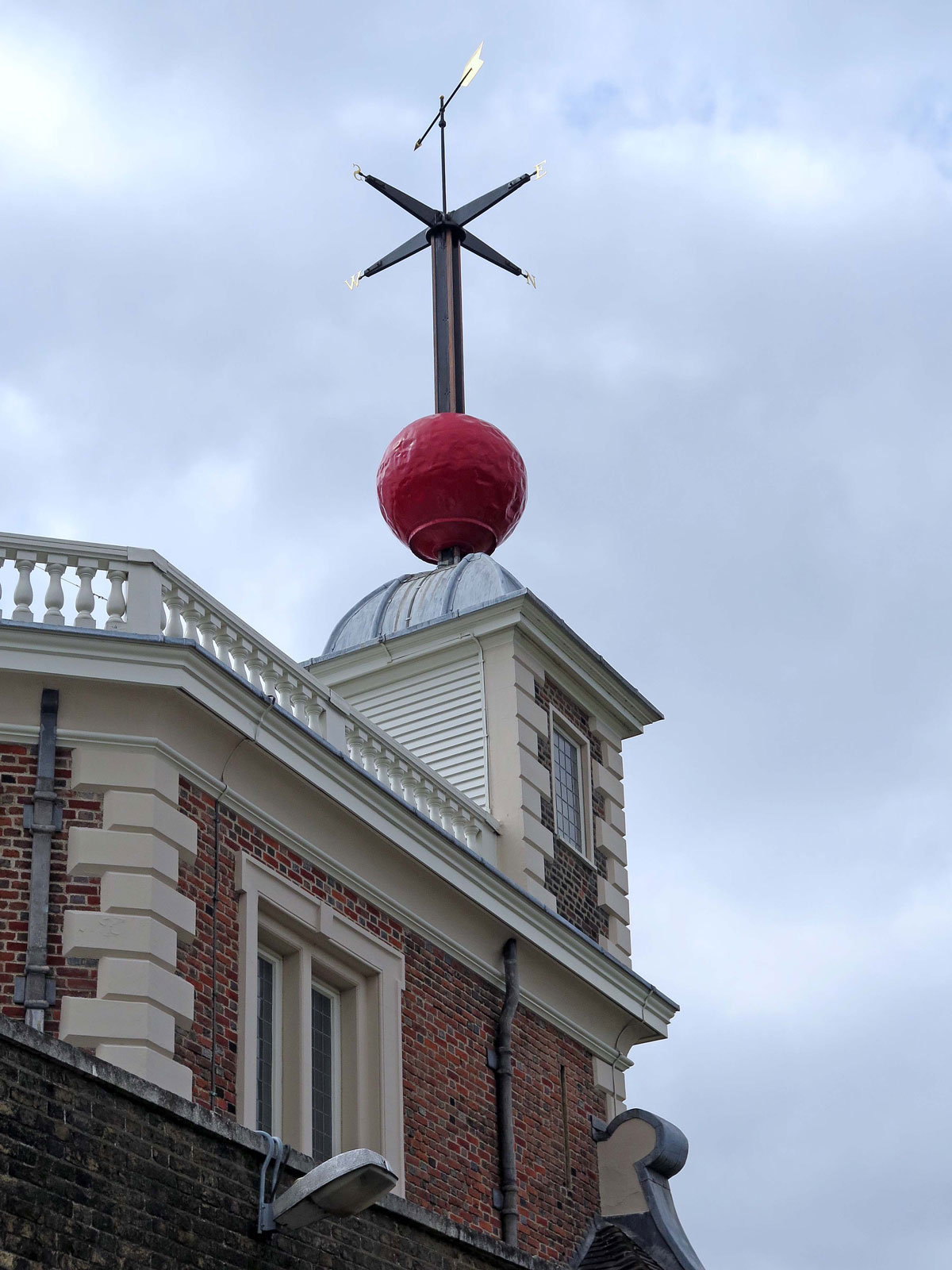
The significance of the Time Ball as a navigational aid for timekeeping was not lost on the powers that be, and this new standard time (which was based on the movement of the sun rather than the stars) was extended to land-based clock and watch-makers. In 1847 the British railway network adopted this new standard for their timetables, and by 1855 98% of all public clocks were using Greenwich Mean Time. GMT, as it became known, was not officially recognised as British Standard Time though until 1880.
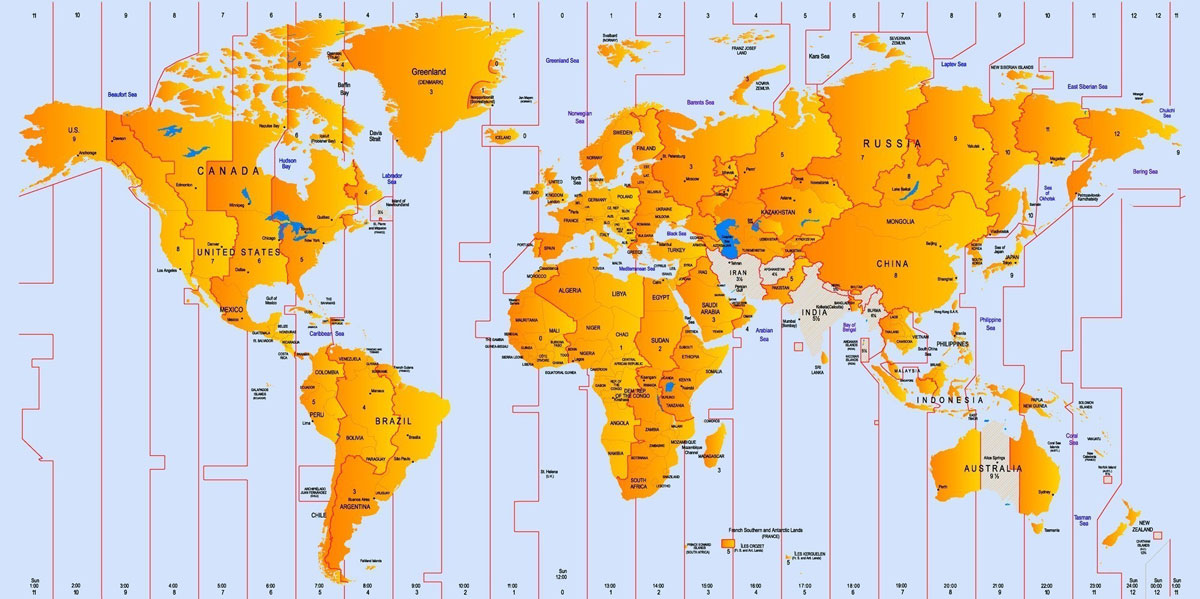
It didn’t necessarily mean that the rest of the world would follow Greenwich Mean Time as their standard because larger land masses needed different time zones. In 1884 at a conference in Washington DC a proposal was put forward to create an International Time Zone system, but in the end the delegates voted by 22 votes to 1 (with 2 abstentions) to accept 0° Longtitude at Greenwich as the Prime Meridian, and by so doing making Greenwich Mean Time the standard by which other nations would base their own time zones on.
The map below shows the different world time zones, with the International Dateline on the opposite side of the world to Greenwich at approximately 180° East or West. I say approximately because it doesn’t run in a straight line like the Prime Meridian. Crossing the Dateline eastbound decreases the date by one day and crossing it westbound increases it by one day.
Time doesn’t stand still of course, and from 1st January 1960 the world started to use Coordinated Universal Time (UTC) as the successor to GMT, and I’ve no doubt it will change again in the future.
Strangely enough though, there is one place where time has stood still – and that is the Royal Greenwich Observatory. In 1946, for various reasons, it was decided to relocate the observatory to Herstmonceux Castle in Sussex and the last observations made at Greenwich were in May 1954. Fortunately, things have been left for everyone to see what went on here. Flamsteed House is still in good shape as is the Meridian Building with some of its original telescopes. Harrison’s four timepieces have a special display and there is also a fabulous collection of astronomical instruments and horological objects from around the world. There’s even a planetarium if you have enough time.
When I was young I always had a fascination for the stars, but I never really gave the passing of time any real thought, but coming here made me think about it in a different way. It’s made me realise how precious time really is, because we’re all going to run out of it at some point, but when that time comes at least there’ll be one thing I’ll be grateful for – I won’t have to hear the sound of a bloody alarm clock ever again.


POSTED – MAY 2022
Originally posted 2022-05-24 07:25:29.
Gosh, that was wonderful. I really wish I’d gone there now.
Everyone should spare some time to come here if possible Shey 😊
Hopefully not under lock and key… but seriously it is an amazing place.
The worlde of how time is told is quite something. I remember thinking that re the Kelentinum in Prague.
That’s quite some clock isn’t it?
There is a wonderful clock tower in Old Town too with quite a story there. But for centuries they would signal noon from some wee slip of light in the Klementinum tower, and then all the church bells would pick it up and ring. They did that until something like 1926. But you get to see the bit where the light came in. Just amazing actually.
Apologies for not reading your comment properly. I ws assuming that you were referiing to the astronomical clock in Old Town Square, but I see what you mean about the Meridian Hall in the Klementium Tower. Thanks for pointing it out 😊
Well they are both really something to see in very different ways and not that far apart.
Wow, I learned a lot from this, Malc. 🙂 I’ve never been to Greenwich, but you’ve presented a fascinating ‘brief history of time’ here, of which I knew very little indeed. I can see why a visit here would cure you of your clock phobia, as they often say the way to get over something you fear or struggle with is to learn more about it. Still, the brilliant folk back then had the advantage of living and working with the cogs, wheels and ticks of wonderful clockwork machines, whereas today we have to endure the cacophony of synthetic alarms and maddening beeps, one of the scourges of the modern world in my view, so we agree on that entirely. Love the picture of you straddling the two hemispheres. That’s something you don’t get to do every day! 😀
You made me chuckle comparing this post to Stephen Hawking’s masterpiece Alli, and as far as watches and clocks go, you’re so right about those old timepieces. The craftsmanship and ingenuity that went into making them converted me into a closet horologist a long time ago. Straddling the two hemispheres is a fun thing to do, but I’d love to straddle the International Dateline too 😊
An encyclopaedic canter through time. The seventh dial of seven dials is the monument itself. Another fascinating blog post.
Thanks Stephen. I trust that you’ll be attending Upfest this weekend
One hundred percent.
Nice
Thank you. Glad you enjoyed reading it 🙂
This is an incredible article Malc. Splendid. You have researched and organised much information and made it very easy to read and understand. The idea of time is a fascinating one indeed and the historical perspective you have proffered is outstanding. The pics, as usual, are exceptionally good and you look just grand there straddling the East and West Hemispheres! Cheers Malc for such an interesting and informative piece.
All the best,
Francesc
Thanks for your smashing comments again Francesc. You know how much I value them.
I’m only the messenger here. People who do all the scientific work into all sorts of subjects like these spend many painstaking hours collecting and gathering data before they can even begin to fathom out what it all means. It astounds me sometimes when people revere so-called celebrities and yet they’ve probably never heard of those who have done so much for the human race.
I quite agree my friend. You’re welcome and all the best!
Thanks F.
You’re welcome Malc!
As always, you are able to make complex topics accessible to everyone.
I really enjoyed the visit you took me to: the other times I visited Greenwich I didn’t have such a competent guide.
I love your photos and I appreciated the fact that you didn’t escape the traditional photo straddling the two hemispheres.
Thank you so much for your flattering comments Luisa. I really don’t deserve them, but I’m so pleased that you enjoyed reading about Greenwich Observatory again 😊
It was really a great pleasure 🌹🌹🌹
🤩
You have a real knack for making complicated subjects seem much less so, and you’ve done a great job of explaining the story of longitude and time measurement here. I always love visiting Greenwich so it’s also good to see your photos showing it off so well!
Coming from somebody who is as knowledgeable as you about the written word Sarah, I take your comment as a big complement, so a big thank you for that. As regards the photos, I think I could do better if I was to go back, but another thank you all the same 😊
Just looked this up :This is the challenge facing the U.S. Navy as it tries to bring back celestial navigation. The Navy stopped training its service members to navigate by the stars about a decade ago, focusing instead on electronic navigational systems. But fears about the security of the Global Positioning System and a desire to return to the basics of naval training are pushing the fleet back toward this ancient method of finding a course across open water.
I think they’re very wise Pat. I’m also a belt and braces man myself 😊
Fascinating Malc and you even made it understandable. I believe that in the US Navy,the ship’s navigator still uses a sextant (when the sky cooperates) to take the ship’s position (despite the use of navigation satellites and other aides to navigation.) Tradition!
I’m glad you enjoyed reading this post Pat, and even more pleased that you understood it 😊
It may be tradition in the U.S. Navy to still use a sextant, but I believe that a good background knowledge of any vocation in life is worthwhile for any number of reasons.
Another fascinating post Malc, I’d like to see that time ball operating but probably never will as I have no wish to ever go to London. Another way of waking without an alarm clock – just before you go to sleep bang your head on the pillow the equivalent number of times you want to get up and that’s the time you’ll wake. Totally stupid I know but it does work 🙂 🙂
Thanks for taking a look at my post Eunice even if you don’t intend visiting the RGO yourself. It sounds as though you’ve never been to London, but maybe you have but just didn’t like it.
It seems like I’m not the only one who has a dislike for alarm clocks, but your remedy sounds very plausible 😊
I went to London with my parents when I was 12 Malc, stayed for three days en route to an Isle of Wight holiday. We did all the usual touristy things and being a child I loved it – fast forward to 1999 and due to a mix up with our holiday booking my partner and I had to travel through the city by coach. It was horrendous, people and traffic everywhere (probably even worse now) and I said then I would never ever go to London for any reason.
As for my daft remedy for waking up without an alarm clock I’ve got an equally daft one for curing hiccups but I’m not going into that 🙂 🙂
Incidentally, I noticed recently that you mentioned about not getting notifications of comments on my blog posts – if you tick ‘notify me of new comments via email’ under the comment box you should get them, if you’ve already done that and still don’t get them then I haven’t a clue what the problem is 🙁
London isn’t everybody’s cup of tea Eunice that’s for sure, but there’s so much of our history there it would be difficult for me to ignore. As you know I’m keen on learning about the past and not just in our country either. It’s not my only interest as you probably realise which is why you’ll find me flit around from one subject to another. A Jack of all trades, master of none you might say 😊
I’ve made sure that I’ve checked the box on your latest post and I’ll try to remember in future as well 😊
I continue to find it fascinating how the old-time sea-captains determined longitude at sea with the aid of sextants and whatnot, though I assume it is now down quite differently (and automatically) using satellites and triangulation.
It must have still been a dodgy business though Don. Today of course, as you quite rightly say, it’s a lot more accurate and trustworthy
Your essay on time, clocks, Greenwich, and many things more, Malc, is beyond good, it is brilliant! I love you seemingly innocent observation that make mi smile. I didn’t venture into Greenwich that far because I thought it is well known, I was wrong.
Thank you for the pictures. I can offer one suggestion on not using alarm clock. Try just before falling asleep to say to yourself, ” I must get up at seven or any time you need”, and you might be surprised that it works. It works for me and I don’t have alarm clock at home.
Joanna
Thank you so much for your lovely comments Joanna. Coming from someone who produces posts as good as you do, that’s really humbling. As you quite rightly point out, there is a lot to take in at the RGO. So much in fact, that it’s difficult to know what to leave out when writing about it. As for the alarm clock, I don’t need it so much these days, but I’ll remember your tip for when I do. Thanks 😊