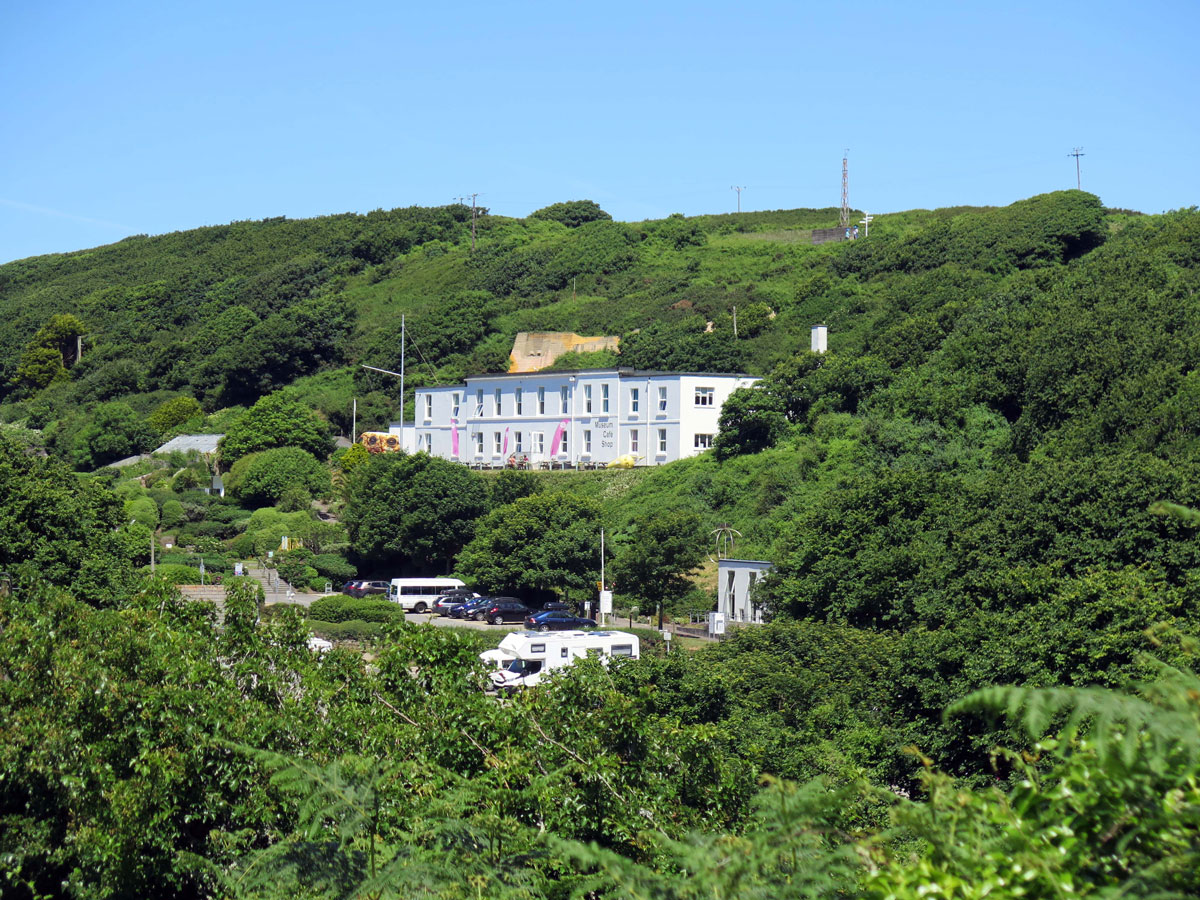
The Porthcurno Telegraph Museum
Cornwall has an unbelievably rich history in communications, and as tempting as it might be to talk about early signal stations, Marconi’s wireless achievements on The Lizard, or even the first Trans-Atlantic television transmission to Goonhilly via Telstar, it’s Porthcurno’s importance as an international hub for cable communications that I’ll be talking about here.
Prior to the invention of the telegraph, communication over long distances was difficult to say the least: In Cornwall early communication signals would have been by beacon or semaphore, but the only real way of getting messages delivered over long distances was by writing a letter which could take weeks if the recipient was overseas.
The word ‘Telegraphy’ comes from the Greek words tele (at a distance) and graphein (to write) meaning ‘to write from a distance’. It was brought into modern usage with the invention of the telegraph in the mid-19th century, which in essence meant being able to send messages in the form of electrical pulses, making connections over long distances much quicker than was previously possible.
The first man to really make his mark in this field was the American, Samuel Morse, who made his first working telegraph instrument in 1837 using his Morse Code. Other people played their part in helping to make the telegraph system work, but Samuel Morse is the person who seems to take most of the credit.

These telegraph messages were initially sent overland through telegraph wires, but sending messages overseas meant laying cables on the sea floor which was easier said than done.
Thanks to new technology in cable making, ships such as Brunel’s SS Great Eastern were used to lay these cables and by 1866 the first successful transatlantic cable connected Newfoundland to Ireland, opening up the possibilities for Britain to connect with its ever-expanding empire – and this is where Porthcurno came in.
One of the men involved in the transatlantic cable was Sir John Pender who now turned his attention to India. Initially, he chose Falmouth for the British end of the cable, but had a change of heart when he realised that the harbour at Falmouth was too fraught with obstacles for it to be safe, unlike Porthcurno which had easy access onto the beach.
On 23rd June 1870 the connection between Porthcurno and Bombay was established and a message that previously would have taken 6 weeks between London and Bombay was now delivered in just 9 minutes.
Pender’s network of cable spread like “an octopus” and by 1880 there were almost 100,000 miles of undersea cable.

At the height of its activity Porthcurno was the world’s largest cable station with fourteen telegraph cables in operation, all of which came ashore (and still do) just above the beach into a cable hut.
This cable hut is the only one of its kind, complete with original features and fittings, and contains the largest collection of historic telegraph cables and termination boxes in the world. Visitors can still see the original cables which appear from under the floor and connect to a bank of terminals. Unfortunately, I’ve still yet to go inside and see where these cables terminate.
The heart of the telegraph station was Eastern House, which now forms a major part of the museum, but with the onset of WW II it was obvious that the station needed protection, and so two hundred tin miners dug tunnels into the hillside, and everything was moved lock, stock and barrel underground. These tunnels are now part of the museum and Grade II listed.
After the end of the war Eastern House was refurbished and opened as a training school. In 1970 exactly 100 years after the arrival of the first cable, the telegraph station closed, but the training school remained until 1993.
There is, of course, a lot more that could be said about the background to this fascinating place, but I also need to discuss what the museum offers today.
Eastern House has live demonstrations, interactive exhibits and displays of technological significance such as cable design and models of cableships, plus for youngsters, a “Nerve Centre of Empire”, opened in 2010 by the Princess Royal which enables kids to dress up in costumes and immerse themselves in what life was like during the times of Porthcurno’s heyday.

The wartime tunnels were where the relay stations operated from during WW II, and the first tunnel shows a fully working automated relay station using the same equipment as would have been used at the time. There is also an authentic (but reconstructed) telegrapher’s workshop and a replica wireless room.


There is also space allocated to what life would have been like for the employees of Cable and Wireless (who were responsible for running the facility at the time), and the Porthcurno community in general. There’s even an unexploded bomb on display that was dropped on a nearby farm and an escape route that is accessed through a secret door up 120 steps through solid granite rock.


The Testing Room shows how cableships were used to lay and repair thousands of miles of cable including a film showing the ingenuity of those involved. These days most cables are laid under the seabed.
Technology has moved on from back then of course, and instead of electrical pulses being sent through the cables, it’s light in the form of fibre optics, and there’s a section dedicated to explaining how this works. That doesn’t mean to say that the cables running under the seabed to Porthcurno are now obsolete. On the contrary, 98% of all international communication is by optical fibre – and not satellite as you may have expected.
Porthcurno is still an important communications hub believe it or not, even though it’s not used in the same way as it once was. If you want to know your galvanometer from your siphon recorder then come and take a look at this fascinating museum, but you don’t need to be a radio ham or understand how electromagnetism works to enjoy it. There is one thing I am perplexed about though: why is it that in a location that has been recognised as one of the most connected places on earth, that I couldn’t get a signal on my mobile phone?

Originally posted 2018-09-26 14:42:29.
My favourite place to go. The nicest cove in the uk.
It’s difficult to argue with that. Thanks for commenting.
Of course now we haave the net and mobile phones but hwo fascinating what was achieved back then.
I’ve always marvelled at what our predeccesors achieved.
Oh yes…… Truly.
heading off for a a family weekend. Place doesn’t let you in till 4 so we are prob gonna head off anyway and do some walking seeing as it is quite ncie walking countryside. As they say, see you on the other side. Enjoy your weekend.
You too of course. Can I ask where you’re off to?
We take a lodge at a place called Piperdam which is not far from Dundee. Ther’es our two girls who you have heard tell of…their hubbies and their 3 bairns. The first time we did it a few years back was rather than buy the adults’ Xmas pressies. While it looks expensive it is a 3 way split (the quoted prices are for 2 nights) and we also bunce re the shopping for the two evening meals, then you bring your own everything else you want. So it works out far cheaper than a basic hotel up here. And the lodges are lovely, in a forest setting. Ours this time had a sauna–the floor of which grandie no 1 poured buckets of water through. I did tell him as he assured me–he doesn’t take after his mam for nowt–that this was how it was done, that it was all fine so long as it wasn’t pouring in to the room underneath, and a hot tub, which we managed to break every rule going regarding–they should have been in plainer site. It is also one of these places that doesn’t charge the earth. The activities, if you want to them are all cheap, the swimming pool is part of the overall package and the Mr and I got two nice walking sessions in, cos it is in Sidlaw Hill country and one even started from the car park. It is prob the kind of place we’d be thinking was 7th heaven IF it was further away. But cos it is virtually on the doorstep, it is not a place we’d book oruselves.
Sounds brill and a great idea. Hope you enjoyed it!
Oh yeah. It is full on. But the two of us started the hol on Fri afternoon with a walk at Backmuir Woods and a stop at the Birkhill Inn on the way up. And then again on Sat we went and did a hill while they all went to the pool. Later the fellahs did the golf driving range, while the ladies and the younger two kids hot tubbed it with the wine–obvi they had juice. We’d a Halloween bash for them later. Of course there’s fraught moments etc but we had plenty laughs. And the kids love it.
I think it’s a fantastic way of getting together. Tomorrow I’m having a day out with my daughter. Just the two of us.
ENJOY. Tha will be lovely.
Ps… hope it is somewhere really nice.
Exmoor!
Great.
I learned Morse code as a boy scout, and later in the US Army, though when push came to shove in Vietnam I was never fluent enough to make proper use of it. In any case, I have always been fascinated by 19th century telegraphy and hope to see this museum some day.
If you manage to get here Don, you’ll be able to have another go 🙂
This looks fascinating – though I’m not sure I want to visit a museum with an unexploded bomb therein 😉
I’m sure it’s been defused by now 🙂