Devonport - Pt 1 The Birth of the Dockyard
Devonport Dockyard is a bit of a mystery to many people, and if you’re one of those people who would like to know what goes on behind those dockyard walls, then follow me in a series of short posts that I hope will answer some of the questions about a world that the general public rarely gets to see.
To put things in perspective, Devonport is one of three UK Royal Navy operating bases, the other two being the nuclear submarine base at Faslane on the River Clyde and the surface fleet base at Portsmouth.
People are forever getting Portsmouth and Plymouth mixed up, which doesn’t go down well with the people of either city, but although it’s understandable in a way, Portsmouth and Devonport Dockyards are really quite different, especially from a visitor’s point of view.
While Portsmouth’s Historic Dockyard is open for visitors to wander around, with several major attractions to keep people occupied for days, the dockyard at Devonport can usually only be seen from a distance when taking a boat trip out of the Barbican.

I can’t claim to know all what goes on at the largest naval base in Western Europe, you’ll need to contact the Russian Foreign Intelligence Service for that; but having worked in Plymouth for many years, I got to know a fair number of people who worked in the Dockyard, and their stories often intrigued me, and so I thought it was about time I got to know more about how The Yard developed.
The fortunes of Britain’s dockyards, like the sea, has ebbed and flowed for centuries. The first Royal Dockyard was built at Portsmouth by King Henry VII in 1496, purely for the purposes of expanding trade, but it was his son, Henry VIII, who formally founded the English Royal Navy in 1546 to protect England (and himself) from foreign invasion. He built dockyards at Woolwich and Deptford near to his palace at Greenwich, and his daughter Elizabeth I, added Chatham to the list. In 1665 a dock was built at Sheerness to supplement the one at Chatham, and in the late 17th century, Devonport became the location of the Royal Navy’s sixth dock.
In 1689 Prince William of Orange became King William III of England, and to bolster up his defences against France and Spain, he needed a ‘Dry Dock’ west of Portsmouth to service the fleet that patrolled the Western Approaches to the English Channel. He instructed the Surveyor of the Navy, Edmund Dummer, to find a suitable location – and the site he came up with was Point Froward on the River Tamar, near to where it joined Plymouth Sound. The map below shows the location of Devonport’s first dock in relation to the area today.
Dummer was also given the responsibility for designing and building the new dock, and it wasn’t long before the project was set in motion: A Wet Dock Basin was constructed to allow access to the stepped Dry Dock where men could work underneath the ship’s hull. A storage area known as the Quadrangular Great Storehouse was built alongside the basin and there was also a Rope House and an Anchor Smithery which, for obvious reasons, was located well away from vulnerable buildings such as the rigging, hemp, yarn and pitch houses. Unsurprisingly, many of these original facilities have since been rebuilt including the basin and dock, which are still in use today but known as No.1 Basin and No.1 Dock.
A grand terrace of thirteen three-storey houses built for senior dockyard officers were also built, and managed to survive until Devonport became a target for the Luftwaffe during WWII, but at least one end of the terrace was left standing and is now Grade II listed. The whole complex appears to have been completed by 1698, and is still part of the Devonport Dockyard set-up after 325 years.

The area where this first dock started out is known as South Yard today, and in the next instalment I’ll be explaining how the dockyard started to expand, and how accommodation built to house the dock workers became the town of Devonport.
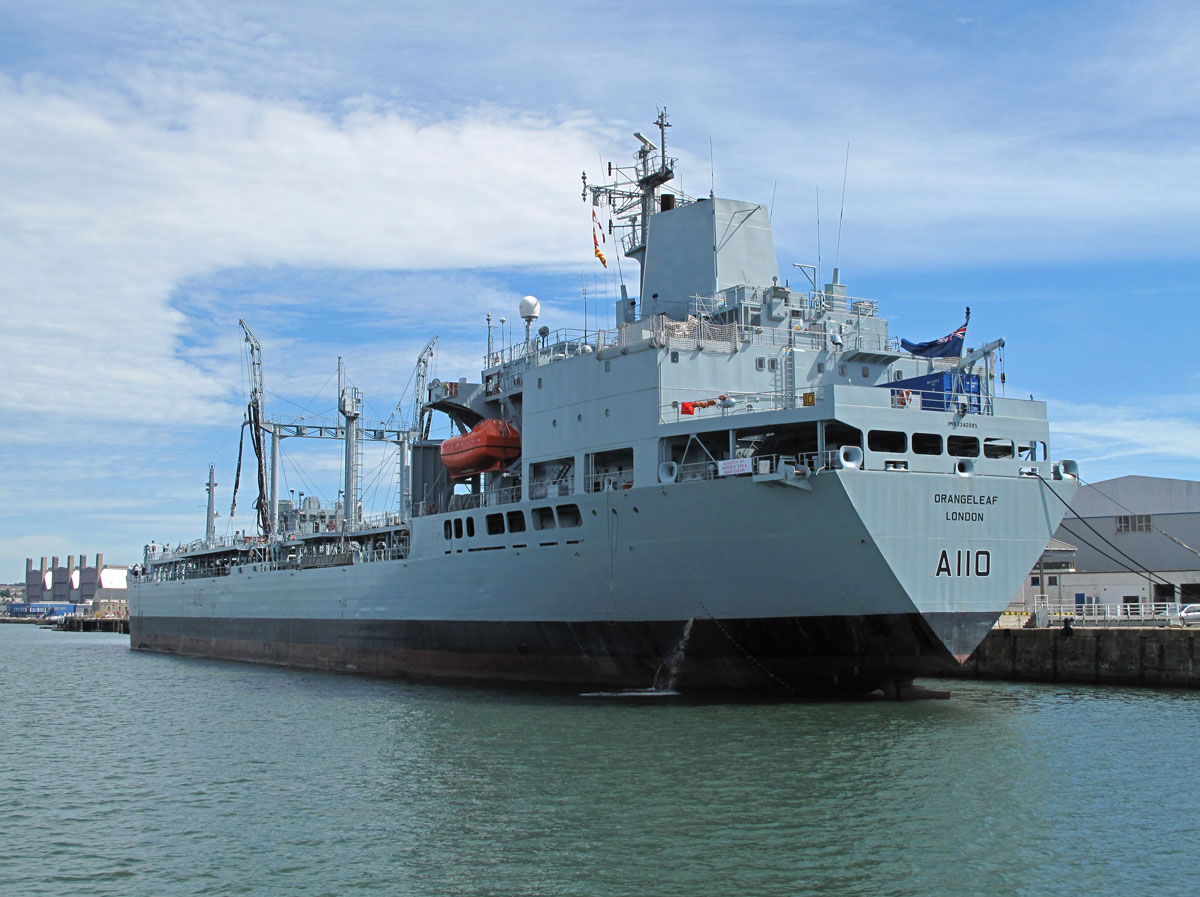
The pic below shows the Royal Fleet Auxiliary ship Orangeleaf at South Yard before she was decommissioned in 2015.
POSTED – DECEMBER 2023
Originally posted 2023-12-27 13:59:05.
Fascinating, thanks for this information. On my iPhone a lot of the text appears interspersed with html when I view through the Jetpack app. Maybe something about my settings as no one else commented thusly. Cheers.
Thanks for commenting, and I’m sorry that you weren’t able to view the post properly on your phone. Although I create these posts for wider screen viewing in general, you should still be able to view them correctly on your phone as well.
I hadn’t realised there was such a significant dockyard in Plymouth, let alone the largest naval base in Western Europe. I had thought that accolade would go to Portsmouth. But if Devonport was created way back in the seventeenth century it’s clearly of great importance, both historically and defensively. At least I’ve never got Plymouth and Portsmouth mixed up, but then I’ve only been to Portsmouth and we know it well. Clearly there’s much to learn about Plymouth’s Devonport though, and I’ll enjoy reading about it. 🙂
Devonport has never been a visitor-friendly place to visit and is probably why most people don’t know much about it 🙂
I reckon they’re missing a trick there. With a bit of investment they’d turn it into a good tourist attraction and bring some money into the area (and, of course, create jobs).
Wishing you health, hope and happiness in the New Year!💞
Thank you Luisa. I hope that 2024 is a good year for you too and thanks for your continued support during 2023 💙
Thanks a lot 🙏🙏🙏 … and same wishes your way. 🙂
An interesting slice of history from a city I know just a little about, but none of this! Just one point that made me smile (sorry!) – you mentioned people getting Portsmouth muddled with Plymouth, then titled one of your paragraphs ‘Portsmouth Dockyard’ 😄
LOL. I have plenty of pictures of Portsmouth Dockyard, but for obvious reasons, not so many of inside Devonport. I’m hoping that by the time I’ve finished these posts, the differences will be clear.
Oh yes, I see now – your caption to that photo is so big I took it to be the heading of the paragraph below!
Great naval history Malc! Looking forward to part 2! I tell you I’ve learned so much from your posts that I never knew and they always remain as reference with fab photos! Cheers Malc!
Thanks Francesc. Your comments are always so complimentary, even if they’re not justified.. Thank you so much. I hope your exhibition in Barcelona went well.
As you know, I really like the way you post the information. I invariably learn a lot of new things from your articles!💖
Thanks Luisa. Hope you’ve had a lovely Christmas 💙
I wanted to give you a formally cordial reply, but, to tell you the truth, my Christmas and Boxing Day were spent in almost total solitude: luckily I had my old doggy Sissi to keep me company 🐾
Oh Luisa! What can I say? I’ve guessed for some time that you’re not in a happy place, but you know I’m with you all the way. I just don’t know how to reach out to you 💙
I know you are close to me, dear Malc, and I am very grateful to you 🙏💞
You know that I’m always here then 🙂
🙏💖🙏
Excellent post. And I glad to see the words Part 1…
LOL. I sometimes feel that a few smaller posts are better than lengthy ones, but it depends on the topic. Hope you’ve had a great Christmas with the grandees 🙂
Oh it was crazy. I hope you had a good time.
We had a peaceful one but not boring thanks 🙂
That’s the main thing.
When in the very first paragraph, Malc, your words make us smile (the reference to the Russian Intelligence Service), we know that we are onto something interesting and sharper than a description of the feast you had as some bloggers concentrate on today. The historical background of the beginning of dockyard building in this country was as always well written, and aroused my interest to read more, especially as it came with a map, and a touch of your humour. There is more to look forward to reading in part 2, and the overwhelming impression is my regret that you were not my history teacher as you make ANY subject interesting, and memorable. Thank you!
Joanna
Thanks Joanna once again for your fabulous comments. As regards the comment I made about the Russians knowing more about the dockyard than I do isn’t as daft as it may sound. During the Cold War days I knew someone from the MOD who told me that there were KGB agents living in the flats overlooking the dockyard. They knew who they were and where they lived, but whether the spies knew that they knew I wouldn’t know 🙂
An interesting bit of early Naval history Malc, I’m looking forward to reading more especially if you include the Royal William Yard at Stonehouse 😉
I’m currently researching the lifting up and moving of two old pubs – not that I’ve ever been in either but it’s an intriguing subject 🙂
Thanks Eunice. The RWY will feature in a post about Stonehouse at some point.
I’ll be waiting to see what your post on the pubs throw up as well then Eunice 🙂
Interesting article, Malc. I didn’t real that the RN was so (comparatively) late in being formalized. Also looks like you will have two series running (Iceland and Devonport so please don’t get yourself and us confused). 😉
Before Henry VIII created the Royal Navy most ships operated for private individuals, whether it be for influential people or just for themselves. It doesn’t mean to say that monarchs previous to Henry VIII didn’t use ships for fighting battles or trade, it was just that he was the one to bring it all under royal control.
I’ve got another series underway as well – Northern Ireland, but I’ve left that alone for a while. With so much strife going on in the world at the moment I didn’t think people wouldwant to read about more bloodshed, which is why I’ve gone for a military post instead. LOL