Is it Derry or Londonderry? - Pt 2 The English Take Control
In Part 1 of this series, I explained how Derry came into existence and how the English came to be in Ireland, but now, I’m going to turn my attention to how Derry found itself under the rule of the British crown rather than one of an Irish king.
After the 12th century Norman/English invasion of Ireland, English interest and influence gradually diminished, thanks mainly to more pressing engagements at home. It wasn’t until the conclusion of the Battle of the Roses in 1487 that England was able to turn its attention elsewhere – and bringing Ireland completely under English control was on the new Tudor dynasty’s list of things to do.
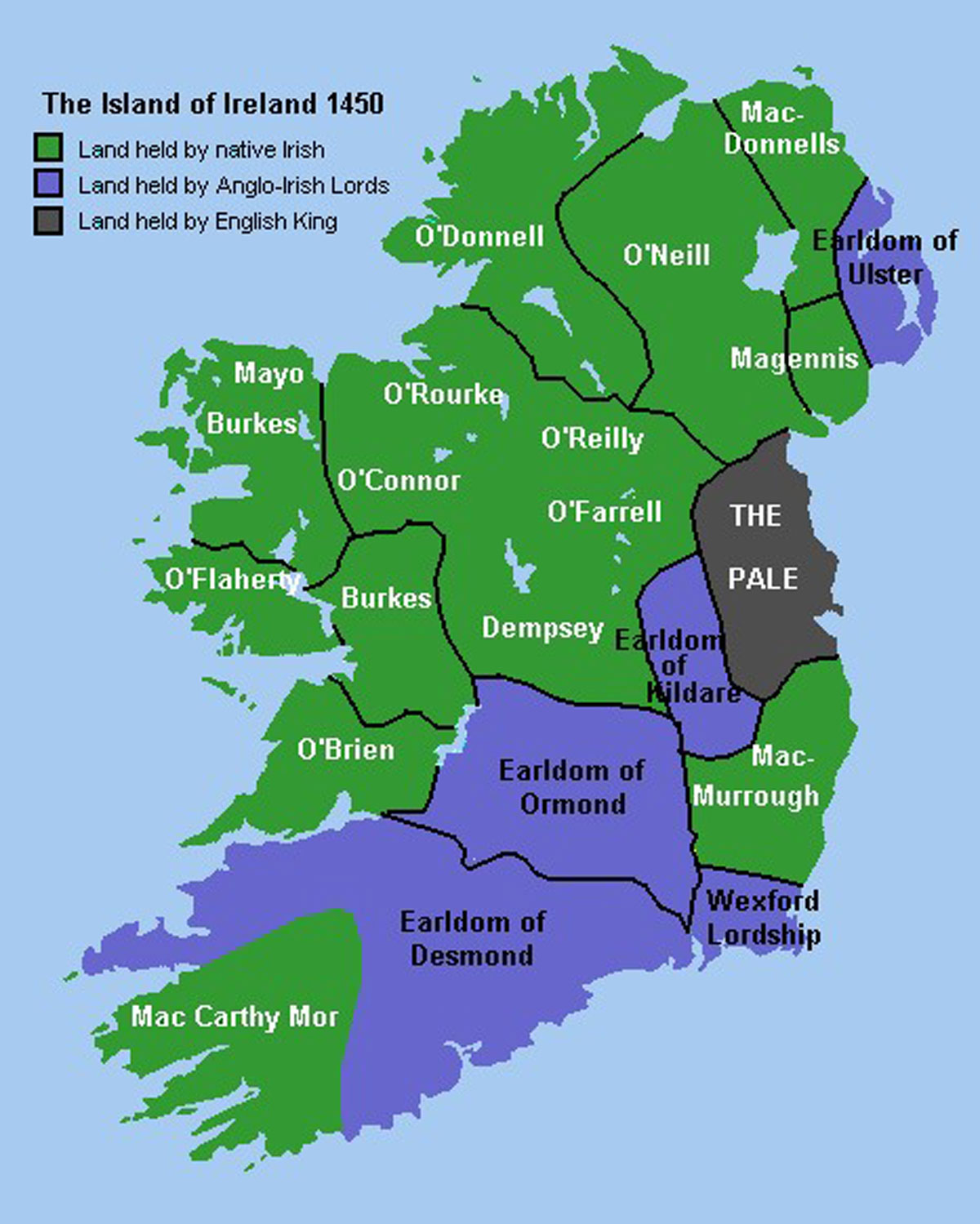
Early attempts proved unsuccessful, not least because the intervening years had changed the geo-political landscape. By the 15th century, the English were left in control of just one part of Ireland known as The Pale, which covered an area between Dublin and Dundalk, but ‘beyond the Pale’, the rest of the country had largely returned to its Gaelic roots. Not only that, the Anglo-Norman lords (both inside and outside of The Pale) had inter-married with the Gaelic-Irish aristocracy.
The map below shows how Ireland looked before the Tudor dynasty took over in England. Land in green was owned by the native Irish, land in purple by the Anglo-Irish Lords and the land in grey was ‘The Pale’ owned by the English King.
When Henry VIII came to the throne on 22nd April 1509, I don’t suppose Ireland was uppermost in his mind. For a start, he was less than a couple of months away from marrying his first wife, Catherine of Aragon, but as we all know, his eyes started to stray elsewhere, and the new love of his life, Anne Boleyn, was to bring turmoil not just to England, but subsequently Ireland too.
The Reformation in Europe was already in full swing when Henry fell out with the Pope over the proposed annulment of his marriage to Catherine of Aragon, and the disagreement led to a divorce, not just from his wife, but also the Catholic Church. The 1532-1534 laws passed by the ‘Reformation Parliament’ abolished Papal authority and made Henry the Supreme Head of the Church of England.
Henry’s break from Rome brought England into conflict with other European countries who saw the Pope as the undisputed head of the Christian world, and so Henry was careful not to alienate the Catholic Irish because he needed their support to fend off any potential threat from countries like France and Spain. He may have fallen out with the Pope, but King Henry still upheld Catholic values and England hadn’t yet become a Protestant country.
In 1541 Henry achieved his objective of getting Ireland under his control by using a form of diplomacy which he referred to as “Politic drifts and amiable persuasions”. In practice, what this meant was that he bought off the Gaelic-Norman dynasties by offering them certain privileges. This involved the Irish kings surrendering their lands to the crown, which Henry then regranted back to them with extra titles and royal protection. He also offered safeguards for future generations of their families as well which was no doubt a sweetener, but an unsustainable one I would have thought.
Many of them accepted these conditions – but not all. For the Irish lords it meant that they more or less carried on running the show as before, but for Henry, he was not just King of England now, but also King of Ireland.
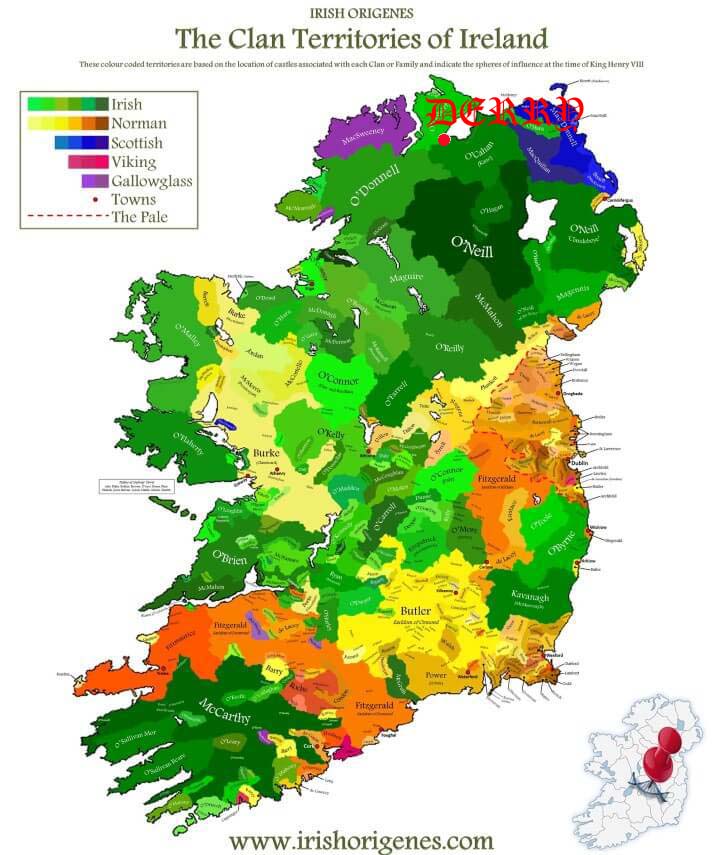
The map below shows Derry in relation to how the Gaelic clans made up Ireland. The town bordered the middle order Gaelic kingdoms of O’Cahan (County Londonderry) and Tyrconnel (County Donegal) which were both part of the Northern Ui Neill Overkingdom, and when Conn Bacach O’Neill agreed to Henry’s Surrender and Regrant policy he became the 1st Earl of Tyrone.
Diplomacy was never one of Henry’s strong points, and you might be forgiven for thinking that this cosy arrangement couldn’t last – and it didn’t. Henry had already shown what he was capable of in 1537 when he separated the head of ‘Silken’ Thomas Fitzgerald from the rest of his body after a failed rebellion against him. He wasn’t going to let that happen twice, and it didn’t take the new King of Ireland long to make his presence felt. As time progressed, Henry started to push his ample weight around and take more control – and by the time he died in 1547, the people of Ireland were glad to see the back of him.
Henry VIII’s successor was his only son, 9 year-old Edward, who as Edward VI was too young to govern his realm without a regency council. He only lived until he was 15, but during that time he completed the transition of turning England into a fully paid-up Protestant nation.
When it was discovered that he was terminally ill, he and his council connived a plan that would prevent his half-sister Mary (who was Catholic) from becoming queen, and announced that his distant cousin, Lady Jane Grey, was to succeed him – but her reign was to be even shorter than Edward’s.
The Nine Day Queen, as she’s been called, inherited the title after Edward died on 9th July 1553, but she didn’t even get to be crowned, because a fortnight after she arrived at the Tower of London to prepare for her coronation, she was back in there as a prisoner of Mary, her Catholic cousin.
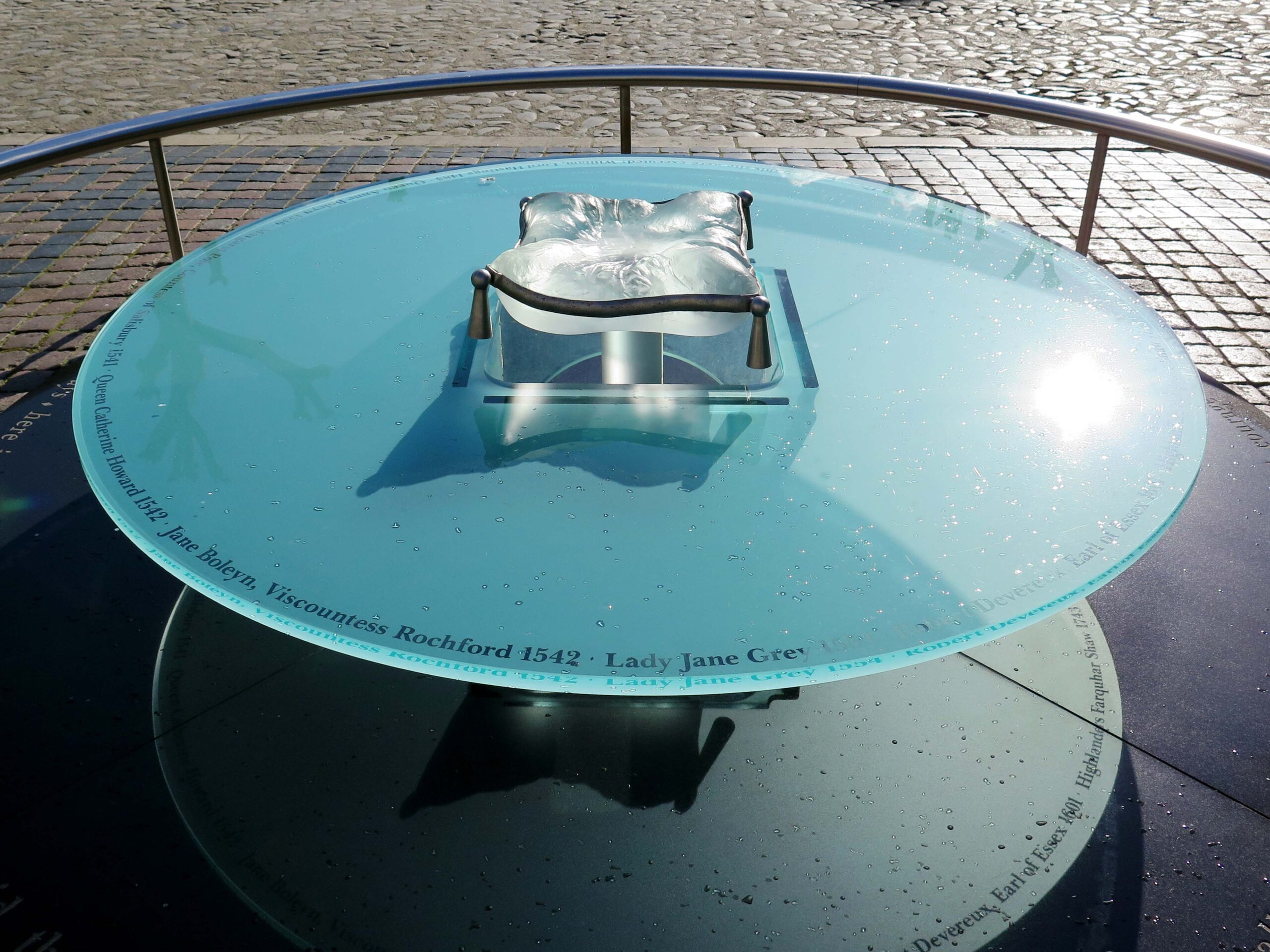
Mary had convinced the Privy Council that she should be the one wearing the crown, and after being found guilty of treason, the seventeen year-old Lady Jane was sentenced to death. On 12th February 1554 she was beheaded on Tower Green.
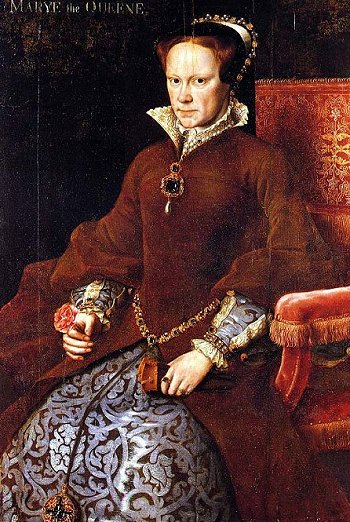
‘Bloody Mary’ was crowned in July, England was back to being a Catholic country, and, although under English rule, Ireland did at least have a Catholic monarch. Ireland was now at peace – or was it? Find out in Part 3.
POSTED – JANUARY 2023
Originally posted 2023-01-05 08:09:23.
An excellent summary
Thanks Shey. An Englishman writing about Ireland with a Scottish lass reading it means that I’m treading on dodgy ground here 🙂
Lol… Well let me shore you up by saying, only those with no grasp of the complexities or knowledge, who blabber on meed worry about shaky ground.
Thanks for the endorsement 🙂
lol…by order….
Your history posts are always an enjoyable as well as informative read 🙂 I’m assuming this is where we get the phrase, ‘beyond the pale’? I always felt especially sorry for Lady Jane Grey – I don’t suppose she even particularly wanted to be queen at that young age.
Thanks Sarah. Not much in the way of pictures on this one I’m afraid, but the history of Ireland has always captivated me for some reason. It’s a complex history which is why I’m trying to cover it in small doses. As regards ‘Beyond the Pale’ most people believe this is where it originates from although some people will argue about it coming from the original meaning of the Pale being a barrier such as a palisade, and I think you have a very valid point about Lady Jane Grey.
Malcolm,
Wow! Your post is somewhat like an exciting mini-series in that I can’t wait for the next episode!
I learned the origin of the term “beyond the pale” while in Ireland visiting Malahide Castle near Dublin, so using the term here crystallizes its meaning in regards to the separation of the land and who it was governed by. The history of the Tudor reign is fascinating! Poor Lady Jane Grey …….
This topic will stretch out a bit to cover it properly Sylvia, so I’m glad that you’re enjoying it
Fascinating history, Malc. I had heard that the Pale dealt with Jews in Imperial Russia
Interesting to learn about it also applying to the English in Ireland. Nice job.
Thanks Pat. Irish history isn’t easy to unravel, but I’m trying to keep it as staightforward as possible
Another interesting post Malc, it certainly explains the saying ‘ beyond the pale’ and I’m looking forward to part 3 🙂
As for your technical issues, when I read your previous post I wondered if you were posting from a phone or tablet as I now get what seems to be a printable version and a ‘like’ button which doesn’t do anything – this post is the same. I hope you get things sorted soon, I’m sure you can do without the aggro 🙂
Eunice, thank you for suporting my efforts to still stay with WordPress Reader but I’m beginning to think that I might have to find another way to keep friends like you onboard
I love the Tudor period and your article is really enlightening and fascinating❣️
Thank you Luisa. There will be a few on this topic all being well 🙂
Great! Thanks a lot, dear Malc🙏💓🙏
Dear Malc, this is another of your lessons in history that is unmissable, I read it with raising excitement. Like most of your readers, I learned so much and knowing more than I knew is always a reason to be happy.
Thank you, Malc, again, greatly appreciated!.
Joanna
Thank you Joanna. Your comments are always so encouraging, and I can do with some of that at the moment as my website is having technical issues with WordPress Reader. If you get this reply would you mind doing me a favour and just put a smiley in return so that I know you’ve seen it. Thanks 😊
Yes, I read it, and thank you! You are too wonderfully good to need anything from anyone, as we will always
read you with great interest, and beg for more!
Joanna .
Thanks Joanna. I wanted to make sure that you didn’t miss my reply, but your comments are far too generous. By the way, if you really do want to see more, then I think you missed the previous post on Lincoln Cathedral. The link to it is just below the ‘like’ button above. Thank you for your wonderful support. I really do appreciate it.
Interesting Malc. This article is a bit different from your other ones but being as I too have some family origins in Ireland and their close familial ties to many of us from the north of Spain, I thoroughly enjoyed it. Cheers my friend and all the best.
Glad you enjoyed it Francesc. There are more of these to come
I never knew the origin of the expression ‘beyond the pale’.
Some people would argue against its origins but most people, including me, believe this is where the phrase originates.