Lincoln - A Town of Celts, Romans, Vikings and Jews
Lincoln is not the easiest place to get to from where I live, but on returning from a trip to the North-East we were able to make a detour and spend some time in a city that I’d always wanted to visit, but thought I never would.
The main reason that I was keen on visiting Lincoln was because at one time it was one of the most important towns in the country, and in this introductory post to Lincolnshire’s county town, I’m going to try and unravel its early history to see why – and where better to start than at the location where the Iron Age settlement was established in the 1st century BC.
Today, the River Witham runs through the centre of Lincoln in a much more controlled way than it did 2,000 years ago. Back then, it was a swampy area that included a large natural pool, and it was here that Lindum (meaning ‘place by the pool’) was first settled. These days this area is known as Brayford Pool.

The main way of getting around in those early times would have been by using the existing water channels that were, and still are, prevalent in this part of the country, but when the Romans arrived in 43 AD transportation became far more sophisticated.
It’s believed that that they were responsible for building the Foss Dyke, a canal which connects the River Witham at Brayford Pool to the River Trent. Looking at a map of the area shows that this canal would have allowed boats to travel between the Wash and the Humber with Lindum in between. If indeed it was built by the Romans, then it would make Foss Dyke the oldest English canal in use today.

More importantly, it was their road-building programme that had the most significant effect, not just on Lincoln, but on the whole of Britannia. A network of roads connected all corners of the country, and two of the most important arteries in this network came to Lindum.
The Fosse Way ran in almost a direct straight line from Isca Dumnoniorum (Exeter) to Lindum, and Ermine Street went from Londinium to Lindum, before continuing on to Eboracum (York). These roads no doubt contributed to the establishment of a fortress and settlement of their own, which they referred to as Lindum Colonia.
Today’s High Street more or less follows the same line as the Roman Ermine Street and crosses the river via High Bridge. Built around 1160, High Bridge is the oldest bridge in Britain to still have buildings on it, with the timber-framed shops dating from about 1550. The size of boats being able to pass under it from Brayford Pool is limited due to the shallow water and narrow crooked arch. In fact the only reason that the bridge is still standing is because in 1803 it was deemed too expensive to demolish, and even though it has contributed to flooding in the past, the ‘Glory Hole’ as local boatmen refer to it, is unlikely to be knocked down any time soon as it is Grade I listed.

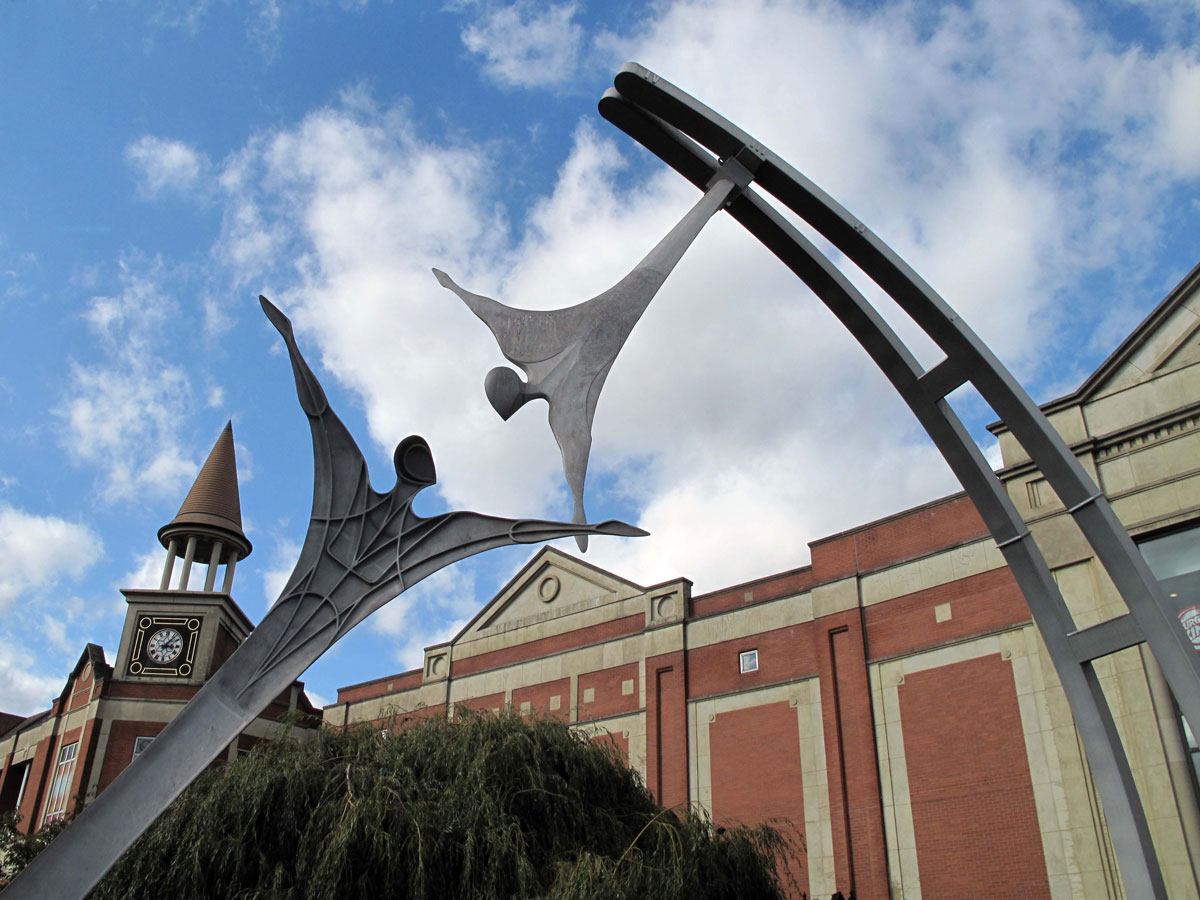
Presumably, flood control schemes have been introduced over the years, and is perhaps why the Witham runs a straight course through here now. Alongside the river is a modern development known as Waterside, but for me the most striking thing of all is the aluminium and steel sculpture spanning the river called Empowerment by Stephen Broadbent. These days, urban artwork is everywhere, and not all of it good, but I like this piece of modern art. I like it a lot.

The void left after the Roman departure was filled, firstly by Angles and Saxons, and then by the Danes who dramatically increased trade – and in the process, Lincoln’s prosperity.
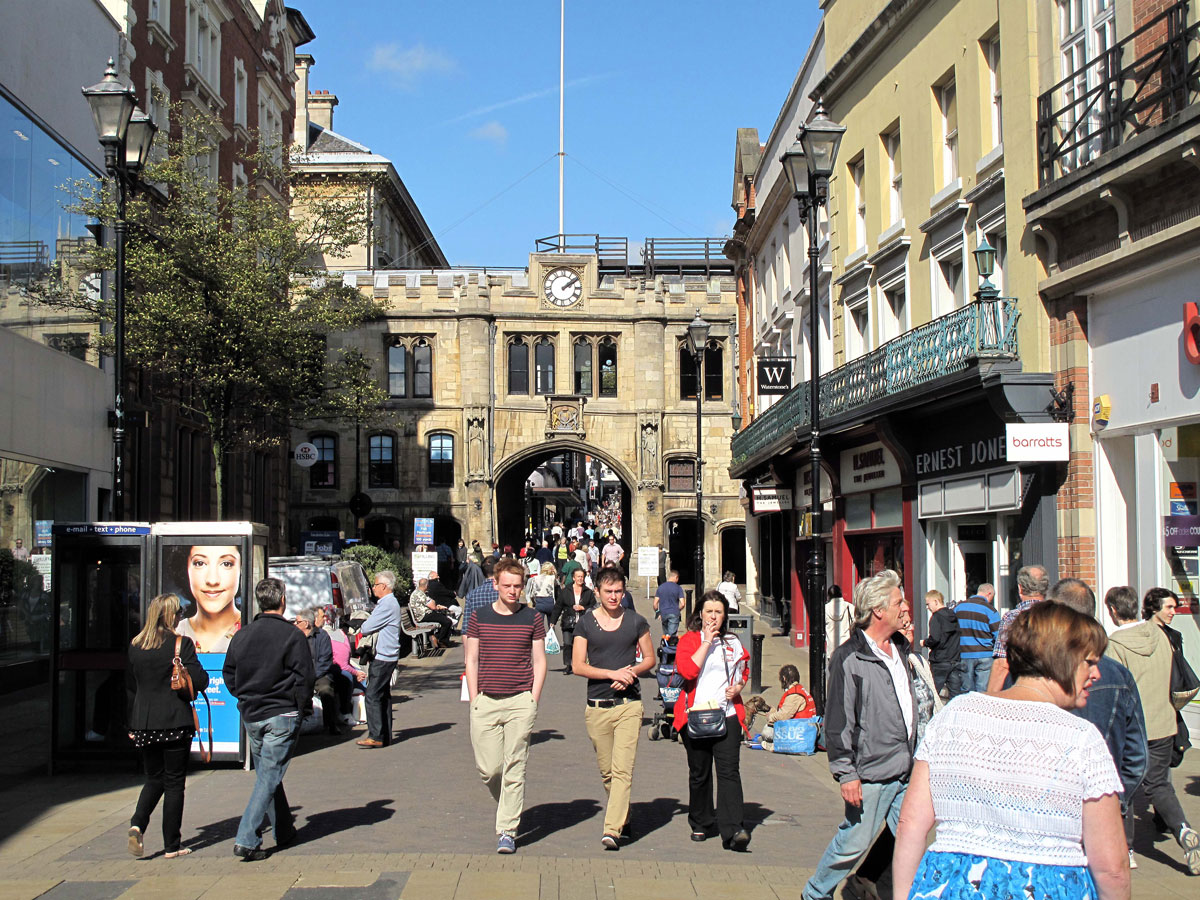
Walking up High Street north of the river immediately brings us to the Stonebow which gets its name from the Danish word ‘Stennibogi’, meaning stone arch. The river used to flow past this point and was the location of the Roman South Gate whose remains now lie beneath it. Linked to the Stonebow is the Guildhall which has been used for administrative purposes ever since the 13th century, although the present structure wasn’t completed until 1520.
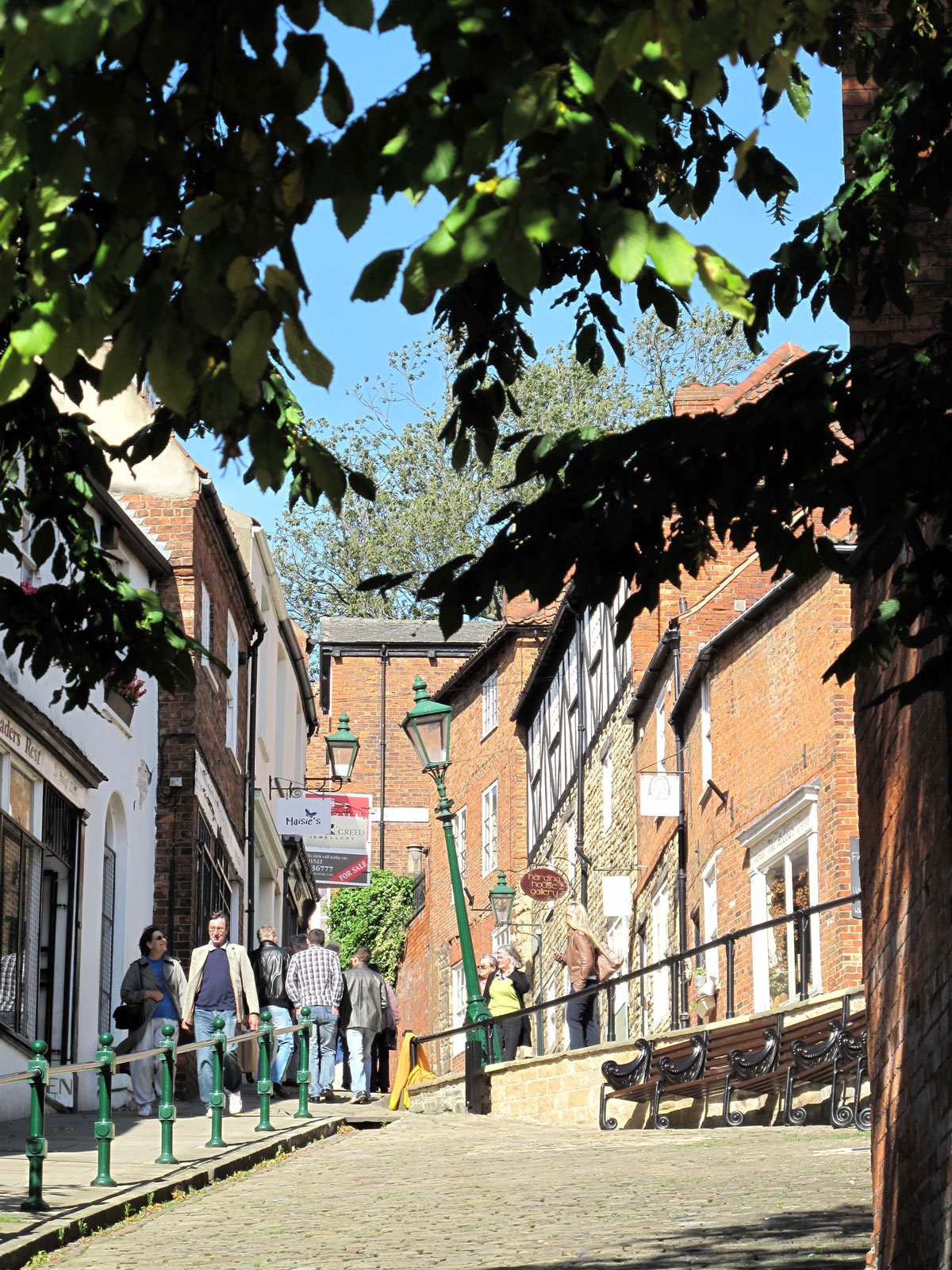
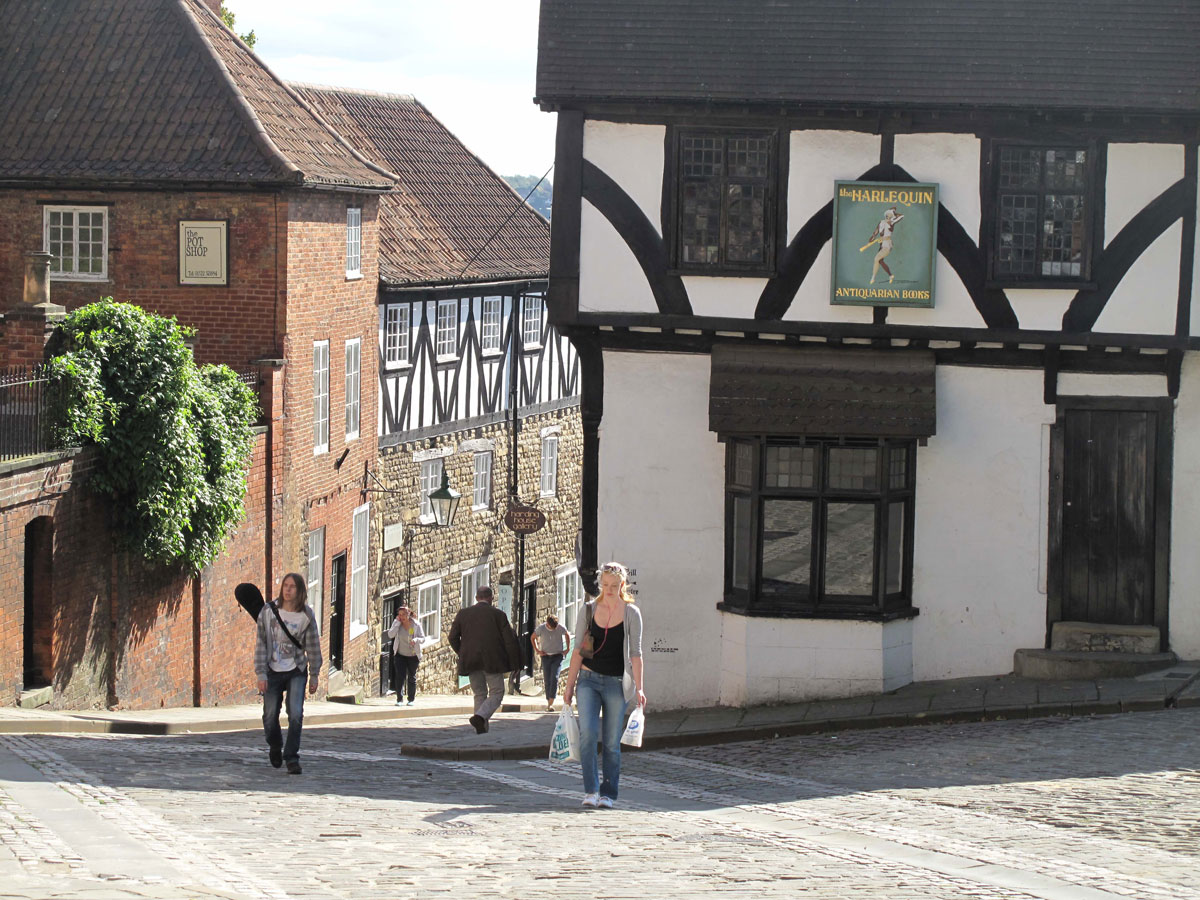
Compared to the western side of the country, Eastern England is comparatively flat, and with this being my first visit to Lincolnshire, I was surprised to find out how hilly the city was. On reflection, perhaps I shouldn’t have been, but nevertheless, Lincoln is unofficially divided into Uphill and Downhill, and connecting the two is Steep Hill, once the centre of a thriving Jewish community, and reached by walking through the Stonebow into what is now known as the Cultural Quarter.
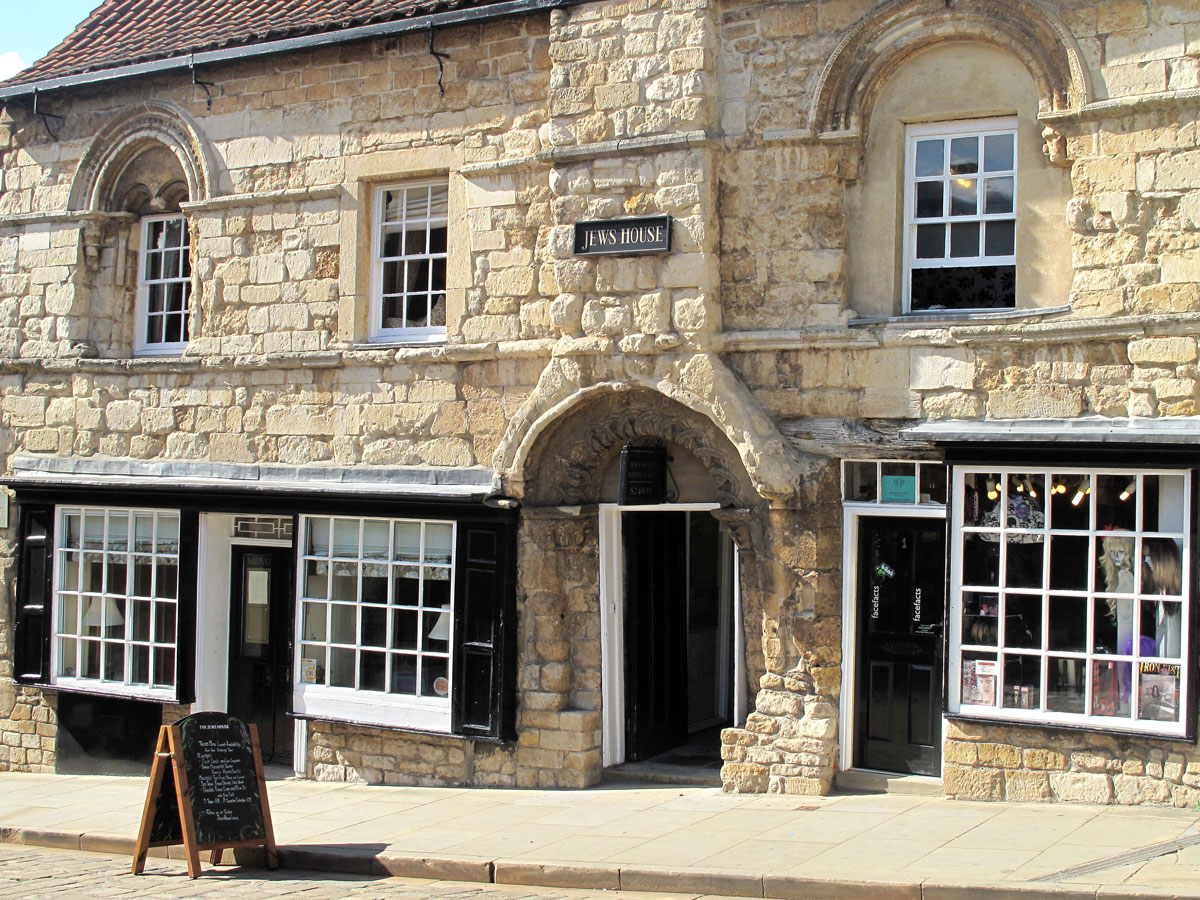
The 11th and 12th centuries were prosperous times for the good people of Lincoln, and especially so for the Jews who made their money by lending it: It has to be remembered that at the time, Christians were forbidden from being involved in the practice of moneylending, but even so, persecution followed, as it did in many places. On the section of Steep Hill known as The Strait is the Jews House: Built around 1150 it is one of the oldest surviving domestic buildings in England.
Steep Hill is a picturesque street that leads up to the most interesting part of the city at Castle Hill, and now that you know how the town grew in importance, I hope you’ll join me in part 2 to see how the Normans extended its influence.
POSTED – OCTOBER 2022
Originally posted 2022-10-22 16:40:53.
Now, this is acity I know very little about so that was really interesting.
There must be a lot of people who haven’t been to Lincoln, but it’s a very likeable place once you leave the traffic behind.
It looks areally nice place.
nice
Thank you for taking a look and commenting 🙂 Is there a way of liking and commenting on your posts too by the way?
I’ve never been to Lincoln, but it sounds like an interesting place with lots of history. Looking forward to part 2.
Thanks Don. I think you would like Lincoln 🙂
Got a bit of time to catch up a bit at last! And what a great post to come back to. I have been to Lincoln, many moons ago, and I remember Steep Hill and see your point about how hilly the town is in an area that is known for it’s flatness. I hadn’t known the earlier history though, which is fascinating. I’ve fancied going back for some time now to visit the castle, with its associations with The Marshal, although i guess that’ll have to wait for a while now.
I love learning how places got their names as there’s always a great story or explanation behind them, and Lincoln is no exception. Great pics of course, and I can’t wait for part 2! 🙂
It’s good to see that you’ve got a bit of time to chill out at last Alli, so presumably you’ve moved out now. As for Lincoln, I don’t need to tell you that it’s well worth a visit, and apart from part 2, there may well be a part 3 – which Stuart might enjoy.
I’ve never been to Lincoln nor thought to go, but you make it sound very interesting – and surprisingly hilly! And yes, I like Empowerment a lot too 🙂
I certainly wasn’t disappointed with my visit to Lincoln Sarah, but it is a bit of an oasis in a desert if you know what I mean.
Such a lot of history and a mix of influences- I suspect Lincoln might be a bit underrated. I’d like to visit, shall add it to the list! An enjoyable read, thank you.
To be honest, Lincolnshire isn’t overrun with ‘must see’ places to visit, but Lincoln is definitely an exception. Thanks for checking it out.
Fabulous this place Lincoln! Loved it Malc, and as expected, next to the brilliant description and information, your beautiful photographs!
You’re far too generous with your comments Francesc, but thank you just the same. I like places like Lincoln too 🙂
Not generous mate, I admire your writing and research skills that always makes me want to go and visit the places you feature and Lincoln in particular caught my eye. Always a pleasure 🙏 have a great Sunday!
Thanks again Francesc. I hope you feel the same after part 2. Enjoy your Sunday too. I’m another year older today so I’ll have a virtual drink with you later 🥂
Well many happy returns of the day! Yes! I will raise a real glass for our virtual drink! Enjoy your day!
👍
A fascinating post! The historical details and the wonderful photos make your post a great treasure.
Thank you, dear Malc!
You’re too kind Luisa, but a big thank you all the same. I can’t wait to find out more about your Egypt trip by the way 🙂
Thank you again!
Have a lovely weekend
You too Luisa 🙂
An interesting post Malc and great photos as usual, I’m looking forward to part 2. I passed through Lincoln very briefly two years ago on my way to Metheringham about ten miles south east of the city centre, I was going to collect my new little dog Snowy 🙂
Thanks Eunice. Lincoln may not be the best place to walk Snowy, but I think you would like it 🙂
You are a great history writer, Malc, and your posts always read as an enlightening experience. The pictures are beyond good, ad without your heroic efforts I would be ignorant of such an important part of the country.
I can hardly wait for the second part! Thank you!
Joanna
I’ve said it before Joanna, and I’ll say it again, your comments are so welcome given the fact that you’ve got such an amazing talent yourself. Thank you so much
I did. You have a knack for this.
You’ve really made my day Pat as I haven’t been feeling quite the ticket of late
Pobrecito…😭
Gracias 🙂
Por nada. 👍
Fascinating history and pictures, Malc. A pleasure to read and looking forward to part two.
Thank you Pat. So glad you enjoyed it,