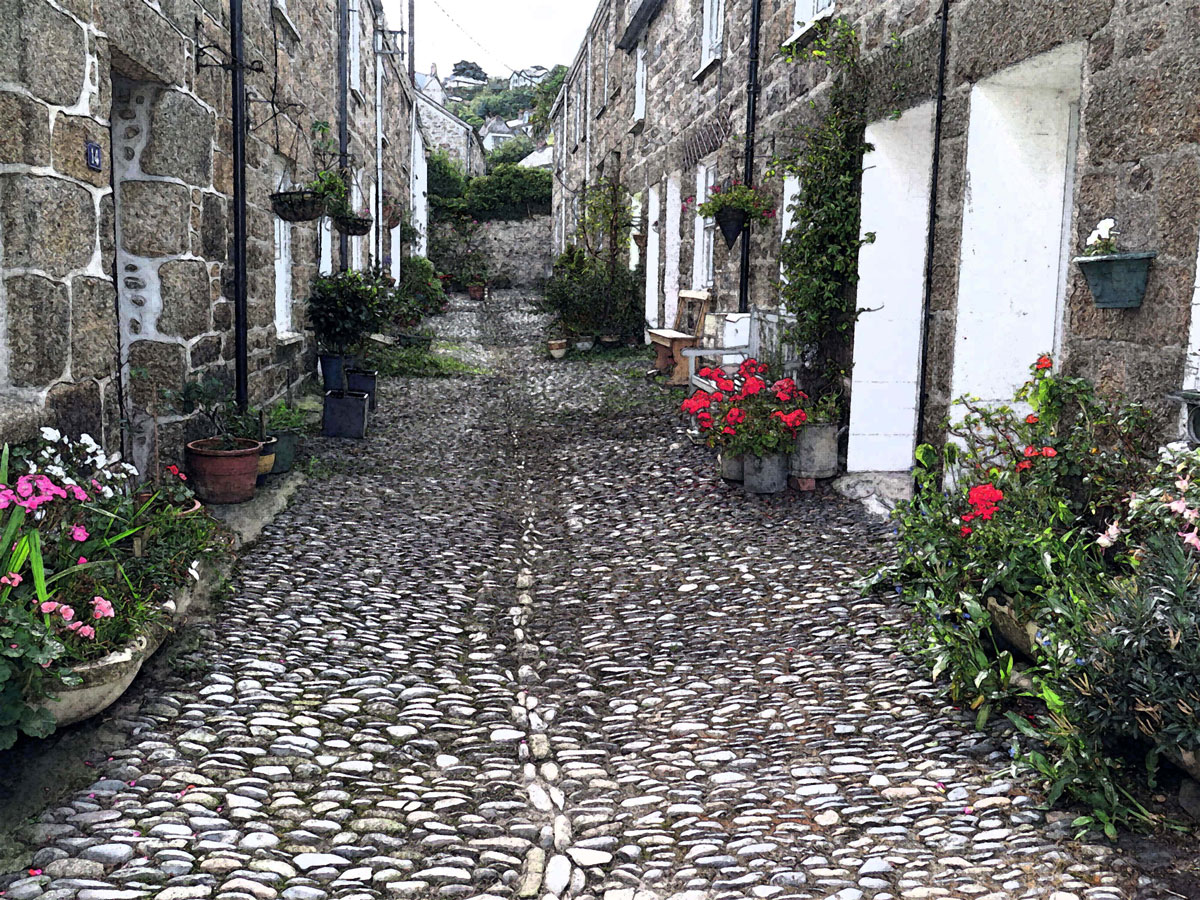
The Newlyn Artists - Pt 1 Walter Langley And The Founding Of The Newlyn School
Cornish fishing harbours are a magnet for tourists, but Newlyn has never really been one of them. While St Ives on the opposite side of the Penwith Peninsula attracts plenty of visitors (some say too many at times), Newlyn may just get a handful drop in on their way from Penzance to Mousehole.
I don’t think it bothers the good people of Newlyn too much though because they’re more interested in trying to earn a living from the main business of fishing, and which is why you’re more likely to find a down to earth pub full of raucous fishermen drinking copious amounts of ‘Proper Job’ rather than a sophisticated wine bar occupied by ‘ladies who lunch’ sipping the odd glass of Chardonnay.
Newlyn may not have attracted as many tourists as St Ives, but it has attracted as many artists (and I’m not talking about the drinking variety now): In actual fact, artists arrived here to paint en plein air quite a while before the St Ives school was established, and if you’re interested in reading more about the art scene in St Ives you can find it in my post Have you Seen the Light?
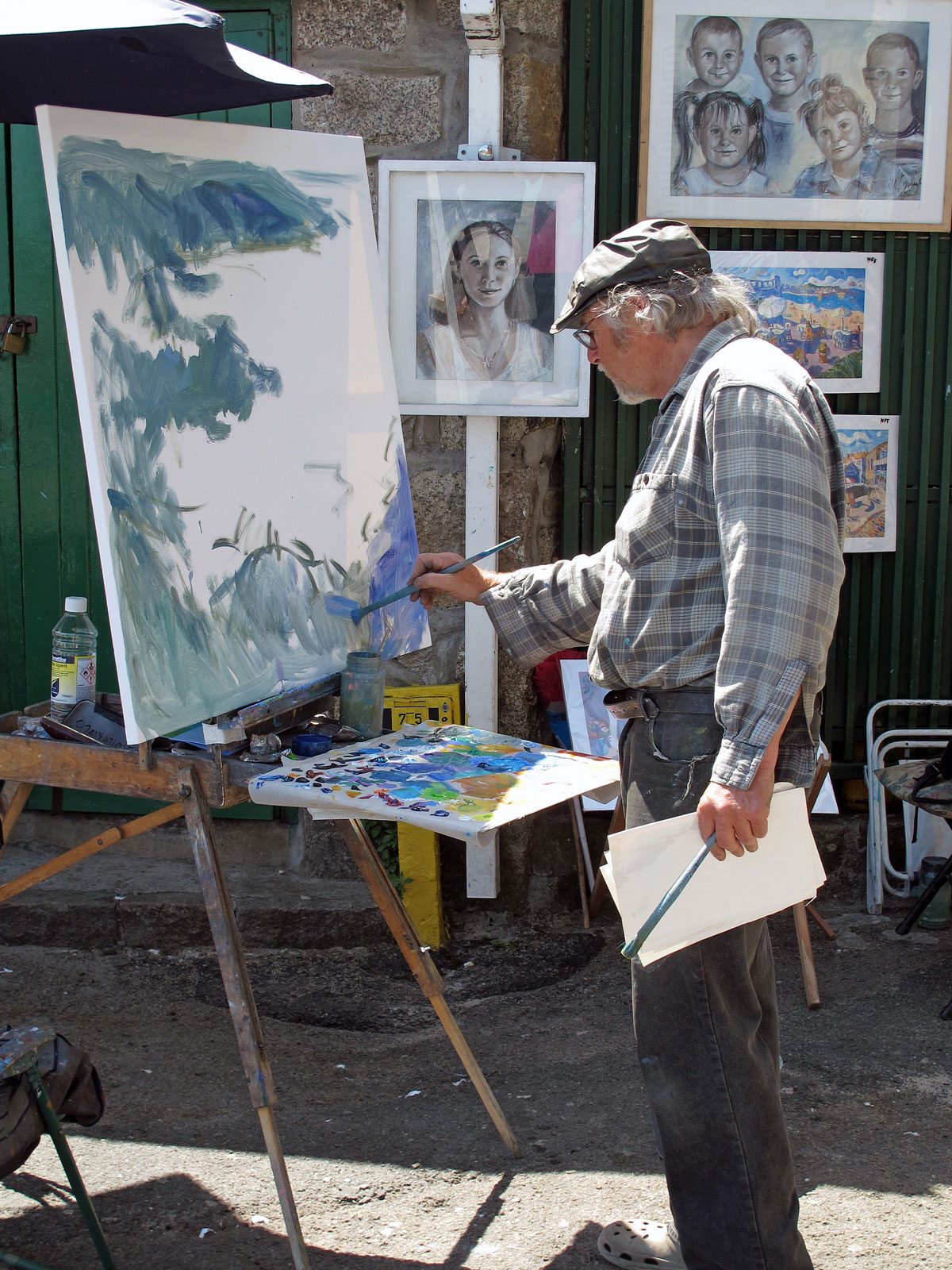
Painting ‘en plein air’ sounds as though it was a French phenomenon during the Impressionist era, and it was, but painting in the open air wasn’t anything new as such; but until people like John Constable came along, painting and sketching outdoors was just a way of preparing a work of art for completing back in the studio.
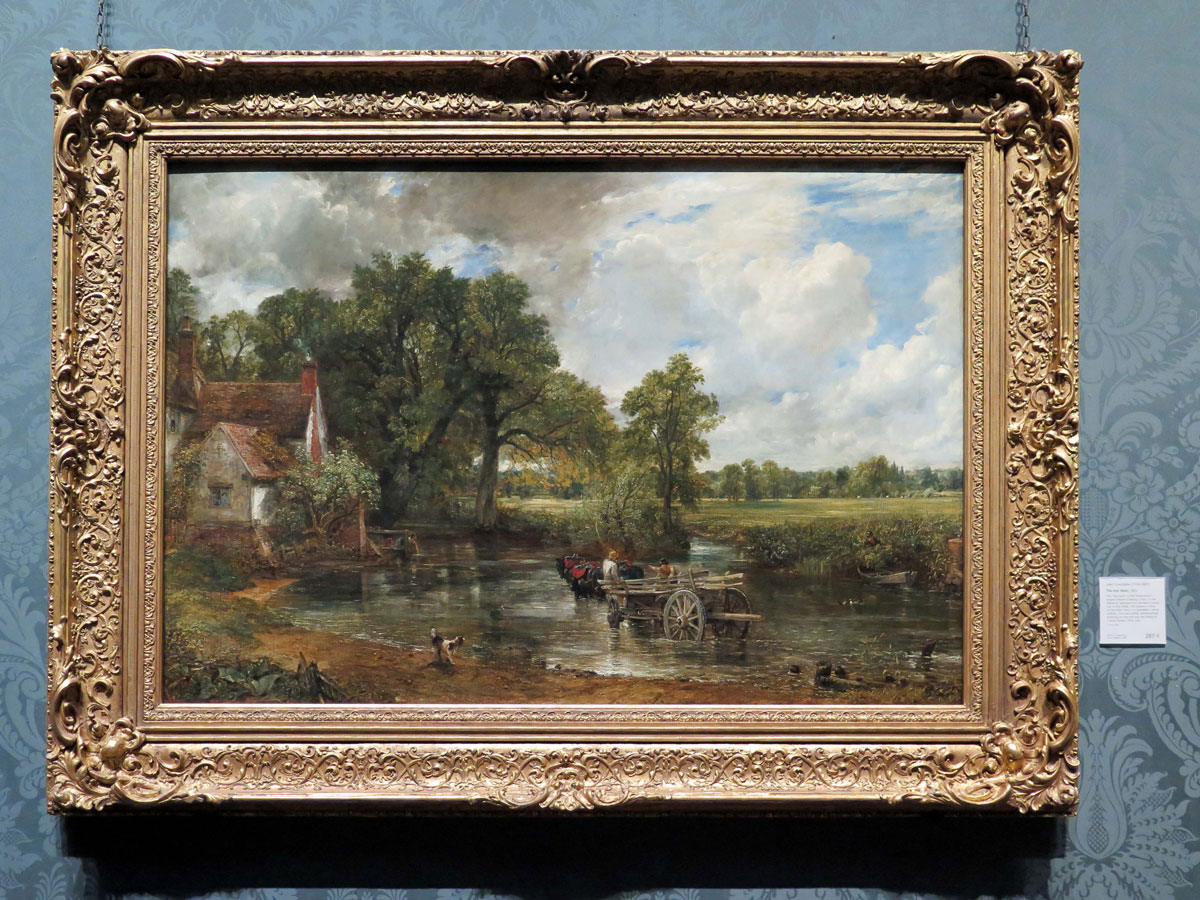
John Constable was a 19th century Romantic English artist who was among the first to paint idyllic country scenes in situ, such as those around his native Suffolk. His paintings of Flatford Mill and other places earned him a good deal of recognition, but unfortunately not a good deal of money.
At the time, it would appear that Constable was more appreciated in France than he was in England: Young Parisienne artists such as Jean-François Millet saw the attraction of Constable’s outdoor rural scenes and decided to follow his example by packing up his easel in Paris and cart it off to the countryside near the Fontainebleau Forest where he was joined by other like-minded artists at Barbizon.
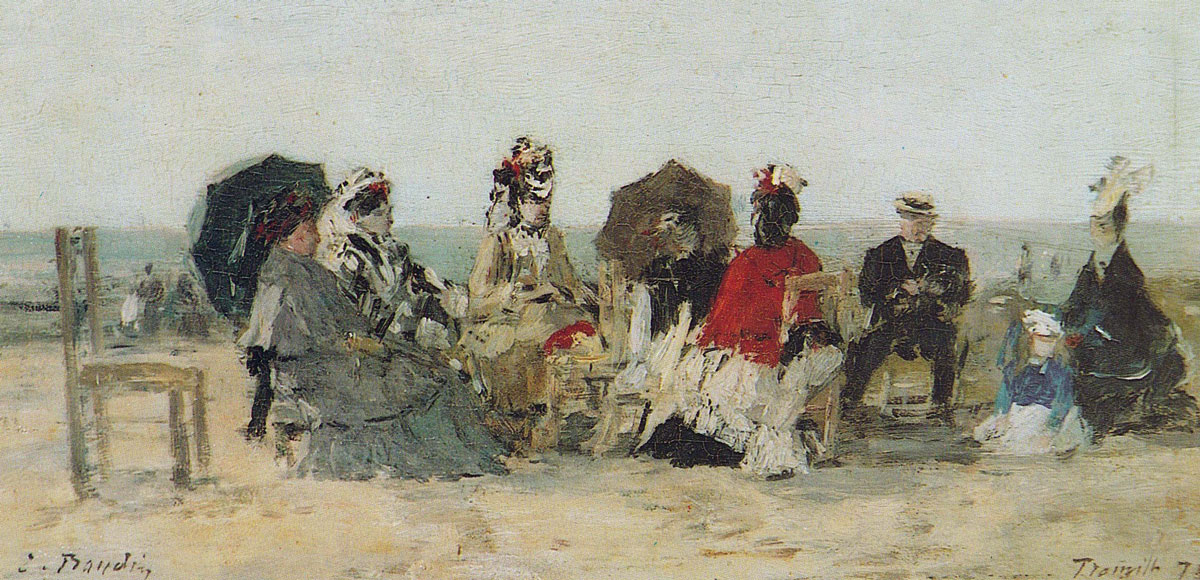
Other Realist and Impressionist artists such as Monet, Renoir and the marine artist Eugène Louis Boudin all found painting en plein air to their liking, and as their style increased in popularity, then so did the number of artists from England who travelled across the channel to join them.
One of those English artists was Walter Langley. Born into an altogether different background in the industrial Midlands in 1852, he was the eighth of eleven children, and although his first job as a lithographer (like me) gave him an appreciation and understanding of art, it wasn’t the lifestyle he was really looking for. His ambition was to follow a life similar to the French impressionists, but to begin with he wasn’t in a position to hot-foot it over the channel, not least because he now had a family to look after, and so in 1880 he and a fellow Brummie took off for a brief sketching holiday down to Newlyn where a few unrecognized artists had already decided to get away from the hum drum of everyday life.
His trip to Newlyn coincided with the sinking of the lugger Jane which sank with six men and a boy on board in full view of their families, and some of you may remember reading about it in my post Newlyn – Pt 1 Pilchards and Piers. It obviously had a profound effect on Langley who soon realised that everyday life was no easier on the Cornish coast than it was in the factories of Birmingham.
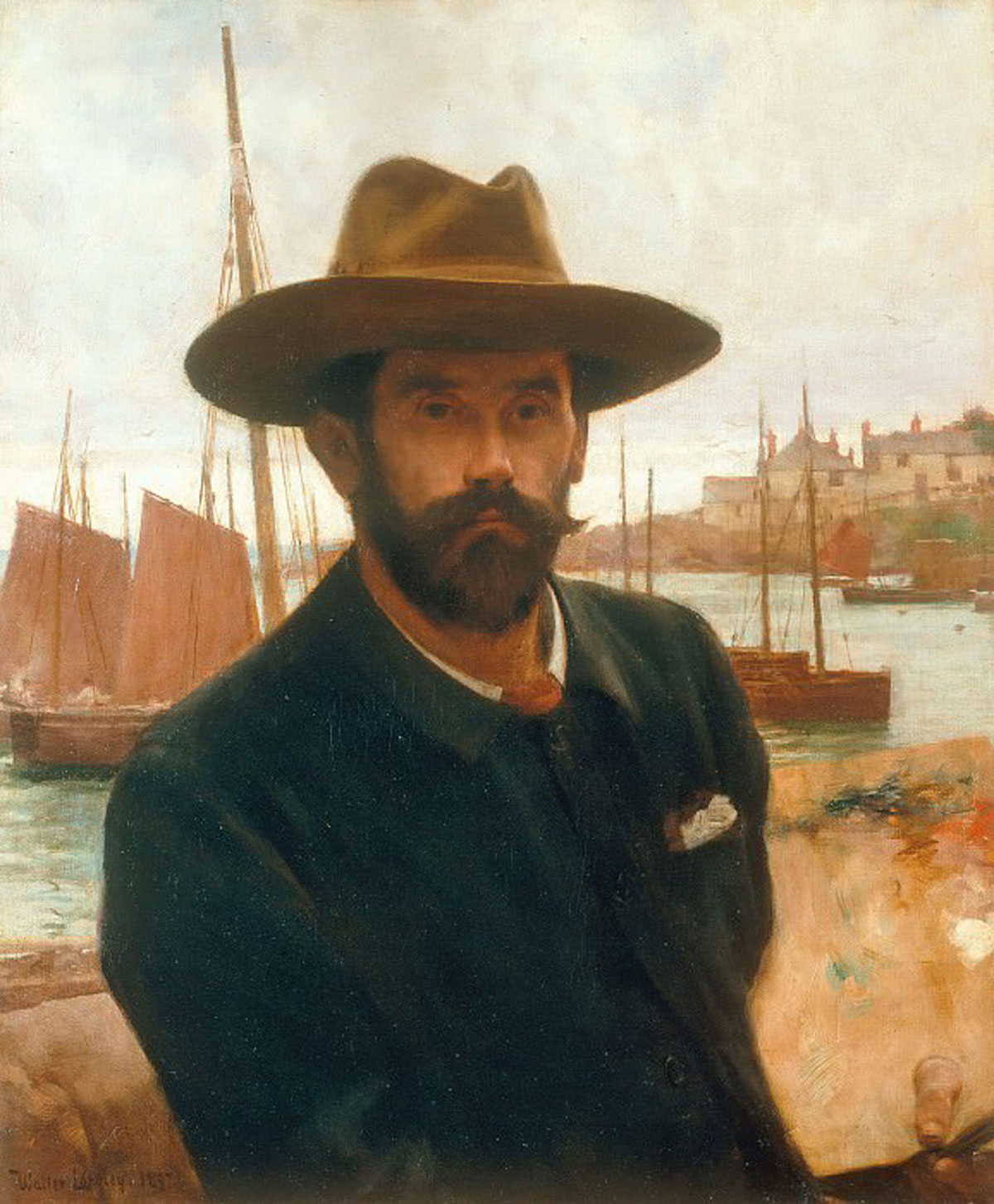
Langley’s experience in Newlyn was enough to encourage him to transport himself and his family over to Brittany, which turned out to be a rewarding experience artistically, but not financially. Fortunately, his work in Newlyn hadn’t gone unnoticed, and in 1882 he received an offer of a commission to produce some paintings of everyday life in and around the fishing port. The offer came from a successful photographer and dealer, JW Thrupp, who also came from a Birmingham working class background himself. The generous renumeration for the proposed commission enabled Walter, his wife Clara, and their four children to rent the handsome Pembroke Lodge on the southern edge of the village.
The Lodge (which is still here) was in stark contrast to his background and the lives of those he would be painting, but he never lost sight of where he came from. Politically he supported the working class, which would have made him like a fish out of water with many of his conservative colleagues, but his artistic ability, and the fact that he set up home in Newlyn, was the reason that he has since been generally recognised as the founder of the Newlyn School.
His early work in Newlyn largely concentrated on painting water colours of hardship in the fishing community, and especially how it affected the womenfolk.

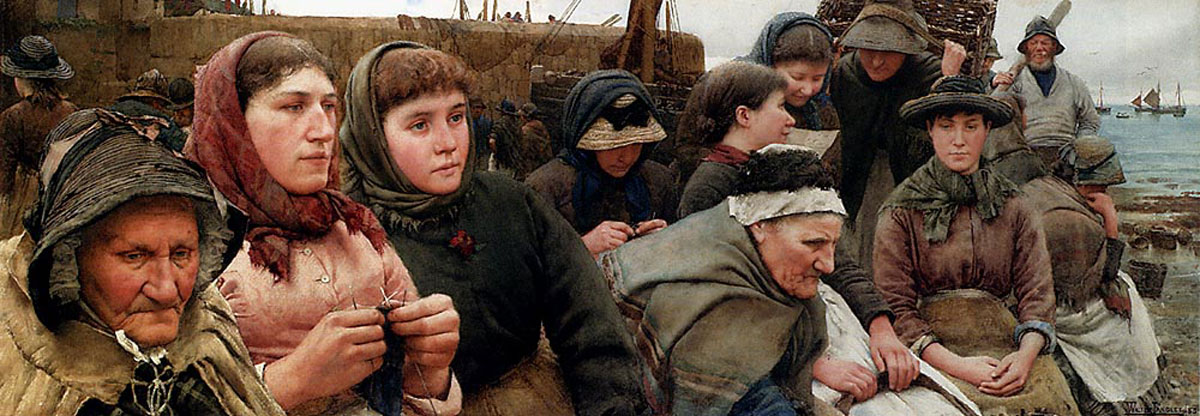
In 1895, his wife Clara died at the age of 45, leaving him to bring up the four children at their cottage in The Fradgan (which is just off the Strand in Newlyn). Working on a large painting at the time, he gutted the building to make one large studio room with a glass front, and although he returned to Birmingham for a while and took a short visit to the Low Countries, he spent most of his life in Cornwall.
His work mellowed somewhat as time wore on and became more associated with the calmer side of Newlyn life.

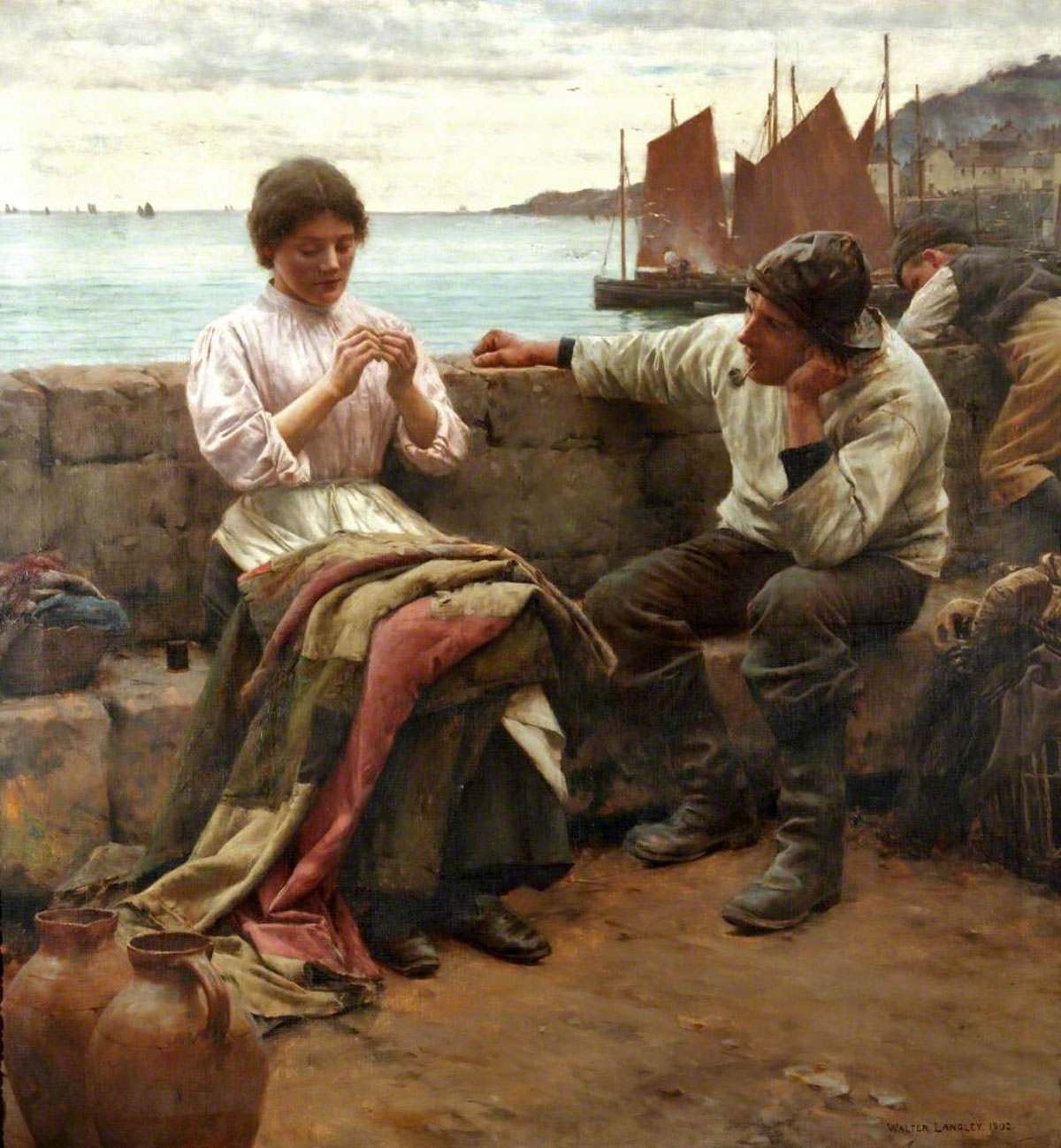
Langley married his second wife, Ethel Pengelly, in St Johns Parish Church Penzance in June 1897, but by now he had been joined by several other accomplished artists. Walter Langley may well have been at the forefront of bringing the fishing village of Newlyn to the artistic world’s attention, but it was only the beginning, and in the next post I’ll be describing how other Newlyn artists captured the essence of West Cornwall in their own inimitable way.
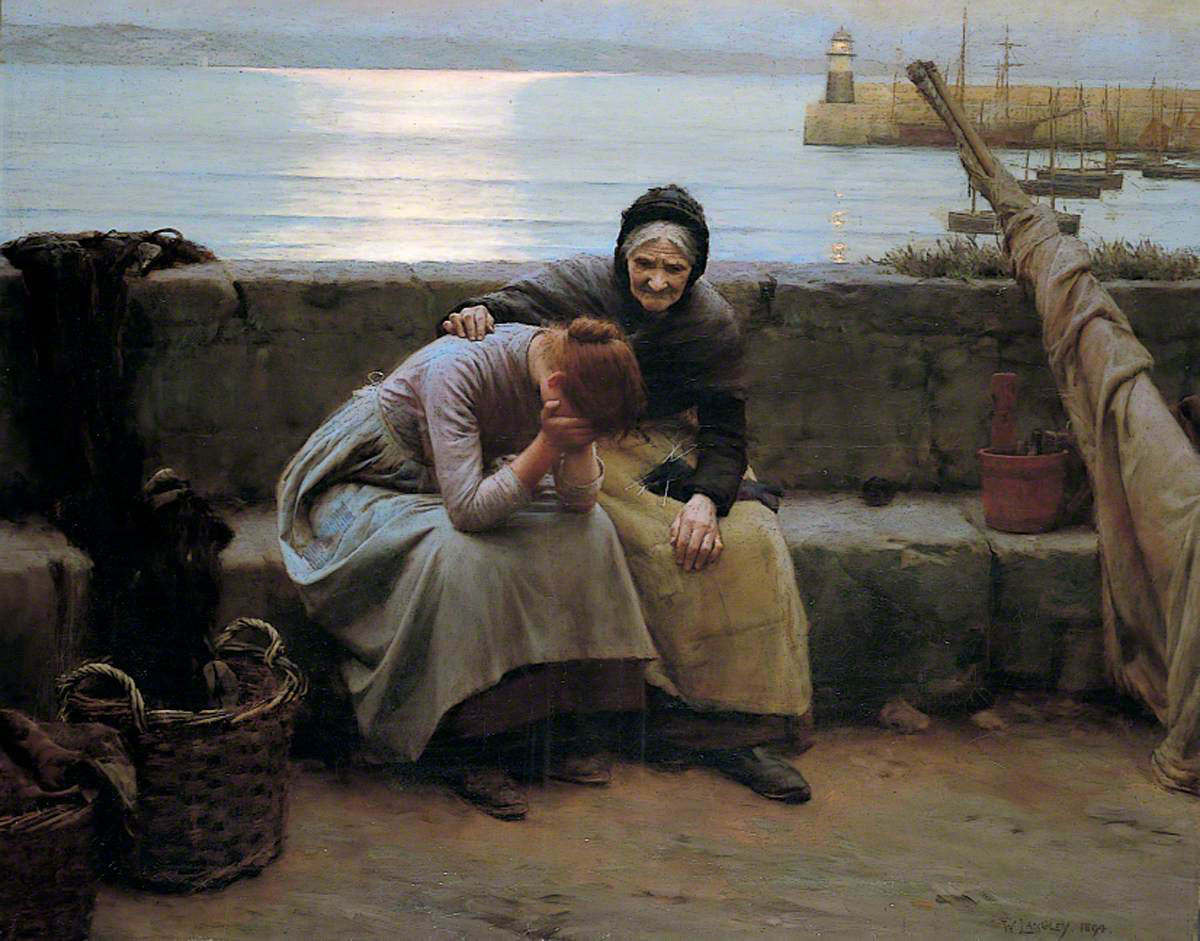
Walter Langley’s later work was no less creative, but to me, the most poignant were those that captured the grief of the fishermen’s wives waiting helplessly for the return of their loved ones, and my favourite has to be the oil painting entitled Never Morning Wore To Evening But Some Heart Did Break (1894). He died in Penzance on 21st March 1922 aged 69.
POSTED – FEBRUARY 2025
Originally posted 2025-02-09 09:37:31.
Another superb read, Malc. 🙂 I knew of the Newlyn artists from an antiques course I did many years ago, but this has filled in a great deal of gaps in my knowledge. Walter Langley was immensely talented, wasn’t he? Thanks for the account of his interesting life and showing us some of his impressive portfolio. They’re all excellent works, and very evocative, but I can see why the last painting, ‘Never morning…’, is your favourite. It’s mesmerising, and so realistic it could be a photograph (I know you’re not supposed to say that about an artists’ work, but it’s meant as a genuine compliment to Walter). It captures the mood and emotion of the scene so perfectly, you can’t help but empathise. Wonderful. 🙂
Thanks Alli. Langley’s work is a great example of ‘Realism’, and for someone like me this style of art means something, unlike some of the work that supposedly passes as art. 🙂
I’m with you on that, Malc. I like a bit of Realism. 🙂
St Ives certainly is full to bursting these days, slightly different to the 80’s when we first visited. Love the last painting
It can be Jim if you go at the wrong time, but I’m fortunate I suppose that I can go out of season without any problem. Even so, the world has changed, and I too miss the good old times. Thanks for commenting.
Oh what an absolute treat. This is the kind of art I have long loved. For me it is a pictorial record. Thank you Malc for this wonderful post.
A pictorial record is a great way of describing it Shey, and I admit I’ve always loved looking at the art of the Newlyn School because West Cornwall has always been a place dear to my heart.
Thanks for the plug on X by the way 🤗
You are very welcome to the plug. Least I can do. It’s wonderful to see all the faces, clothes everything. A whole way of life captured.
🙏😊🙏
A great post which makes fascinating reading Malc. I’d never heard of Walter Langley before this – what have I missed? His paintings look wonderful and that last one is just ‘Wow’ – it really says it all doesn’t it? 😊
Thanks Eunice. I’m glad you enjoyed it. They say a picture paints a thousand words but I think that one paints more than that 😊
What a wonderful post. Langley’s work is almost photorealistic, and an extraordinary window into the time and place.
Thanks Stephen. I couldn’t have put it better myself.
That last painting is so expressive, Malc.
Isn’t it just Jo?
Thank you for this introduction to the work of an artist I’d only vaguely heard of. I can quite understand your choice of favourite but based on this selection I think I like even more the one called ‘Waiting for the Boats’ – the expressions on the women’s faces are so well done.
I certainly couldn’t argue with your choice Sarah. Those faces say it all don’t they?
Interesting info Malc, and good artists…
Cheers Francesc. Enjoy the rest of your Sunday.
Pleasure Malc. You too my friend.
Reading a few times your outstandingly excellent post, Malc, made my Sunday special! I love having paintings on my walls and have many books about the various periods in art. Your review of John Constable, my favourite painter, warmed my heart, especially when you included some of his paintings. I was greatly impressed by your tribute to Walter Langley, his life, and his work. The erudite explanation of what brought painters to Cornwell, and Walter Langley’s influence on Realists and Impressionists is worth knowing about as is the beginning of painting in the open air, and the special light that makes painters get the best results. Seeing those results made me thankful that at least I can write as my drawing efforts are by comparison non-existent. I am looking forward, Malc to your next post!
Joanna
Thank you so much Joanna and I’m so glad that it resonated with you. Like you, I can’t paint or draw to save my life which is why I admire those who can
Fascinating, Malc. I love his paintings of the fishermen’s wives and mothers. Glad my lot has been easier than theirs. Great post. 🎨🖌️🖼️
Thank you for those lovely comments Pat. I’ve always been a lover of Realist paintings which may explain my outlook on life in general, but I also love Romantic artists too, but that doesn’t necessarily make me a romantic – or does it? 🤗
This is so interesting, Malc, and brimming with things greatly important to me that I will read at least a few times before I will comment. All I can say for now, Malc, is that I love this post!
Joanna
I’m pleased to hear it Joanna. Thank you 🙏
Really interesting: I have visited Newlyn briefly but I have never stopped to analyse its artists and their works.🙏❤️🙏
You and many others Luisa, but at least you know where I’m talking about. Thank you once again for your continued support 🙏
Thanks a lot to you for the nice reply!
You are always very kind, dear Malc!
Happy Sunday
You too of course 🤗