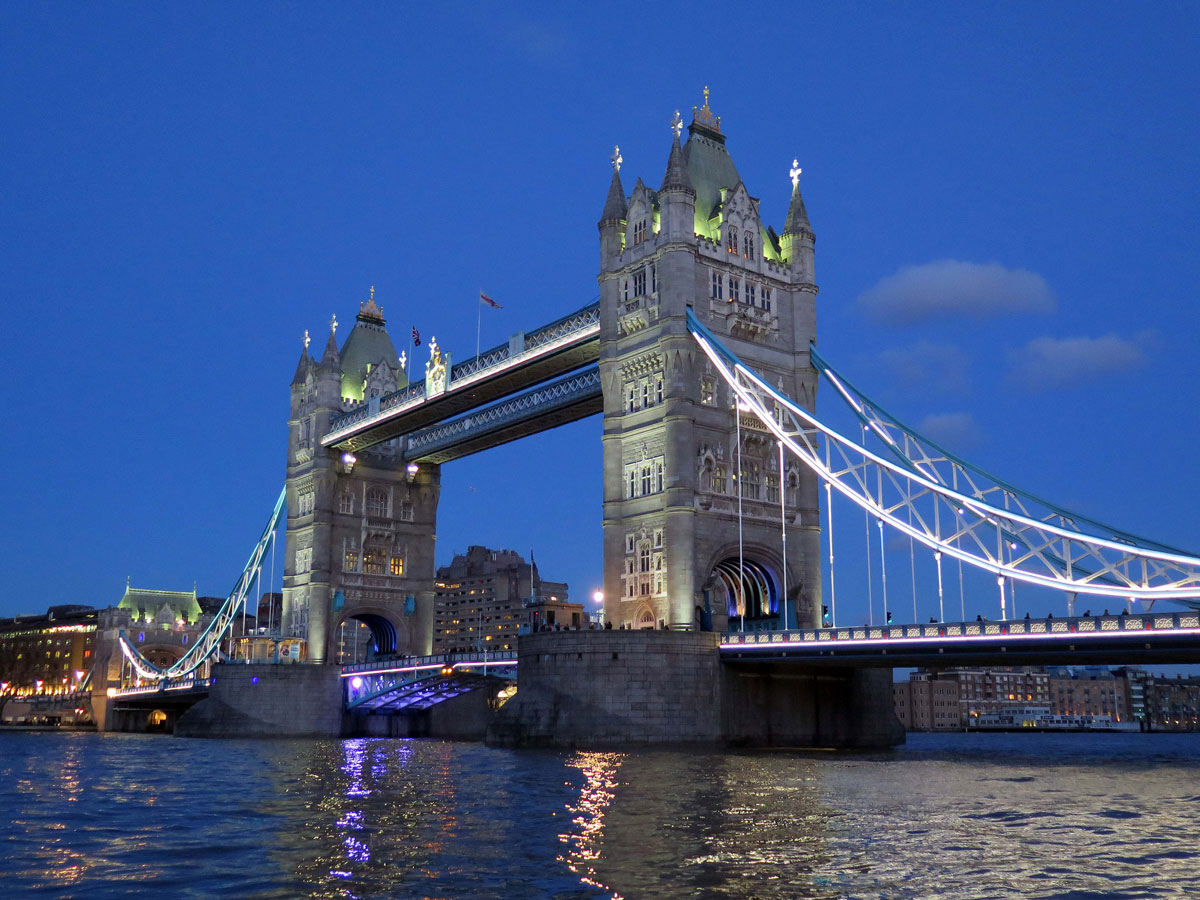
Tower Bridge
Some bridges have a great design and some are just practical, but what captures my imagination about Tower Bridge is its ability to achieve both.
40,000 people a day still use the bridge in one way or another, but ships passing underneath still have priority, and that’s around a thousand times a year: Even President Bill Clinton’s cavalcade on a state visit got split up when they didn’t time it right.
The need for another crossing downstream of London Bridge came about with the growth of London Docks.
The Industrial Revolution and the ever-expanding British Empire helped the burgeoning London Docks become the busiest in the world, and apart from providing access across the river downstream from London Bridge for the first time, the new Tower Bridge was going to have to allow shipping access in and out of the Pool of London.


Sir John Wolfe Barry was appointed engineer and Sir Horace Jones the architect.
Work started in 1886 on building a bascule bridge which would enable the tallest of ships to sail through, and a high-level walkway that pedestrians could use at the same time.
Unfortunately, Horace Jones died during the early stages of construction and was replaced by George D. Stevenson.
Scottish steel was used for the framework, but Stevenson decided to change Horace Jones’s idea of a brick façade into a more flamboyant Gothic design using Cornish granite and Portland stone.
The bridge was officially opened on June 30th 1894 by the Prince of Wales.

The high-level open-air walkways proved popular – but to the wrong type of people – pickpockets and prostitutes, and in 1910 the walkways were closed down and remained so until the Tower Bridge Exhibition opened in 1982.


There is no toll on the bridge for traffic or pedestrians, so is it worth £9.80 (full paying adult – Oct 2018) to see the Tower Bridge Exhibition?
For your money a lift will transport you up the North Tower to the (enclosed) High Level Walkways with their glass floors. There are also two short films about the bridge and an exhibition about some of the world’s other famous bridges.
At the Southwark end there is also the opportunity to see the original engine rooms with their now defunct coal-fired boilers and accumulators that were used to drive the hydraulic system that powered the opening and closing of the bridge until an electro-hydraulic system replaced it in 1974.


For any anoraks, sorry statisticians, out there, you may like to know that 432 construction workers used 31 million bricks, 2 million rivets and 22,000 litres of paint on the 1,000 ft long bridge and 800 ft high towers (213 ft of which is above water to the high-level walkways).
Tower Bridge is another one of those great feats of Victorian engineering and one of the most photographed landmarks in London – but whatever you do, please don’t call it London Bridge.

Originally posted 2018-10-19 16:33:18.
It really is quite something. Especially when you look at that the pic of the ship coming through it. An amazing feat of building and engineering.
A London icon if ever there was one.
Oh yes.
Excellent review and even better photos. I vaguely recall visiting the exhibition – it could have been as far back as 1982. I certainly do not recall a glass walkway. In any event I think a revisit would be worthwhile. Also I need to get there for an opening – are times published anywhere in advance? To date I have only seen the opening from some distance away.
Thanks Albert. Here is a link for the Bridge Lift Times
https://www.towerbridge.org.uk/lift-times/
We once had a mini VT meet (me, DAO, Fergy and Jonathan) timed to coincide with the bridge opening – we watched it, took photos, then went to the pub 😉
I’m going to have a stab at where you went. The Pommeler’s Rest?