
Westminster Abbey - Pt 3 The Nave
Visiting Westminster Abbey to see the grand architecture and explore its history is one thing, but getting a spiritual experience from it is another. If you want the full spiritual experience, there’s no substitute for going to a service whether you’re religious or not, but that’s a different thing to wandering around and taking personal photographs, and as soon as you walk into the Nave you’ll see what I mean.
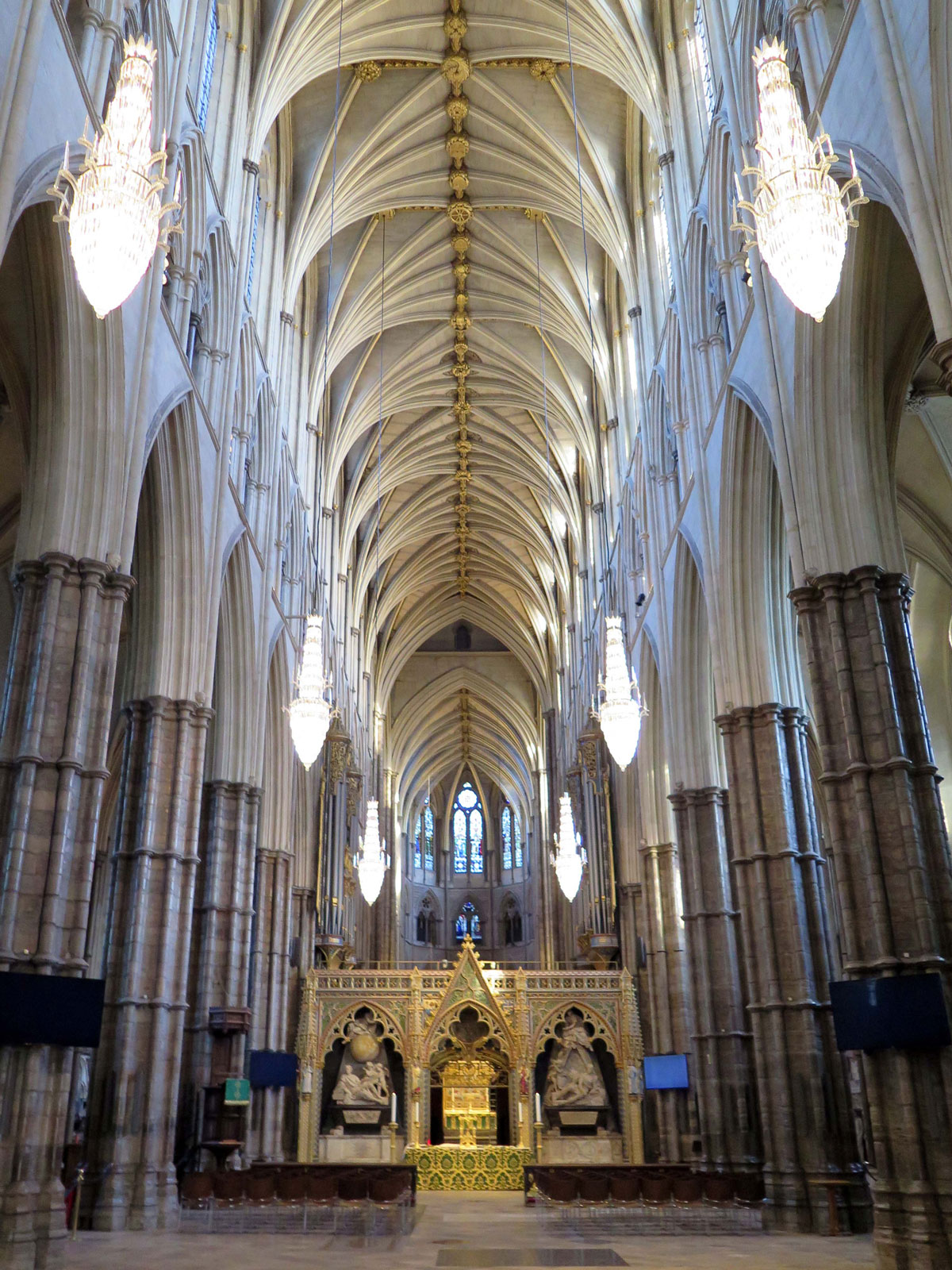
Standing next to the Grave of the Unknown Warrior looking up towards the Quire Screen is one of the abbey’s classic views: Inevitably though, the occasion will be somewhat let down by large numbers of people wanting to do the same thing as you, but as you can see from the featured image above, it is possible to have a much better experience if you know what to do, and you don’t have to be a magician or need special permission to achieve it. The answer is much simpler than that: Just make sure that you’re one of the last people to leave!
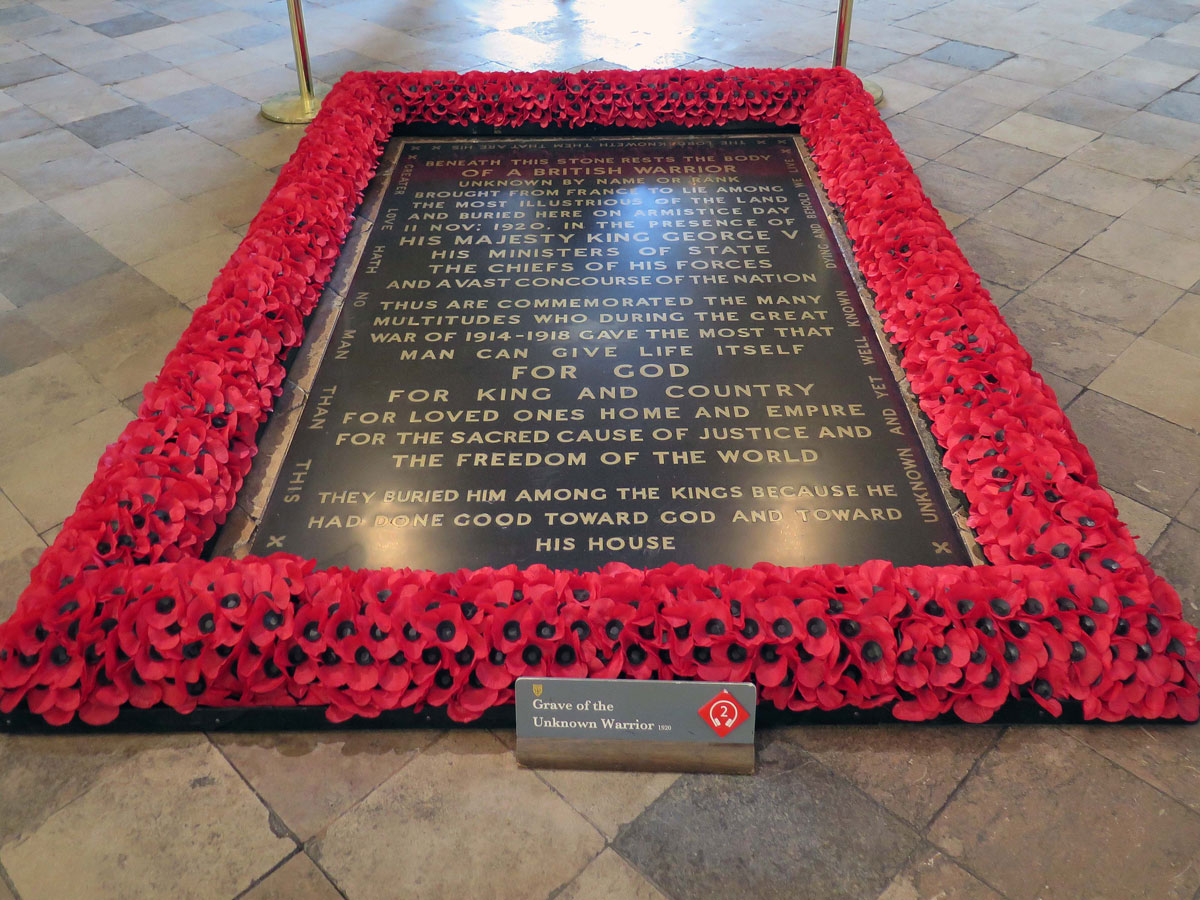
Of all the graves, tombs and memorials in Westminster Abbey, the most poignant of all has to be the Grave of the Unknown Warrior, and I think it’s worth reminding ourselves why. While serving on the Western Front in 1916, an army chaplain by the name of David Railton stumbled upon a makeshift grave with a simple wooden cross that had the words ‘An Unknown British Soldier’ written on it. It was a moment he wouldn’t forget.
Two years after the war ended, the Reverend Railton wrote to the Dean of Westminster suggesting the idea of burying an unknown soldier in the abbey to honour all those unknown British soldiers who died on the battlefields of France and Belgium. Both the Dean and King George V (eventually) agreed, and the process of choosing a body began. Unknown British servicemen were exhumed from four battle areas – the Aisne, the Somme, Arras and Ypres. The bodies were then laid out on stretchers draped in Union Flags, and without knowing from which battle area they came from, it was left to Brigadier General L.J. Wyatt to choose a body at random. The body was then placed in a coffin and sealed.
The coffin was then transported back to Britain on a warship, and on the morning of 11th November 1920 it was transferred onto a gun carriage and taken to Westminster Abbey by way of Whitehall where it paused while the King unveiled the Cenotaph. When it reached the abbey it entered through the North Porch and carried down through the Nave flanked by 100 holders of the Victoria Cross, and was then laid to rest in a grave filled with earth from a French battlefield. Even if you haven’t managed to get an uninterrupted view of the Nave, spend a few minutes reading the words on the gravestone and think about the horrors of what happened just a hundred years ago – and to think that it was supposed to be the ‘War that ends all Wars’.
There are some more graves in the Nave, but not too many until you get nearer to the Quire Screen. You’ll walk over the body of the missionary explorer David Livingstone, but not his heart, because that’s still in Zambia where he died. In actual fact, you’ll probably be looking at the ceiling more than the floor – and who could blame you? The 100 ft high vaulting is in the Gothic style, but if you make your way up to the chairs in front of the Quire Screen and take the weight off your feet for a while, I’ll give you a bit of background information as to how the abbey came to be built and why the nave looks like it does.


It’s difficult to say for certain when the abbey was originally founded as the monks were not against the idea of telling a few porky pies in order to prove that their ‘West Minster’ was older than the ‘East Minster’ at St Paul’s. What is known for certain is that in 960 Dunstan, the Bishop of London, brought twelve Benedictine monks from Glastonbury to found a monastery on Thorney Island. Around a hundred years later, the Saxon king, Edward the Confessor, founded a church of his own on the site of the monastery, and the abbey’s history from then on is well documented.
I’ll be coming back to Edward the Confessor in a future chapter, but as we’re in the nave, I want to explain a bit about its construction.
The 13th century saw King Henry III on the throne (r 1216-1272) and it was his wish to replace Edward’s church with a more ornate Gothic one. Starting at the east end of the church, he got as far as the nave before his number was up, which meant that for the next hundred years, the Gothic east end of the church was left attached to the Norman nave at the west end. When the foundation stone was eventually laid for the replacement nave in 1376, the Gothic style was continued, but it wasn’t until 1517 that it was finally completed.

While I’ve been waffling on, you’ve no doubt been eyeing up the Quire Screen in front of you. If you reckon all that elaborate decoration is Victorian then you would be absolutely right, because even though the core is medieval stonework, what we see was produced by Edward Blore in 1834: The two monuments on either side of the gateway into the Quire however, were erected a century earlier. The one on the left, a monument of Sir Isaac Newton, was unveiled in 1731, and the one on the right is of the politician James Stanley (and his family) which was added in 1733, purely to match up with the famous scientist’s marvellous sculpture opposite. Both sculptures were made by John Michael Rysbrack to a design by William Kent.


Sir Isaac Newton was buried nearby in 1727 and other scientists have followed since, giving this part of the abbey the name of Scientist’s Corner. In between the graves of Isaac Newton and Charles Darwin lie the ashes of Stephen Hawking whose stone features a black hole and mathematical equation. If you’re wondering what the equation means you’re not the only one, and if you’re interested I can tell you “the larger the mass of a black hole, the lower the temperature of the Hawking Radiation”, but we all knew that anyway didn’t we?

In the next chapter we’ll be making our way into the Quire and up towards the Sanctuary and High Altar. I’d like to think that you’re still interested in following me through the abbey because in my opinion, the best is still yet to come.

POSTED – MARCH 2023
Originally posted 2023-03-10 14:52:31.
Of course wht I meant to add in the last comment to you is that..I followed this arrow before going away tomorrow and I enjoyed it too. Now I am sort of in holiday mode,
Hope you both have a lovely time and that you get back safely 🤗
Thank you Malc. Just nice to get a break. AND at least it is warm there.
😎
well..it was sort of warm…
Welcome home Shey. Hope you had a good time.
Thank you Malc. It is a lovely city.
Excellent advice to try to be one of the last people to leave, which could apply to other popular sites too. I really like the marker on Stephen Hawkings’ grave even if I don’t understand the equation. I saw your friend Jo’s comments about her connections to him – wow! I can’t claim anything so grand, unless once sitting next to Eddie Redmayne in a London restaurant counts?!
I’m certainly amongst illustrious company on here. Did he recognise you? 🙂
🤣🤣
Another great read Malc, and I learned more interesting facts. Love the shot at the top of the nave with the unknown warrior’s grave in the foreground. Great advice to wait until everyone else has gone to capture the full view, and the result is so much more atmospheric as a result. That’s exactly what we do when we go to castles etc. We either turn up first thing before the crowds descend, or make sure we’re the last to leave. It’s always worth it for the right shot, isn’t it?
James Stanhope must have been one hell of a politician to be chosen as the subject to balance the monument of Isaac Newton in such a prominent position, although I admit I hadn’t heard of him before. That sounds like a story in itself. And it was good to see the stone of Stephen Hawking. I knew he’d been laid to rest in the abbey, but I hadn’t seen the grave marker. An appropriate and fitting tribute to a brilliant and fascinating man. I thoroughly enjoyed the nave tour, and I’m sure, as you say, the best is yet to come, especially if it involves a look at the tombs of certain medieval monarchs! 🙂
Glad you enjoyed the latest chapter on WA Alli. Trying to get decent photos with so many people around is quite a challenge, but as you say, it’s better to go early or late.
There are so mnay monuments to people like James Stanhope in the abbey, and I did wonder myself who all these people were. Did you see Joanna’s comment about Stephen Hawking by the way? You won’t have to wait long for the next chapter because it will be out either today or tomorrow 🙂
Just looked at Joanna’s comment – wow! That’s some wedding guest to boast about! What a memory to add to an already very special day. 🙂 A truly remarkable man, and I’m glad he’s resting in a place that will reflect that for all time. Looking forward to the next chapter. 🙂
Isn’t it just? Chapter 4 is out now 🙂
Great stuff. Got to go out with Maddie just now, but will catch it tomorrow. Looking forward to it. 🙂
Another very interesting chapter on a world famous monument.
I didn’t know the story of the unknown soldier🙏
Thank you. Not everyone knows the backstory to it, and it’s not quite the whole story.
Thank you again, dear Malc
Have a beautiful weekend
You too Luisa.
I remember seeing the grave of the Unknown Warrior when I was a child but never really knew the story behind it so thank you for telling it here. I love the Quire screen and its two monuments, it’s beautiful 🙂
Thanks for your thanks Eunice. It’s always worth knowing these things, and I agree with you. The Quire Screen is impressive.
Thank you, Malc, Jo who is now lecturing to post-grads students in pure maths at the Oxford University, was attending Prof. Hawking funeral.
Joanna
Your comments are gremlin-free Joanna and I’m absolutely astounded at your revelation
Wonderful summary, Malc. You are popping on all cylinders with this series. Looking forward to reading more.
Thank you Pat. I’m a bit like Forrest Gump’s box of chocolates – you never know what you’re going to get 🙂
I figure nuts are a given….
LOL. Cheeky monkey!
Thank you, Malc, apologies for gremlins!
Joanna
PS. Jo, who is now lecturing in pure maths to post-grads at the Oxford University, was at Prof. Hawking funeral.
My goodness! What can I say? You must be so proud!
Gremlins at work again – it should be “Hawking”! Apologies.
Joanna
Thank you, Malc, for the fascinating continuation about history of Westminster Abbey. I admire your erudite knowledge of history and your attention to details. The photos are so good that looking at them one feels compelled to see the Westminster Abbey again, as is in my case. You are right about spiritual experience, no matter if one is religious or not. The memory of this special place stays with a visitor forever.
Thank you, Malc, for writing such a wonderful post! Looking forward to next one…
Joanna
PS. Professor Stephen Howking was a guest of honor at the wedding of his pupil, Andrew, and my daughter, Jo.
Wow! Have I got that right? Stephen Hawking was a guest of honour at your daughter’s wedding? If so, it was indeed an honour.
I’m no Stephen Hawking that’s for sure, but your comments almost make me feel like it 🙂 Thank you Joanna, and I’m also looking forward to your next post as well.