Derry/Londonderry's West Bank - Pt 2 The Bogside (2) Battle Of The Bogside
WARNING – Some readers may find this article upsetting
My travels have taken me to all sorts of places: Some have been exciting, some a haven of peace and tranquility, and others just fascinating, but then there have been places like Derry – where The Troubles in Northern Ireland began. For those of us who want to try and understand how and why the conflict happened, I’ve embarked on writing several articles to try and make some sense of it all, but please bear in mind that I didn’t write the original script, I’m just recording what happened. I realise that not everyone wants to read topics like this, and so I’ve included a Trigger Warning at the top of the page to warn people about the content before they start reading it.
The Civil Rights marches that I previously discussed, were intended to be peaceful protests by Catholics, not to campaign for a United Ireland, but for equal rights with Protestants, and although Northern Ireland had more protestants than Catholics, in Derry it was the other way round. Both the Duke Street March and the Long March from Belfast ended with violence in the Catholic Bogside, and locals put much of the blame for that onto the Royal Ulster Constabulary (RUC).
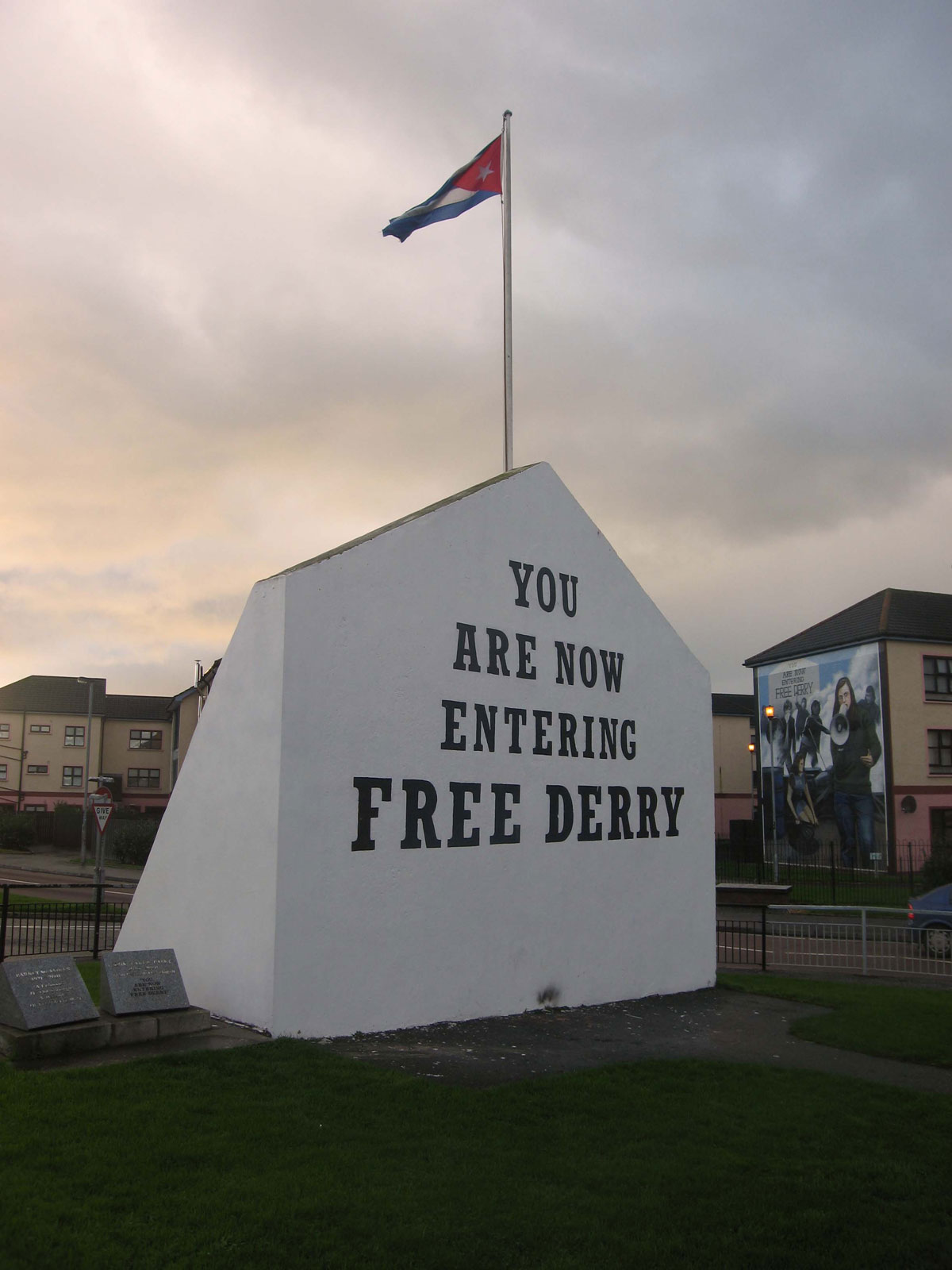
After the way those marches ended up, if Catholics in Derry had any doubts before, they now knew for definite where the allegiances of Northern Ireland’s police force lie – and they weren’t going to put up with being the victims any longer; and so to prevent the RUC from entering the Bogside, barricades started to be erected. On a building at the corner of St Columb’s Street (as it was then, Free Derry Corner now), the words “You are now entering Free Derry” were painted to let the RUC know that if they couldn’t respect peaceful protests, then any future attacks on Bogside Catholics would be met with a similar response.

Tensions remained high after the events at Burntollet, and relations between Bogsiders and the police didn’t improve when an incident occurred on 19th April involving a well-respected local man, Samuel Devenny. Having read several accounts including an official investigation, I’m not in any doubt as to what happened, but I’ll keep it short and to the point.
Another (banned) march from Burntollet to Derry was planned by the North Derry Civil Rights Association (NICRA) for Friday 18th April, but in the end the organizers decided not to go ahead with it. By the time official notice had been received, hundreds of RUC members, expecting trouble, had already arrived in Derry from all over the province, but in place of the march, a sit-in protest was arranged for the square outside the Guildhall.
There’s no conclusive evidence as to how the trouble started, but a confrontation between police and protestors broke out which then spread to the junction of Strand Road and William Street where Sammy Devenny and his family lived. A later official investigation reveals that as the trouble continued up William Street to the junction with Rossville Street, Sammy moved his car to a safer place in Windsor Terrace on the other side of St Eugene’s Cathedral. After returning home, he and a few others watched developments from the relative safety of his front door.
To take control of the situation, the police sent six land rovers down from the top of William Street, forcing Sammy and the others to beat a hasty retreat indoors, but as he tried to shut the door a number of youths also ran in behind him. Some went upstairs, and some escaped through the house and over the back wall. I’ll save you from the graphic details of what happened next, but let’s just say that members of the RUC battered the door down and indiscriminately attacked all those that were inside – and that included Sammy’s wife and children,
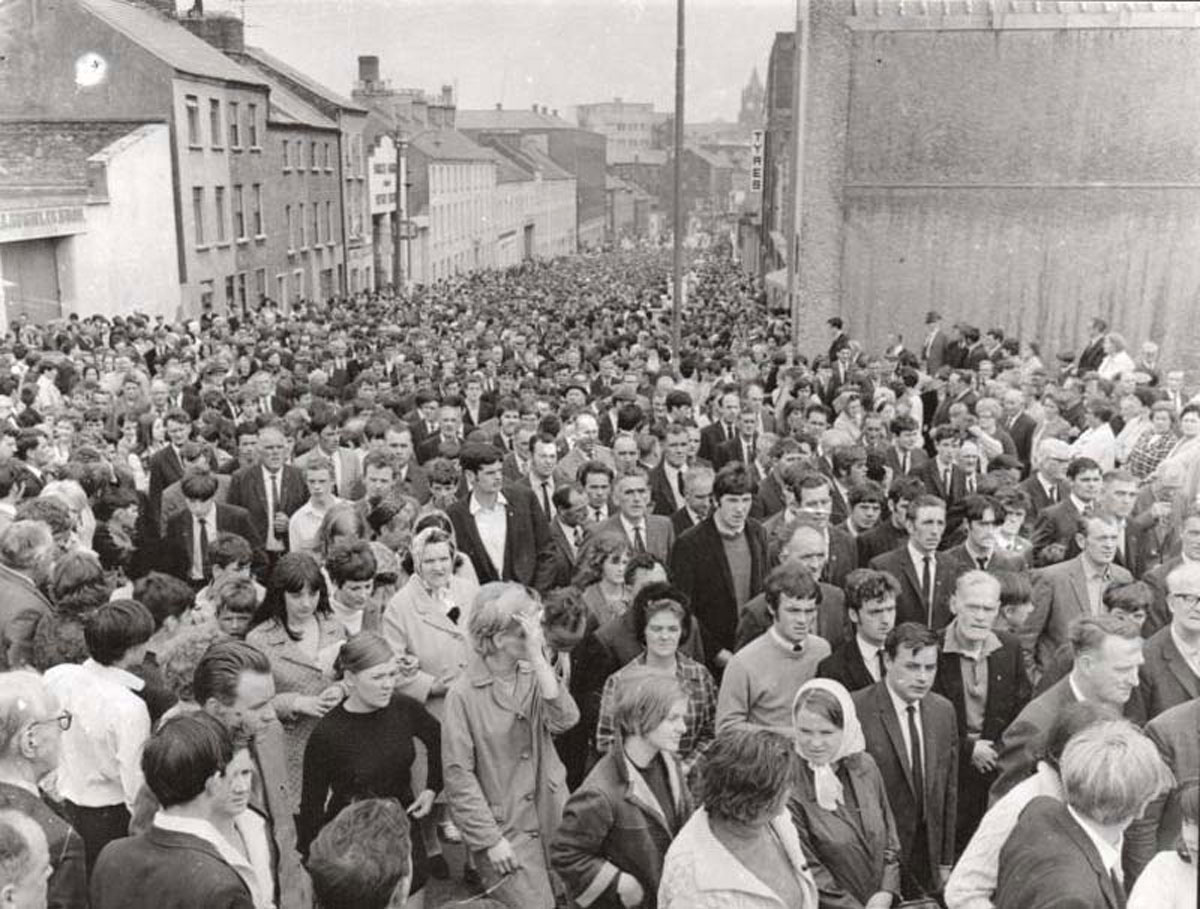
The account of what happened was released to national television the following day by two of Sammy’s daughters who showed reporters their injuries, which were bad enough, but not as bad as their father’s, who died from his injuries three months later. Sammy Devenny is sometimes referred to as the first fatality of the troubles.
Meanwhile, on the political front, things were starting to move, but in two different directions at the same time. The Prime Minister of Northern Ireland, Terence O’Neill, resigned and was replaced by James Chichester Clark, who announced the introduction of ‘one man one vote’ – a key demand by the civil rights movement, but if that was a step in the right direction for the activists, then the introduction of more police and state powers, including internment without trial, wasn’t.
A month after the funeral of Sammy Devenney, the annual Apprentice Boy’s Parade was due to take place on the 12th August. The commemoration of the lifting of the Siege of Derry in 1689 had been a contentious issue with the Catholic community ever since celebrations of the event began, but tensions were now running higher than normal, and if the parade was allowed to go ahead then you wouldn’t need to be ‘Brain of Britain’ to work out that trouble was a distinct possibility.
Requests were made to stop the parade from going ahead, but even though those pleas were turned down, there were still attempts by both sides to diffuse the situation. However, news that Loyalists from outside of the city intended to come and add more ingredients into the already boiling cauldron prompted Bogsiders to take stronger protective measures with the creation of the Derry Citizens Defence Association (DCDA), which in effect became the governing body of the self-declared Free Derry. It wasn’t trouble with the Loyalists that the Bogsiders feared the most though – but the RUC.
As regards the parade itself, the route passed close to the Bogside, but the organizers have since conceded to demands for the parade to be re-routed away from the area. Below is a clip from the parade in 1969 showing protestors and marchers at various locations along the route.
Although trouble had been anticipated, there seems to have been no plan by the participants for any orchestrated violence, but as you would imagine, when the inevitable happened, each side blamed each other. Loyalist marshals insisted that the parade didn’t stop anywhere along the route and Catholic marshals kept people behind barriers, but they struggled to keep control and it wasn’t enough to prevent stones being thrown at the Apprentice Boys as they approached the Bogside. The stone-throwers justified their actions by claiming that the Loyalists taunted them as they marched past, but whether that was true or not, there was no shortage of Loyalist supporters who were happy to return the favour.
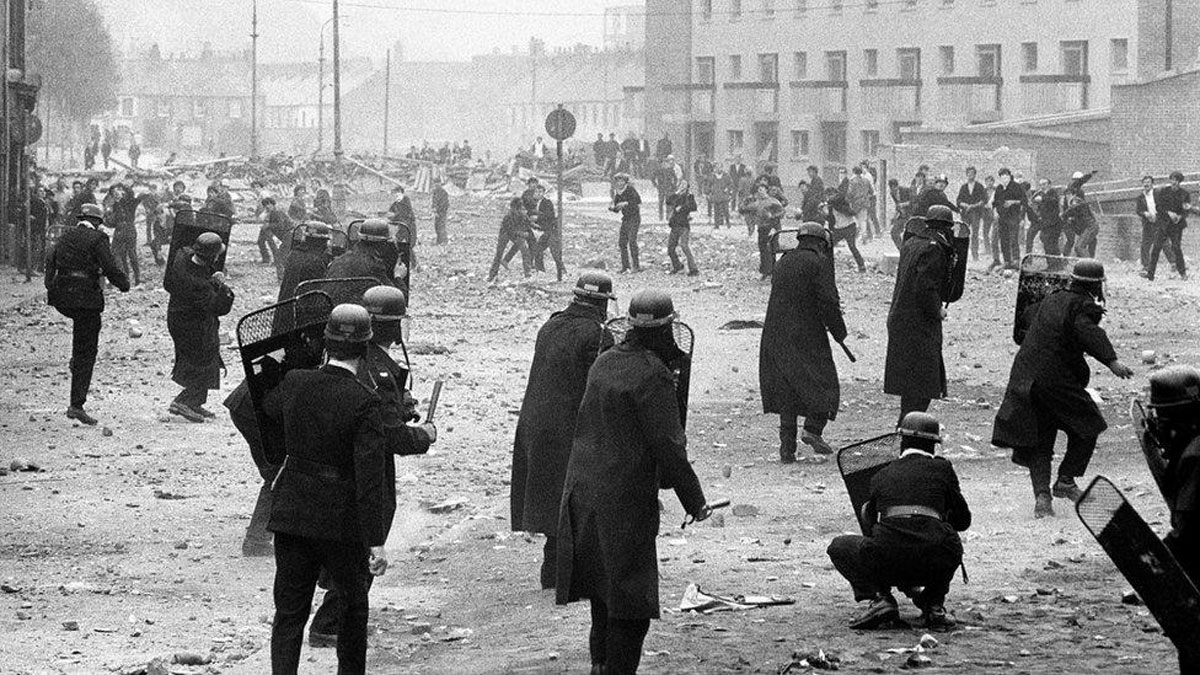
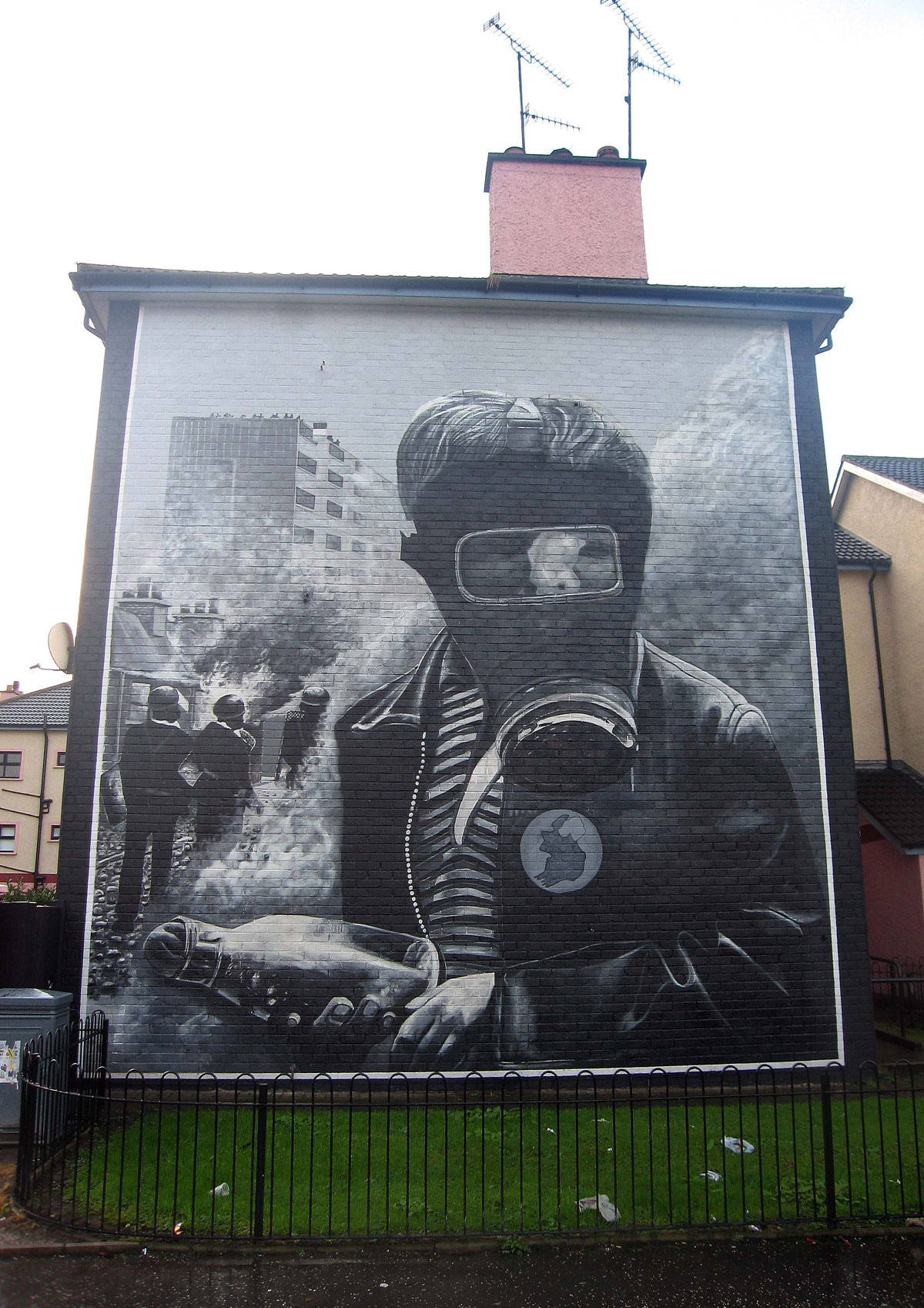
The police were here of course to make sure that the Apprentice Boys were able to complete the march safely from Duke Street to the Diamond, and even our Free Derry guide (who was here at the time) had to admit that the RUC acted with restraint for quite a while before their patience snapped. After about 2 hours of protecting the marchers and being bombarded with stones themselves, the RUC then turned on the protestors and chased them into the Bogside, with Loyalist supporters right behind. The stone-throwers were mainly youngsters, but now Bogsiders felt as though they were being invaded, and people of all ages came out onto the streets to defend their community. The DCDA put their plan into action by organizing a headquarters and erecting barricades. £87 from a civil rights emergency fund was used to buy petrol, and with bottles from the dairy, petrol bombs were made. In response, the RUC used rubber bullets and CS Gas for the first time – and the Battle of the Bogside had begun.
Below is a 6 minute ITN video of how the parade protest ended.
For the next 48 hours police and Bogsiders fought running battles: Children and the elderly were evacuated across the border into County Donegal while petrol bombers occupied the top of Rossville Flats.
The situation could have been made worse if the Irish Taoiseach, Jack Lynch, had carried out his threat to send troops into Derry to protect the Bogside residents, but in the end the Irish army just took medical supplies and assistance to the Northern Ireland border. Regardless, the dreaded Protestant ‘B’ Specials were drafted in to support the RUC and two rioters were shot and wounded in Great James Street, but the reality was that the police were under-equipped, under-manned and over-stretched. In fact, the RUC were so exhausted, that on the afternoon of 14th August, Chichester-Clark had no option but to ask the British Prime Minister, Harold Wilson, for troops to be deployed, and by 5pm a company of the Prince of Wales Own Regiment (who were on standby on HMS Sea Eagle) were patrolling the streets of Derry.
Their mission was purely to restore peace by separating the police from the Bogsiders, but not to attempt to breach the barricades and enter the Bogside. When they arrived, they were warmly welcomed by the locals, and even by the RUC, as they could now get some respite. The only people who weren’t happy were the Loyalists who saw the army as taking sides with the Catholics. Unfortunately for the Bogside inhabitants, their relief at the army’s arrival was to be short-lived.

For anyone interested there is some more footage of the Bogside below.
POSTED – APRIL 2025
Originally posted 2025-04-12 10:59:32.
A balanced and excellent post Malc. Very thorough and fair in terms of getting a handle on the Troubles. Great illustrations–yes I know hat may sound srange but your Free Derry pics say so much about times and changes…some anyway if you get me. Thank you for the attention to detail. It is what makes you one of my fav bloggers. I’m sorry you had to add a disclaimer.
Ah! Thank you Shey, and your comment is what makes you one of my favourite followers too. As you know, my travel exploits encompass all sorts of experiences, and it’s all part of life’s rich tapestry as far as I’m concerned. ☺️
Awwww…now thank you Malc. One of the reasons I love your blog is that you are a backroads traveller, you get beneath the skin of a place and you want to visit places that aren’t on the average traveller’s list. I was speaking to my author pal who went to Vienna and she chose to go to places that if she’d read all the posts on your blog she might have left out on a 3 day trip. So keep up the excellent work. Life’s tapestry sure is rich and not always with rose gardens either.
Roses are beautiful to look at and smell lovely too – but they also come with thorns ⭐
Exactly.
😊🐰
A grim time indeed, Malc. How interesting that the memory of these times is preserved in those excellently produced murals as a permanent reminder, although as we’ve discussed, I doubt anything would stop history repeating itself. My favourite YouTube channel is run by a woman who grew up in Omagh during the Troubles. It deeply affected her and made her despise war in all its forms from then on. In 2004 she left her London home, and her whole life there, when Tony Blair and the US went in against Iraq, and she moved to back to Ireland, to the west near the coast, where she’s devoted herself ever since to planting and nurturing a woodland, which now flourishes and thrives, and she lives in peace with nature. She often quotes what has become one of her life mantras, from the American novelist Maxine Hong Kingston: ‘in a time of destruction, create something’. So it’s true, the scars that these horrendous conflicts leave can change the very course of people’s lives. I just hope that for some of those people involved, something good might have come out of the tragedy.
Thanks for reading and commenting on this one again Alli. The original houses those murals were painted on have since been demolished but the murals were allowed to be re-instated on those that replaced them, and in some cases, the original artists have updated them.
When Tony Blair came into power he gave a lot of people hope (including me) but he was the biggest let down ever, especially where the Iraq war was concerned. I have no time for him now, but he thinks he knows better than everyone else.
I’m in the process of writing the third and final post about the Bogside which won’t make very pleasant reading, but before I finish with Derry altogether, I’m thinking of doing a final one which I hope will offer something a bit more positive.
Collette, the YouTube lady, calls him Tony B-LIAR, which is pretty accurate in my view! She moved to the west of Ireland as she refused to pay taxes to a bellicose, dishonest government. I admire her for voting with her feet, and it’s paid off big time. Of course, as she often acknowledges, the troubles of the world still burden her, but at least she can take solace in her surroundings and know she is doing her bit for the planet we’re ruining.
I’ve got an interesting story (for me anyway) about someone who didn’t want to pay his taxes for something he didn’t believe in. He lived in our cottage (before us I hasten to add) when we decided to escape to a better world, which it was – for a while.
It sounds like a ‘grass is always greener’ scenario, which does happen to many people. I think these days it’s impossible to get away from all the bad stuff in the world, as everywhere has problems now. I suppose it’s about finding your own sanctuary and protecting yourself in whatever way works for you. Of course, the idea doesn’t always match up to reality. At least Collette has done as well as anyone can hope to, and I have to say I envy her (and hugely respect her for what she’s done).
I always believed in following the dream whenever I could Alli and although there were bound to be a few bumps in the road along the way, it’s been a good journey – but I’m bound to run out of petrol at some point. I’m not an envious person to be honest, as I’ve always been satisfied with what I have had, not what I haven’t.
Reading posts like these probably won’t help your current state of mind, so please don’t feel compelled to read them. Just don’t ‘like’ or comment on them. I’ll understand where you’re coming from. Even I’ve cut down on my doomscrolling 😊
Thanks for your understanding, Malc. It means a lot. Thanks also for your email, which I got after we got back from Yorkshire later on Saturday evening (we got waylaid at the Wensleydale Creamery, a fab place which Nathan loved – lots of references to and representations of Wallace and Gromit!). I will respond next week, it’s just been a very busy week since we got back and I’m also trying desperately to put a post together myself, long overdue as that is. Must try harder. In the meantime, have a lovely Easter weekend and I hope the sun shines on your lovely corner of the world. 🙂
That was a long way round to get home from York! Anyway let’s hope the sun shines for everyone this weekend. People always feel better when the sun’s shining, and I’m already looking forward to your next post and email.🌞
This is a very balanced and clearly well-researched account of events I half remember. I grew up almost (sadly) taking it for granted that there was significant trouble in Northern Ireland. It dominated the news and of course eventually spread to the mainland where I saw the impact first-hand after a bomb exploded in Ealing. I’m sorry in a way that you feel a trigger warning is needed. These are real events and we can’t pretend they didn’t happen. It’s very clear from your opening what the post will contain so anyone not keen to read it can stop at that point.
Thank you so much for your smashing comment Sarah. It really is appreciated. I do my utmost to give a truthful and unbiased report so it really shouldn’t be controversial, but I can’t be held responsible for the truth, whichever side of the fence it falls.
Those old photos/footage is so powerful. Thanks for sharing, Mel
Thanks Mel. As they say, ‘a picture is worth a thousand words’.
I haven’t watched the videos, Malc. The descriptions are enough. It’s a relief to know that there is an end to all this, after so many wasted years.
Nobody could possibly disagree with those sentiments Jo. Thank you for reading and commenting. I don’t know, but I’m guessing that these events might resonate with you personally.
Very interesting and historical and part of the struggle for liberation. Have a fab weekend Malc!
Thanks Francesc. You too of course!
All the best Malc!
Thanks for sharing this further historical post. It reminded me of my landlord in Dublin, Bob, who often told me about all these tragic events
There were far too many I’m afraid to say Luisa.
I’m sadly aware of that, dear Malc!