Devonport - Pt 2 The Expansion of Plymouth Dock
Little did I know when I embarked on this series about Devonport Dockyard last month, that HMS Richmond, a frigate based at the yard, would soon be on its way to the Middle East in support of two other British warships (and the US Navy) that have become embroiled in military action in the Red Sea.
Yemeni Houthis have been attacking cargo ships in retaliation for Israel’s war in the Gaza Strip, and where this will lead to is anybody’s guess, but it goes to show that Devonport still has an important role to play in Britain’s defence.
For now though, I want to go back in time and continue where I left off in Part 1. If you remember, the first dock was completed in 1698, and by 1711 Plymouth Dock (as it became known) was employing some 736 men, many of whom were starting to settle in the area, but this was just the beginning, and the 18th century was to see a major expansion of both the dockyard and the number of people it employed.
To begin with, a double lock was constructed north of the basin, and slipways were added either side of the dry docks for shipbuilding, and around about the same time an area to the east was partially reclaimed to create a mast pond and ground for timber storage.
Warships also needed munitions, and the responsibility for this lay, not with the Royal Navy, but with the Board of Ordnance, a separate government department that was created during the reign of Henry VIII at the Tower of London.
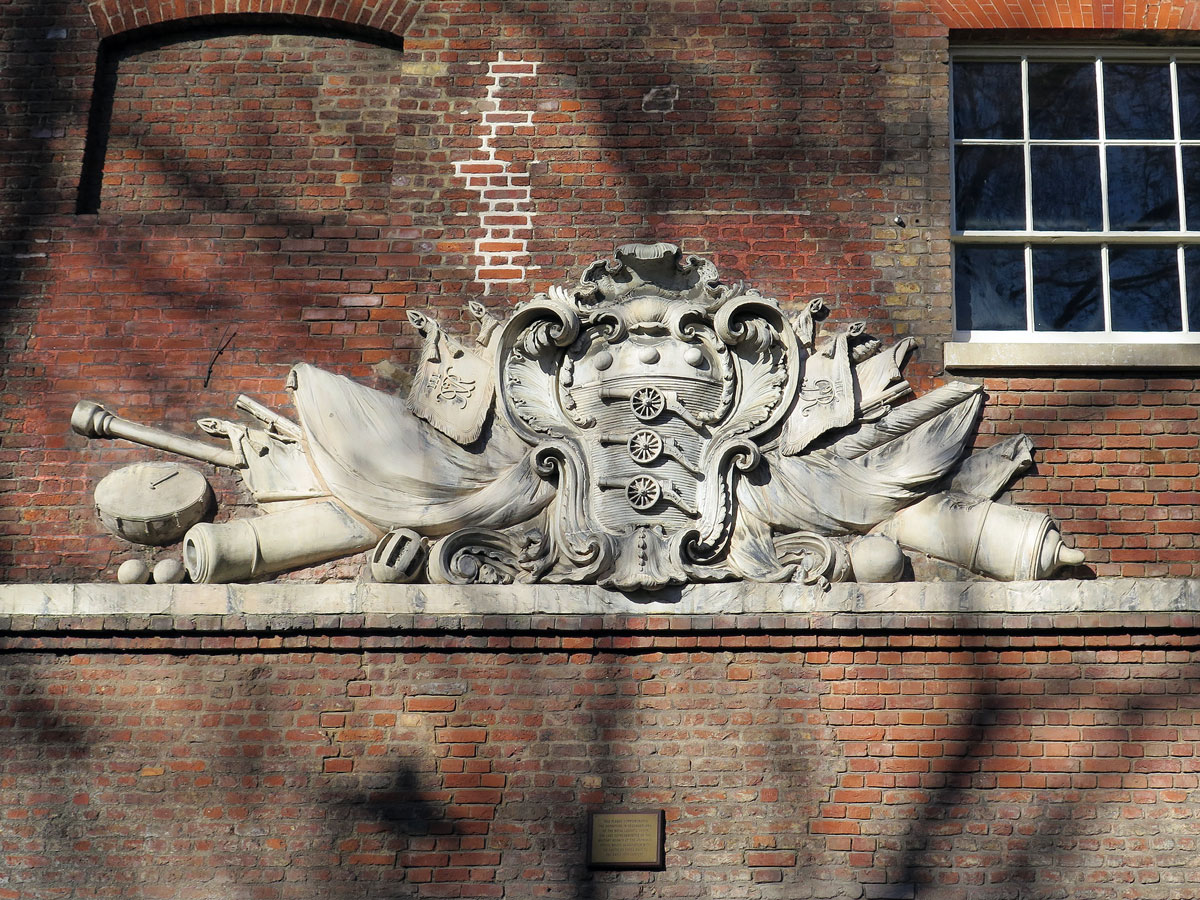
The munitions for Plymouth Dock were kept at Mount Wise, an area to the south-east just outside the dock area, but as the size of the dock increased, the gun wharf and storage facilities were rapidly becoming inadequate.

To rectify the situation, land to the north of the dockyard, was leased from the MP, Sir Nicholas Morice, and by 1730 the new Gun wharf at Morice Yard had helped expand the total workforce at Plymouth Dock to 2,464 – and the local population to around 3,000.
The engraving by Thomas Milton below shows how the yard looked in 1756. The original dock with the new double lock and slipways is in the centre of the pic, the timber ground and mast pond is on the right, and the Morice Gun Wharf is on the left, separated from the dock by workers’ houses.

In 1756 war broke out that involved so many countries that Sir Winston Churchill regarded it as the “first world war”. It has since become known as the Seven Years War, and was fought on three continents – Europe, the Americas and Asia. The main reason behind it was the adverse reaction by some participants in the treaty that ended the War of the Austrian Succession, but to keep it within the context of this post, it meant that Britain and France were at war with each other again.
Up until this point, Plymouth Dock was seen as being in a safe location, and that may well have been the case where an attack from the sea was concerned, but it was suddenly realised that the French could land elsewhere along the coast and attack from the landward side. The same thing could happen at Portsmouth of course, and so in 1758 the Plymouth and Portsmouth Fortifications Act was passed. At Plymouth it resulted in the construction of a Bastion fortification known as the Plymouth Lines.
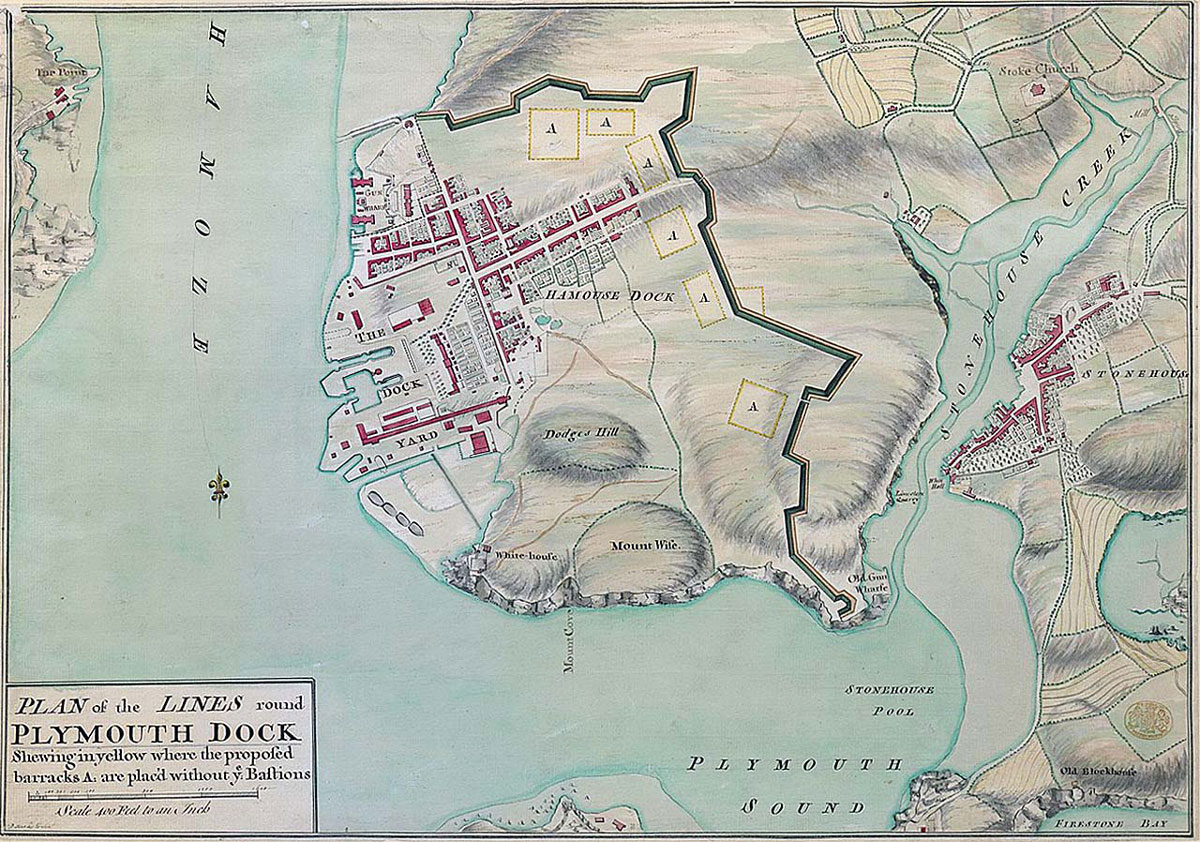
The 1760s saw the largest expansion of the dock so far, but before work could start on the ‘Great Rebuilding’, as it was called, a rocky hillside to the south needed to be cut away. The resulting rubble was then used to help reclaim the nearby mudflats in preparation for the proposed new buildings, slipways and docks.
In order to improve the layout of the site, the original ropehouse was demolished and replaced with a short canal and basin, while a new rope-making complex was built along the east perimeter wall. Another building that was replaced was the Great Storehouse, this time with a double-quadrangular storehouse, which also incorporated a new rigging house and sail loft. A new Smithery was also added which now had 48 forges.
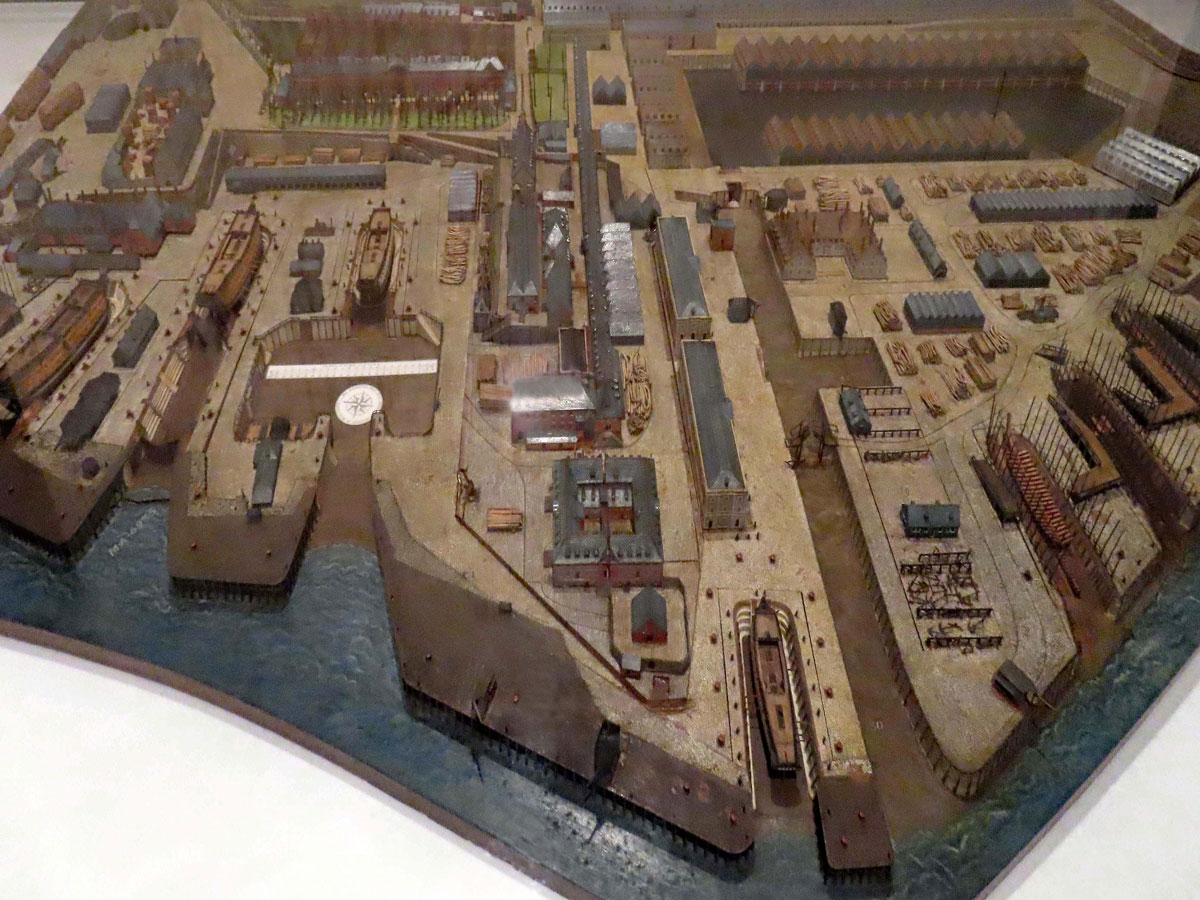
The main business of the dockyard in the 18th century was equipping, maintaining and repairing the fleet. This work was carried out in the dry docks and basin, and to supplement the two existing docks, a pair of slipways were replaced by two new docks. Slipways were still needed though and more were built on the new ground to the south: By 1790 the dockyard consisted of 4 dry docks, 1 basin and 5 slipways.
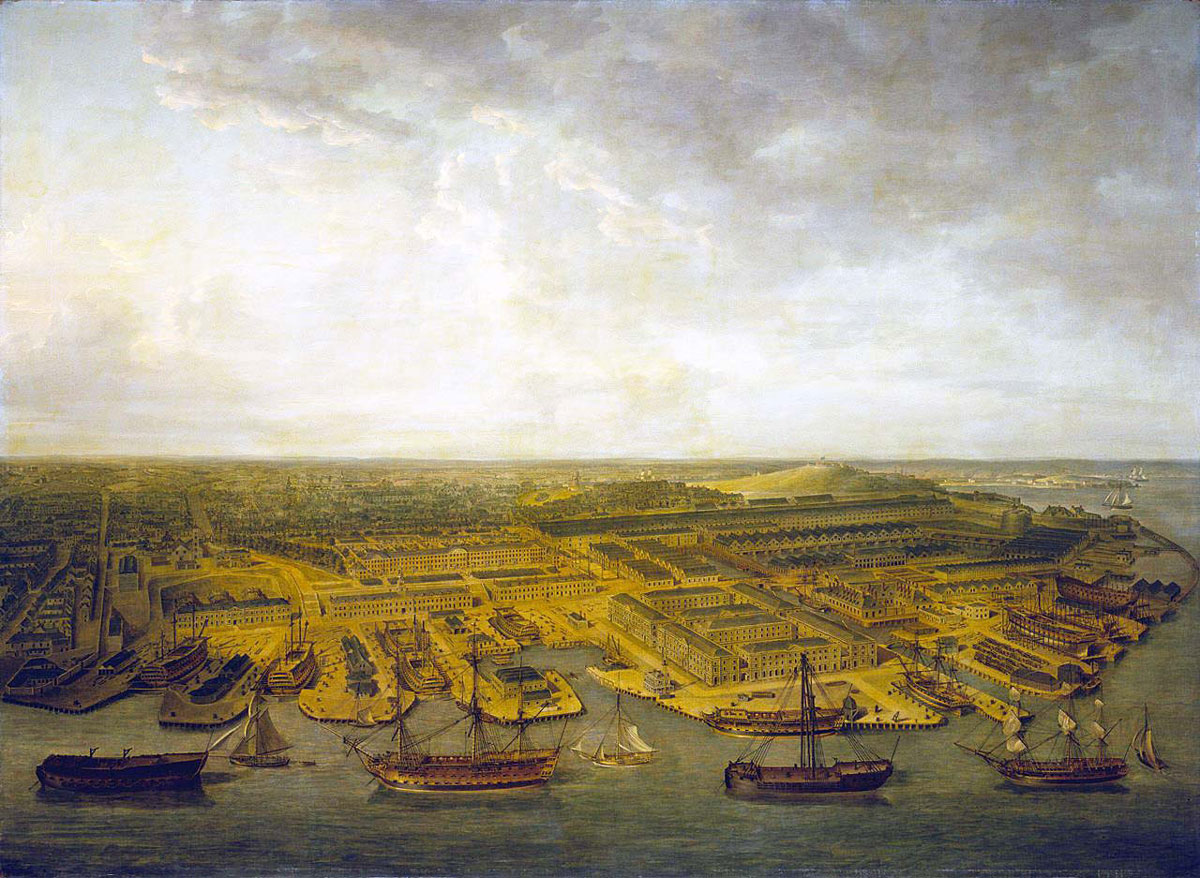
The first picture below is a scale model of the dockyard made in 1774, and is currently on display at Plymouth’s Box Museum. The second picture is a painting by Nicholas Pocock in 1798.
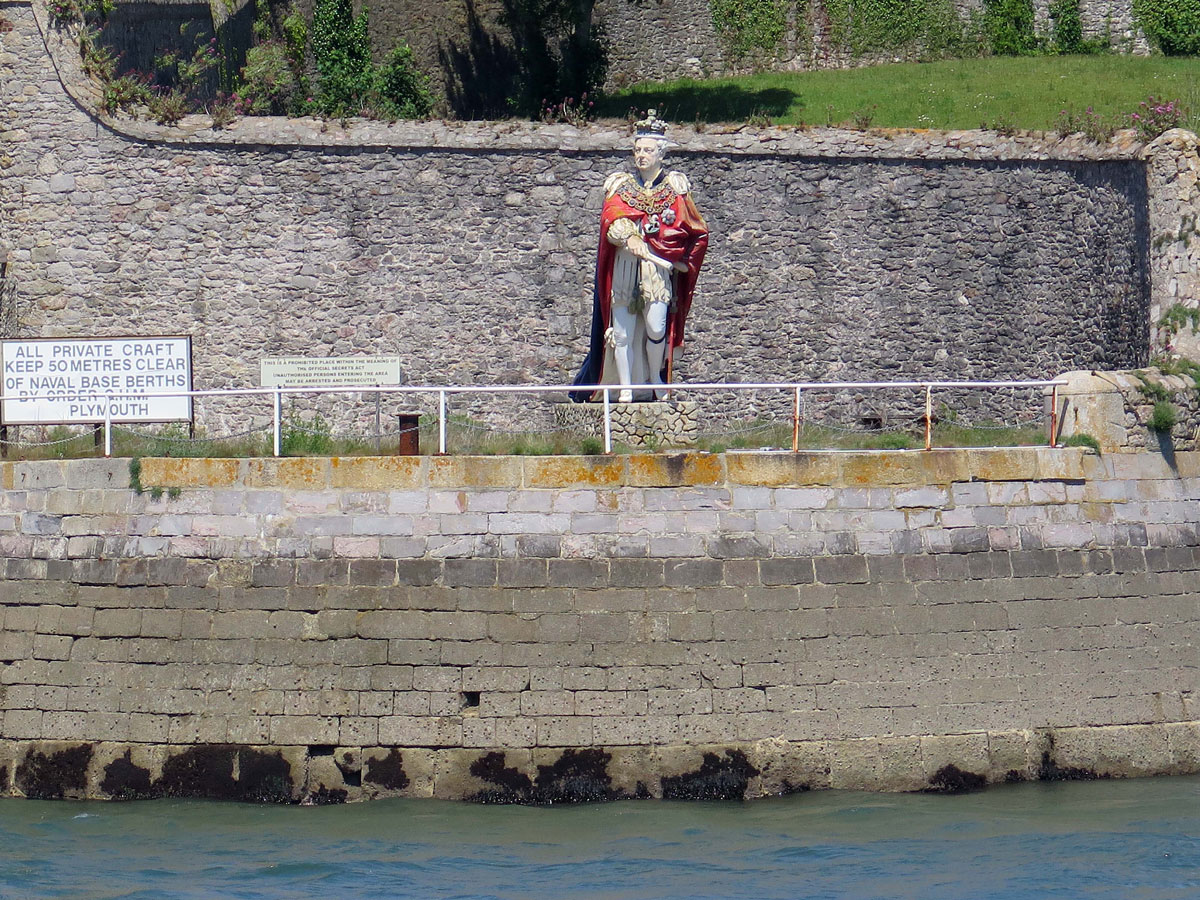
Anyone who takes a boat trip from the Barbican to the Dockyard will see a statue of King William IV next to Slipway No 1 at Mutton Cove, both of which act as an unofficial entrance to the Dockyard.
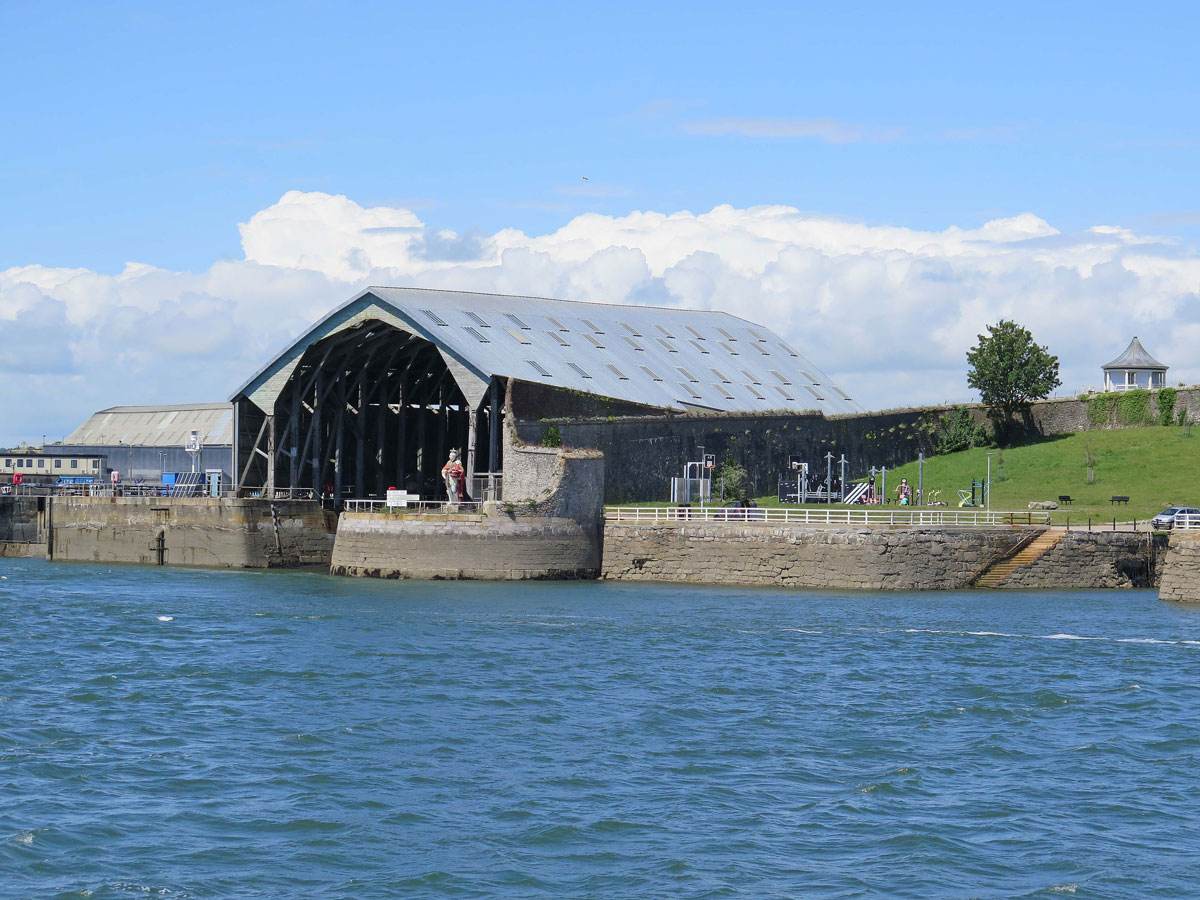
The slip was built in 1774 and is the only surviving unaltered 18th century slip remaining in a Royal dockyard. In 1814 a timber superstructure was added, and although it has a modern roof protecting it from the elements, it is still one of the dockyard’s most historic landmarks (see featured pic at top of the page).
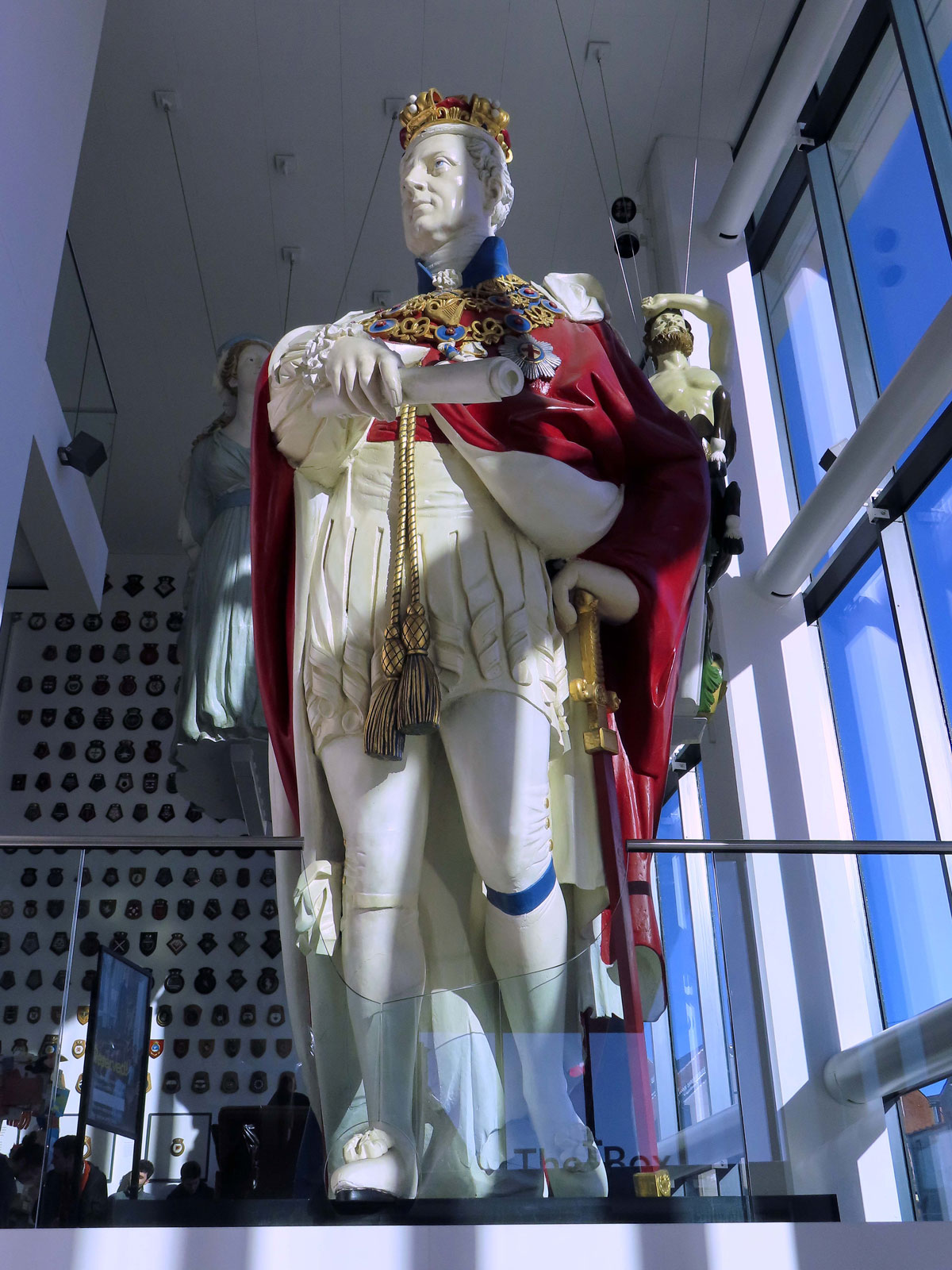
Not to be confused with William III who instigated the building of the dockyard, the statue of William IV (who reigned between 1830 and 1837) was originally the figurehead for HMS Royal William, but after the ship was converted to steam in 1859, the figurehead was replaced by a smaller one. For whatever reason, it was decided that the original should have a new home at Mutton Cove, and it remained here, keeping an eye on the warships come and go, until the 1990s.
The main reason that figureheads disappeared from ships was that, being carved from wood, they could deteriorate quite rapidly, and King Billy was no exception. Plymothians wouldn’t have been happy if he was to disappear altogether, and so a replica fiberglass copy was made to replace him, and this is what you see here today.
The original has since been restored and stands centre stage at the Box Museum, along with thirteen other ships figureheads.
If you’re finding the history of Devonport Dockyard interesting, then you might be pleased to know that there’s more to come, and as recent events have shown, we need the Royal Navy today as much as ever – especially if (and it’s not beyond the realms of possibility) the United States decides to just concentrate on defending its own interests and leave the rest of the free world to defend their own.
POSTED – JANUARY 2024
Originally posted 2024-01-22 14:27:38.
Well that puts things into perspective! Very interesting to read of the dockyard’s development and expansion over time, and now I can see what makes it so important. I’ve also realised that although I know Portsmouth well, and am quite intimately acquainted with the Victory, Mary Rose and HMS Warrior, I don’t know a lot about the history of the dockyard itself. There are a few figureheads at Portsmouth too, and clearly Billy is a valued mascot of Devonport, and as I’m interested in figureheads I’d surely appreciate a look around the Box Museum. 🙂
I thought it was about time I got better acquainted with Devonport’s history as well Alli, because as I’ve said, what goes on behind those dockyard walls is a mystery to many people. To me, blogging isn’t just writing about places that I know well, but also about places I want to know more about.
The Box Museum is a reincarnation of the old Plymouth Museum and incorporates the original classical building with a modern extension. ‘The Box’ sums it up perfectly as that’s what the extension is – just a box made of glass – all very imaginative I don’t think. Being located next to the university it caters for those who are interested in ‘Diversity’ as much as anything, but at least they haven’t shoved Captain Cook, Charles Darwin and Scott of the Antarctic under the table, all of whom had close connections with Plymouth. There isn’t much to see about Sir Francis Drake though as he’s been tarnished with his connection to slavery. The figureheads are worth seeing but I would rather have seen them positioned in a better location, but that would have meant squeezing out some of the other uninteresting ‘arty’ exhibits to make room for them. Exhibitions are regularly changing so there’s bound to be something worth seeing here, and I certainly wouldn’t want to put anyone off 😊
Ah, sounds a bit like a museum of wokery then. That’s a shame. Still, the history and indeed the present of the dockyard itself sound fascinating. They need to make more of it, really, like Portsmouth.
A post steeped in the most interesting history. I await part 3…
You’re right Shey. There’s more interesting stuff ahead.
Bring it on. You fair know how to bring the past to life.
LOL. I’d better get the WordPress defibrilator out then.
As a visitor to Plymouth I thought we had seen a fair bit, until I start reading your posts. Which is good to know more of somewhere we have been and be able to place it. I am not a travel writer and not sure I would have the patience to go into so much detail. I’ll just read yours and others. Thanks, Malc.
Thanks Suzanne. I can see where you’re coming from 🙂 I enjoy writing, even if I’m no Ernest Hemingway.
Fabulous history and information. Loved the paintings and the engraving. And wishing total success for the mission of the Royal and US Navies in the Red Sea. Shamefully our socialist government has refused to support the goodwill efforts to finish off those rebel pirates disturbing the path of commerce. All the best Malc.
I’ve said some of what I think in the reply below Francesc, and I think we’re both on the same wavelength here. Thanks for commenting and I’m pleased that you found the post interesting.
The Thomas Milton engraving is phenomenal, loved it and the history. And I hope the combined efforts of the Royal and US Navies kick arse in the Red Sea!
I’ve said it before Francesc and I’ll say it again. We in the West have been sleepwalking while those who despise us are on the march to change our way of life. It’s already happening wherever we look – from the acceptance of Islam in preference to Christianity, the brainwashing of university students to our history and place in the world, whether we’re male, female or neither. I could go on, but whether it’s vengeance from Putin, global dominance by Xi Jinping, or Muslims wanting to turn us into the Islamic Republic of Britain or wherever, the Western world is under the biggest threat during my lifetime. We don’t need people running our country who are just interested in making money, or on the opposite side, spending huge sums on a lopsided ideology that gives power to the minority – oh, and I like the Thomas Milton engraving too by the way.
I love the Thomas Milton engraving, Malc. I know you will disagree entirely, but having a defence system is tantamount to attacking. I am opposed to weaponry. Where has it got us in this world today? An eye for an eye is not my philosophy.
However, I did find the bear and the strawberry tree in Puerto del Sol. If I ever get to Madrid, I’ll say hello.
The Romans had a saying that “If you want Peace, Prepare for War”. The author (Vegetius) realised that the army became weak during a long period of peace, and he was proved right. History is repeating itself now under our very noses, and I honestly believe that if we don’t wake up to the fact very quickly those of us living free lives will soon be under a dictator with different values than we are used to. It’s already happening. ‘Nero fiddles while Rome burns and all that’ Of course I hope I’m proved wrong because I don’t want war to come again either.
I’m glad you found the Madrid Bear Jo. They ought to plant a real strawberry tree next to him as well I reckon 🙂
It’s sound reasoning, Malc, and I have enormous respect for the Romans, but they did go in for blood sports and brutality. I so hope you’re wrong, but I can’t help feeling that weaponry and the whole industry is evil. It’s a precarious world we live in right now, though my day to day doesn’t feel it.
And, yes- he really should have a living tree.
You know I respect your opinions Jo and I can tell that you respect mine. All I’ll say for now is that your day to day life isn’t affected – yet. I’ve never been one to walk away from a bully, because they just keep coming back for more if you don’t stand up to them. I have no desire to live under a totalitarian regime whether it be a communist or Islamic one, but I’m afraid it’s already beginning to happen here in the UK.
My husband is of the same view. I try to stay optimistic for all of us but you could just call it ‘head in the sand’ 😗🩵
There’s nothing wrong with wanting the whole world to be at peace with one another. Believe me when I say I want the same 💙
🤗🩷
This reminds me of Vauban’s arsenal in Toulon, for instance the rope-making facilities.
Vauban had an enormous influence in the world of military fortifications didn’t he? and I wouldn’t be at all surprised if his ideas were copied on this side of the Channel.
An interesting and informative account of how the dock was expanded and used, I’m looking forward to reading the next part now 🙂
Thanks Eunice 🙂
This part, Malc, confirms that this country had interesting maritime history, and was a power to be recon with during any conflict. Your usual, Malc, attention to details makes for informative lesson in history, easy to retain in memory. I love the history of
the iconic figureheads, and the way there are preserved. The story of Napoleon’s unforced stay at the docks make me imagine his unhappiness at the way his life turned out.
Listening to the BBC news recently, it was obvious that we need to be well equipped to be respected member of NATO, in line with the ancient advice from the military expert:
” If you seek peace, prepare for war.”
Thank you, Malc, for your outstanding presentation, and I am looking forward to your continuation of the story!
Joanna
Thank you for your comments as always Joanna. I worry that our history is beginning to mean nothing to some, but we need to understand it if we are to still have a future that means something.
I couldn’t agree more with you, Malc!
Joanna
Fascinating history, Malc. Thanks for including the US Navy’s support of the Royal Navy in your commentary. 😉 As long as you introduced America in your local history, US history has an appalling habit of never including historical context when teaching American history. I did know that the 7 Year’s War includes what Americans know as the French and Indian War. I’ll also bet that most Americans are unfamiliar with WWII prior to December 7, 1941. I share you concern with what the US might do in January 2024, depending upon who wins the election and what the winner or loser decides to do about the results.
Thank you for your observations Pat. With posts like this I try to reflect the past with what it means to us today.
Good job, Malc.
Thanks again Pat.
Really interesting!
Horatio Nelson was also a frequent visitor to Plymouth Dock, where he repaired his ships or prepared to go and fight Napoleon’s army
You may be aware in that case Luisa that Napoleon himself was a visitor attraction at Plymouth when he was held captive on HMS Bellerophon in Plymouth Sound after his defeat at Waterloo before being exiled to St Helena.
Thanks a lot for this interesting addition , dear Malc
And thank you, as always, for following what I do Luisa 💙
I just learned something new also, Malc.