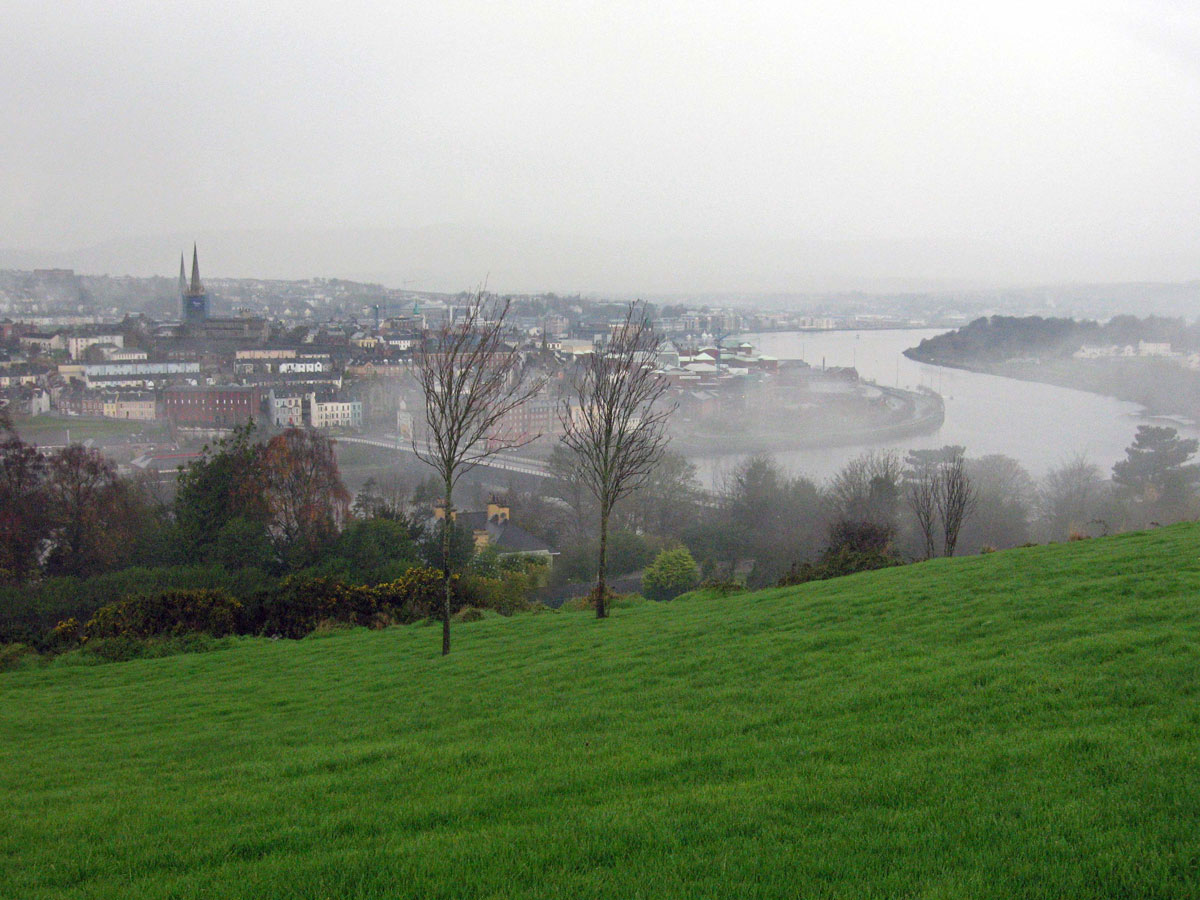
Londonderry - The Walled City - Pt 1 Catholics Rebel against the Plantations
My last few posts have been focused on picture galleries where the images took precedence over the written word, but now I’m back in Ireland, the reverse is true. Unfortunately, Ireland is not a destination people go to get a suntan, and if it’s not already raining it’s usually about to. On my trip to Derry/Londonderry, the weather was grimmer than normal which says it all really.
On top of that, I was going to visit parts of the city where, at the time, it wouldn’t have made sense for an Englishman to be flashing an expensive camera around and so I took a cheap option instead. To be fair though, during my time here I only encountered any sort of hostility once, and most of the people I met were respectful. What all this amounts to is that I apologize in advance for the lack of quality pictures that would have shown the city in a much better light.

Those of you who followed my posts ‘Is it Derry or Londonderry?’ will have seen in Part 4 how the Plantation of Ulster in 1609 by King James I used the livery companies of London to establish the new Protestant county of Londonderry. The city of Derry however, was still only a relatively small settlement, albeit a strategically important one – but all this was about to change.
The British may now have largely gained control of Ulster, but the transition from a province of Gaelic kingdoms to total British control was never going to be that easy – this is Ireland after all. Even a year before the Plantation of Ulster took place there was trouble.
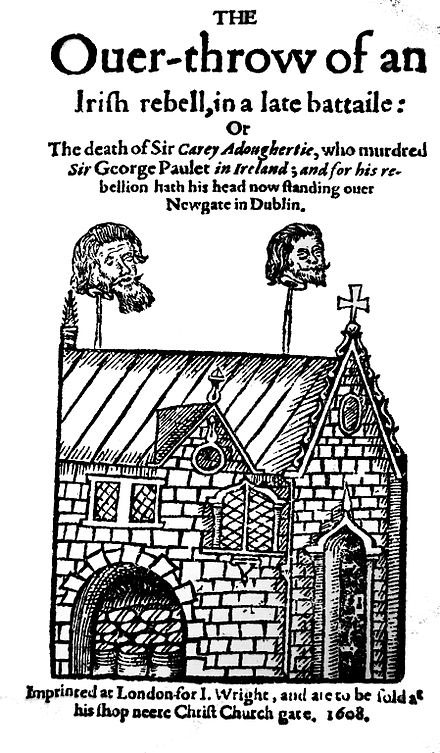
One of the supporters of the British take-over was Sir Cahir O’Doherty, Lord of Inishowen, who, during the Nine Years War, was more than happy to help the British get rid of the Earls of Tyrone and Tyrconnell for his own selfish ends – but he wasn’t the only one who couldn’t be trusted, and expecting to be handsomely rewarded for his support, was none too pleased when the new governor of Derry, Sir George Paulet, saw all Gaelic chieftains as untrustworthy, including O’Doherty himself. To make matters worse, Paulet was given information that O’Doherty was hatching a plot against him: He wasn’t, but Paulet’s subsequent cruel treatment of O’Doherty ensured that he would, and at 2 o’clock on the morning of 19th April 1608, Cahir O’Doherty and his supporters led a rebellion against Paulet which ended up with the governor being killed and Derry being razed to the ground. The rebellion spread, but at the Battle of Kilmacrennan in July, O’Doherty was killed, and his head displayed above Newgate Prison in Dublin. The revolt fizzled out, and the British were back in control.
It’s probably worth reminding ourselves that what we mean here is that Ulster was now back under British Protestant control. The Partition of Ireland was still a long way off, and during the reign of James I the whole of Ireland was under the king’s rule, which is not necessarily the same thing as being under his control. Most of Ireland was still predominantly Catholic, but it was ruled by a Protestant king. At least, now that the county of Londonderry was mostly Protestant, the country’s most troublesome province could be contained, but to make sure that it remained so, James needed to bolster up his defences, and the city of Derry was the obvious place to start.
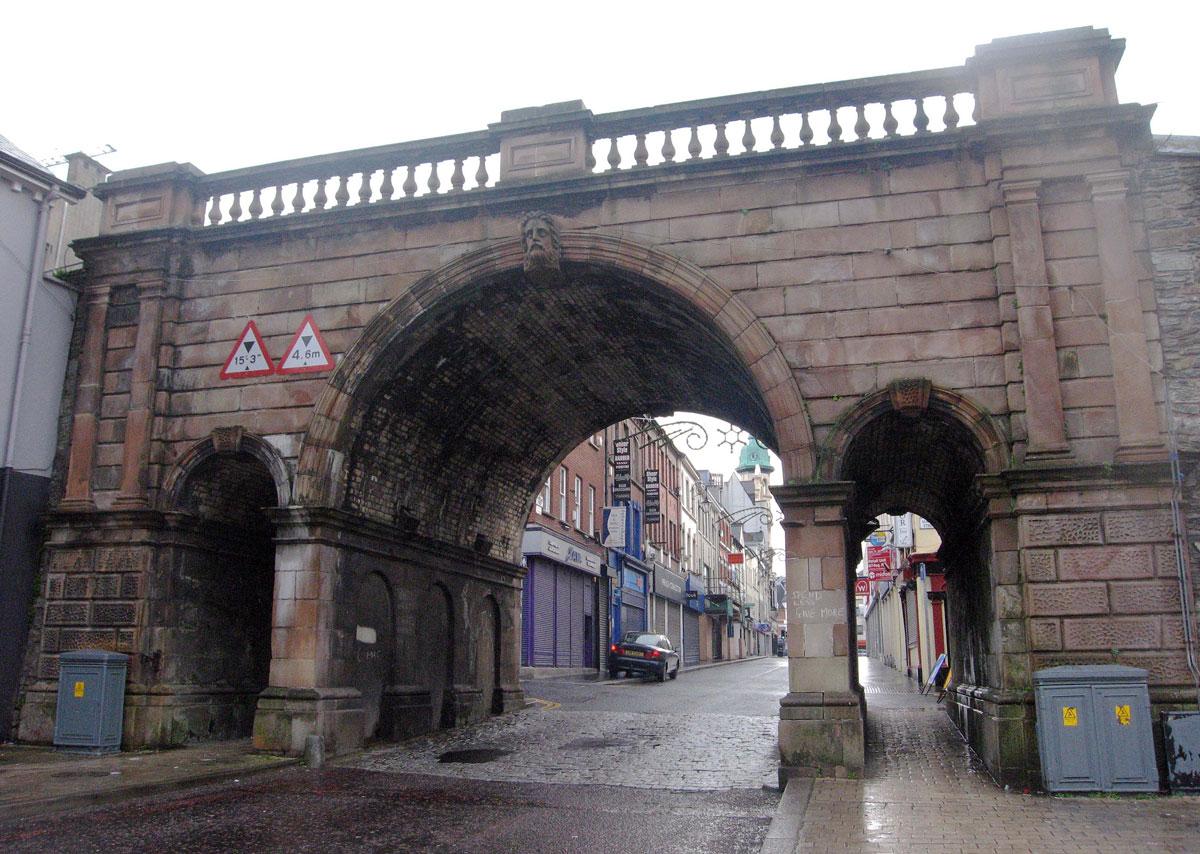
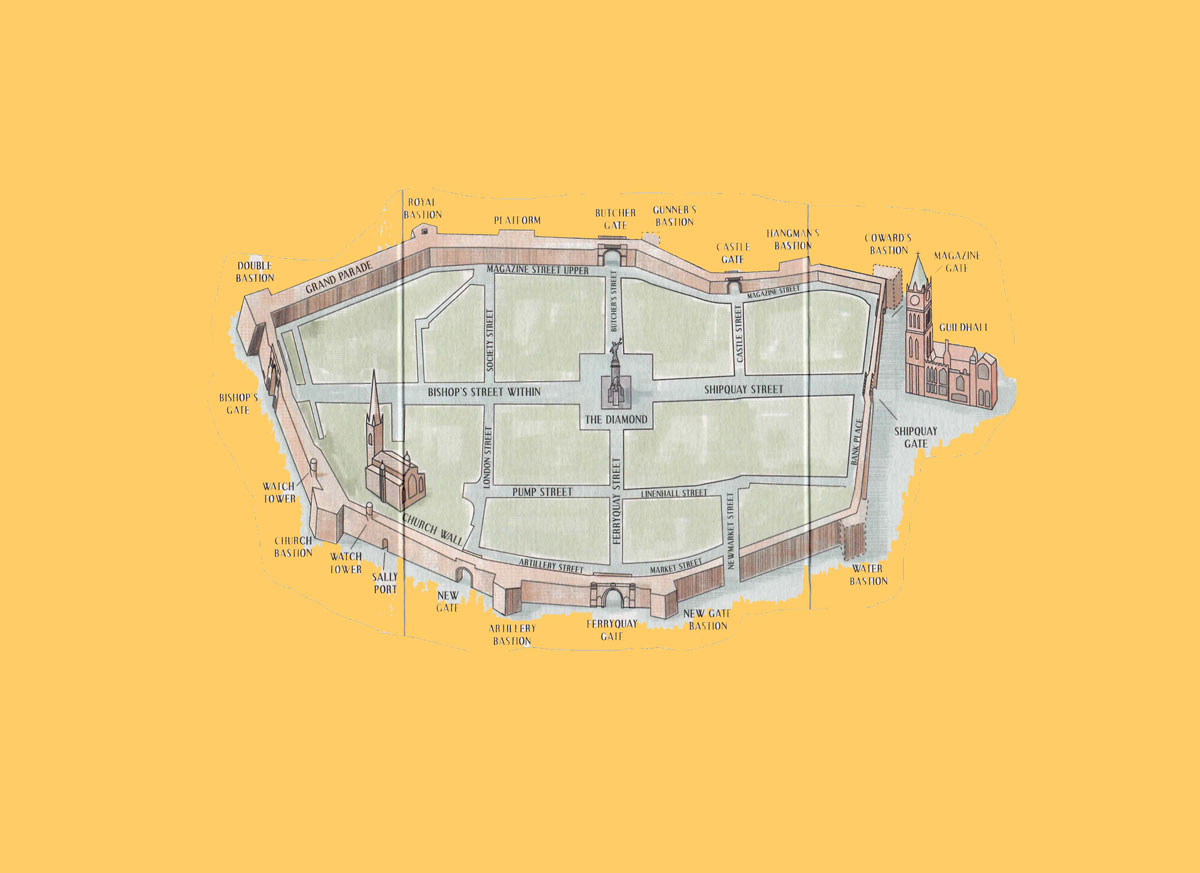
In 1613, work started on building protective walls around what was left of the settlement, with the king granting it a charter and officially renaming it Londonderry in recognition of the financial and practical contribution of the City of London’s livery companies. These walls, just under a mile in circumference, were up to 25 ft high and 30 ft wide, and entry into the city was through one of four gates – Ferryquay, Shipquay, Bishop’s and Butcher’s Gates.
Construction was completed in 1618, but in 1625 Britain had a new king. The successor to James I was his son, Charles I, and although trouble lay ahead, for now at least, Londonderry was more concerned about consolidating its position as the most important city in Ulster.
Within the walls, the streets were designed in a grid pattern, and according to a report in 1628 from the agent for the Irish Society to the King’s Commissioners, the city consisted of 265 houses inhabited by 155 families, which even for those times, could hardly be called a metropolis. However, in the same year, work started on constructing St Columb’s Cathedral, the first Protestant cathedral to be built since the Reformation, and after it was consecrated in 1634, the city, with its central square known as The Diamond, was starting to emerge as the jewel in Ulster’s Crown.

It has to be said though, that generally speaking, the Plantation of Ulster never really attracted the number of settlers that were expected, and events on the British mainland were about to throw a spanner in the works. King Charles believed, like his father, in the Divine Right of Kings, but it was starting to get him into trouble, both with Parliament in England and religious leaders in Scotland where the king tried to impose Church of England practices. As a result, Charles, in his infinite wisdom, decided to negotiate with some influential Irish Catholic landed gentry to form an army to put down the rebellion in Scotland. As part of their conditions, the Catholics demanded that anti-Catholic discrimination was addressed, greater Irish self-determination be given, and confiscated Catholic lands handed back. In return, they would raise an army, one that would consist largely of Ulster Catholics: In fact, just the sort of thing to alienate his adversaries on the mainland even more, and in early 1641, Scottish Covenanters and English Parliamentarians proposed invading Ireland first.
When the Catholic elite got to hear about it, a small group of men, led by Phelim O’Neill, decided to take the law into their own hands, both to forestall a possible invasion and also to force King Charles to concede to their demands. The rebellion began on 23rd October 1641, but despite failing to take Dublin Castle, the rebels occupied most of Ulster within days. At Dungannon, O’Neill issued a proclamation stating that he had the King’s support and that no harm was meant to his subjects.
The Proclamation had the desired effect of bolstering the numbers of rebels to take up the cause, but King Charles had never given his approval, and to make matters worse, O’Neill had difficulty controlling his troops, and the rebellion turned into an ethnic conflict between the Catholic Irish and English and Scottish settlers. The death and eviction of thousands of Protestant settlers was met by retaliation, but incidents like the Portadown Massacre in November, when around a hundred Protestant prisoners were forced off of the wooden bridge into the River Bann and shot if they tried to swim, only managed to store up problems for centuries to come.
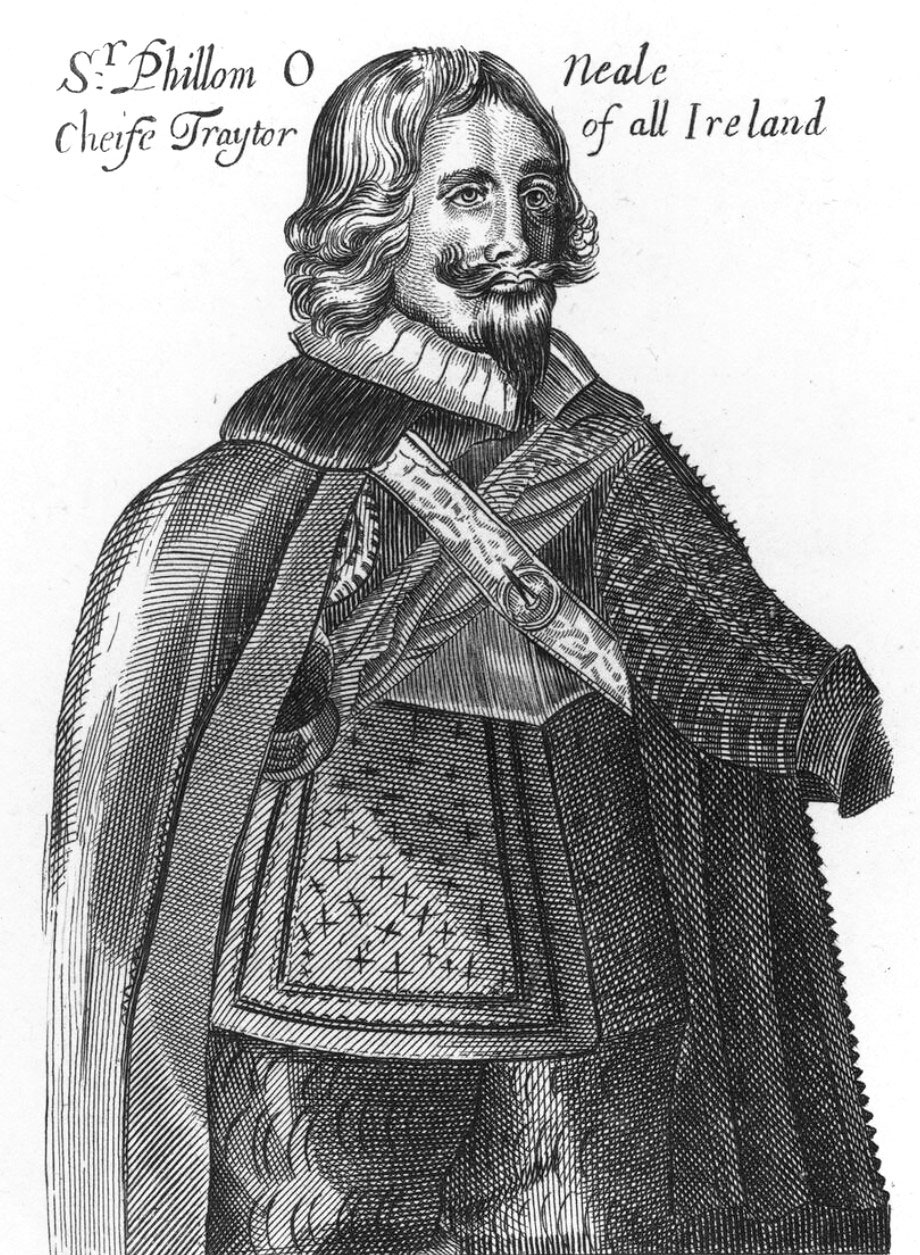
Londonderry’s walled city survived the rebellion, but the rebellion itself was about to take a different course when Catholic churchmen, lawyers and politicians joined together to set up an Irish Catholic Confederation. This Confederation was a parliament in all but name and their aims were to bring order and stability to the uprising and organise an Irish Catholic war against the remaining English and Scottish armies in Ireland.
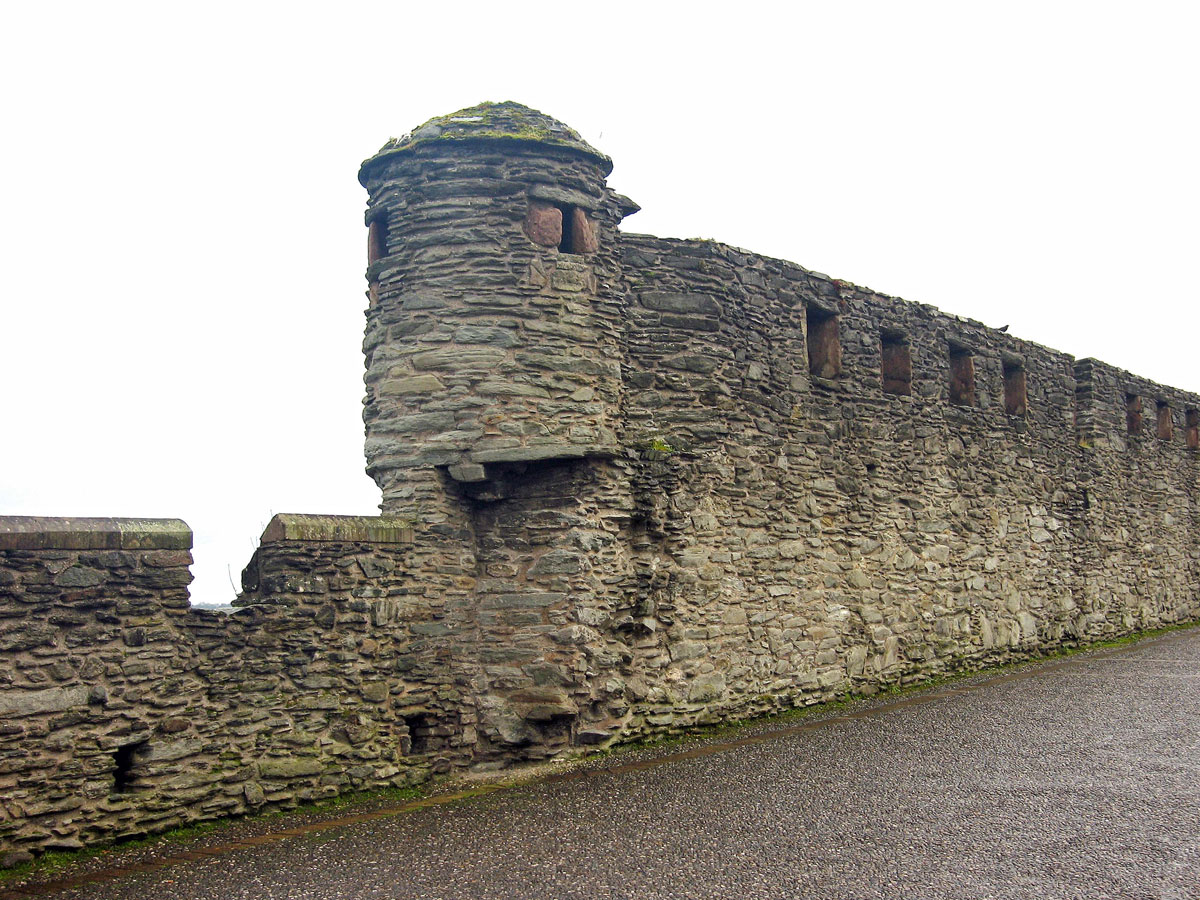
Things were not only getting messy in Ireland, but on the mainland too. The King’s idea of uniting England (and Wales), Scotland and Ireland were now looking like a distant dream as the three countries seemed to be as far apart as ever, and in August 1642 Civil War broke out in England between Royalists and Parliament.
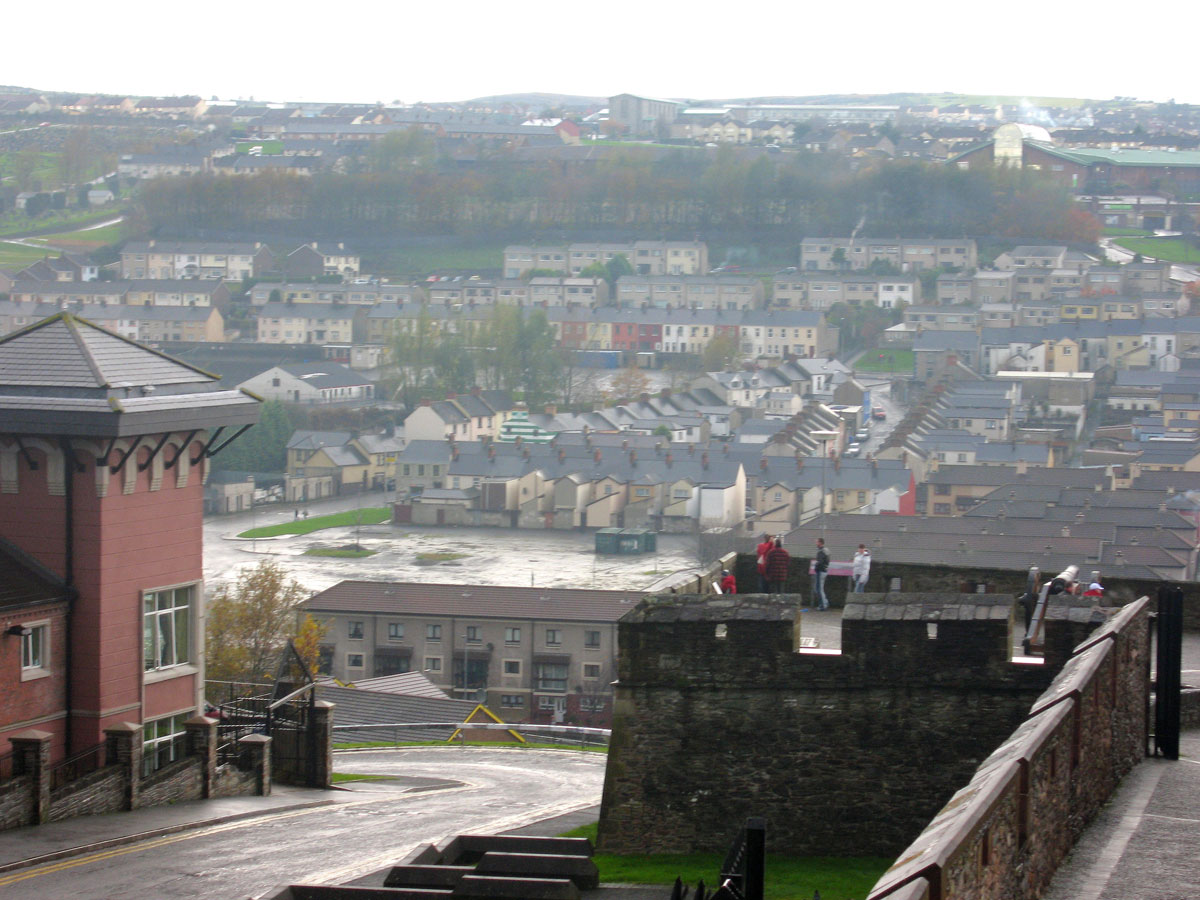
To begin with, the Irish Confederates supported the King because they feared the alternative, but it wasn’t at all straightforward and they ended up falling out amongst themselves. It wasn’t any easier for the Protestants either. In Londonderry, a ‘Lagan Army’ was raised to defend themselves against the Confederates, but they were divided between those who supported the King and those who supported the Parliamentarians – and the Scottish Covenanters weren’t quite sure who to support.

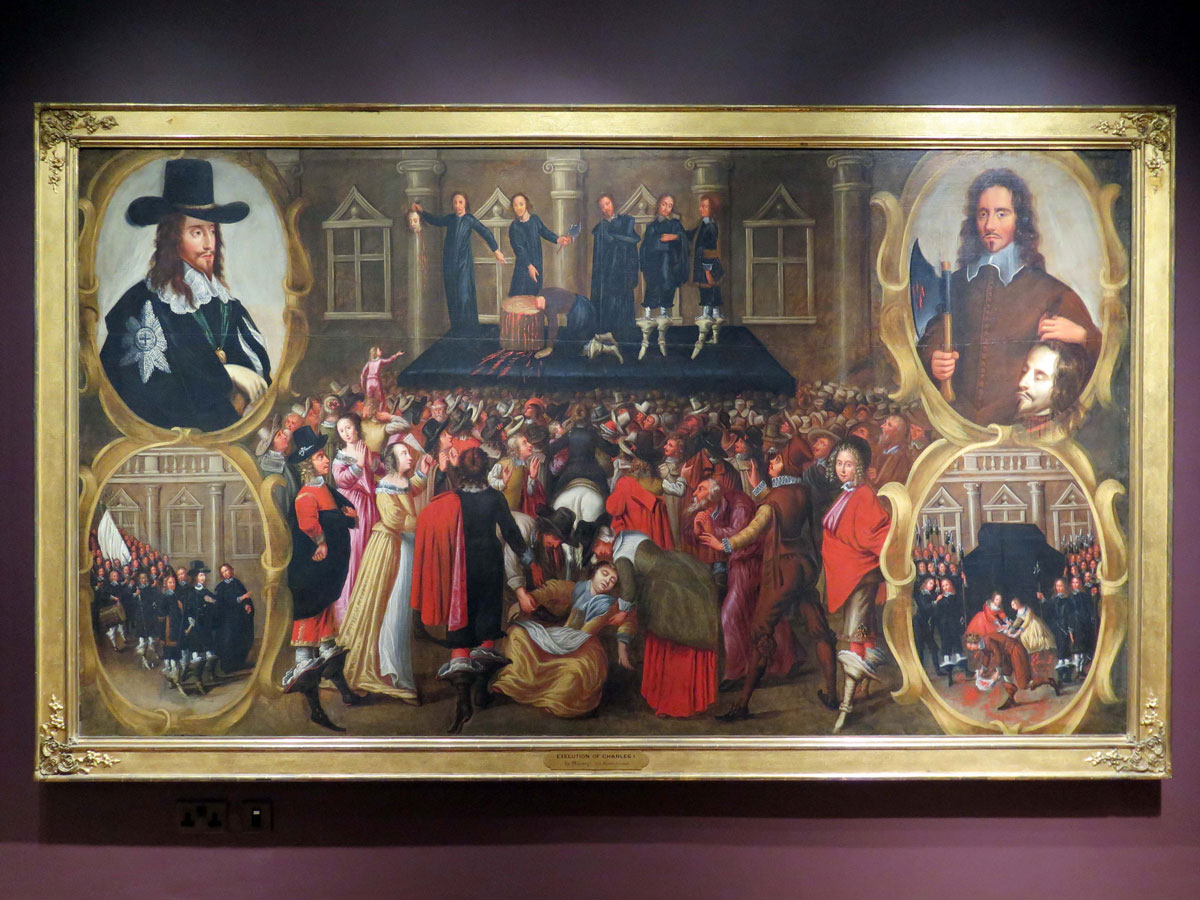
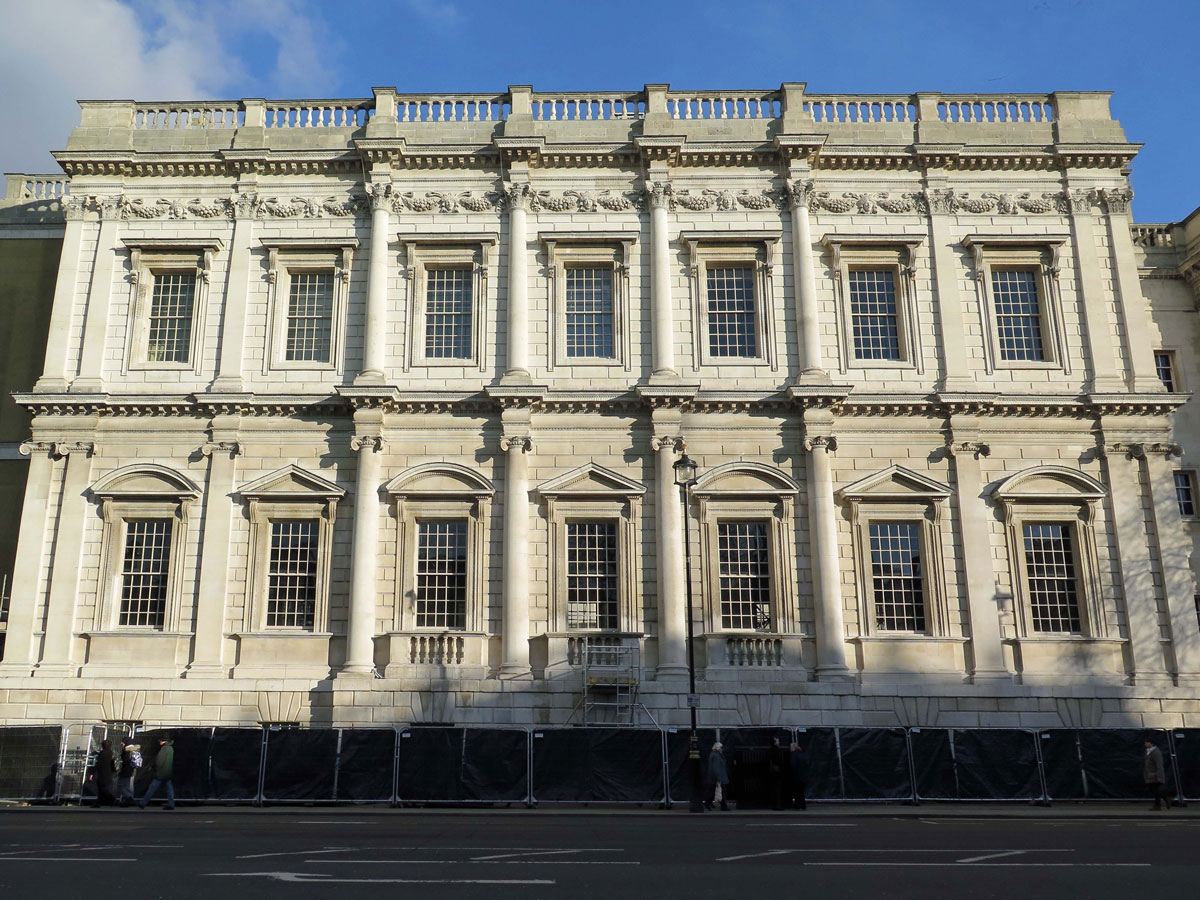
The Civil War in England was settled when King Charles was executed outside the Banqueting House in Whitehall on 30th January 1649. All three countries now had a new ruler – Oliver Cromwell, and it didn’t take long for the Confederates to be proved right in fearing an alternative to King Charles because Cromwell’s New Model Army wasted no time in crushing the Irish Catholic Ulster army at the Battle of Scarrifholis the following year. The Confederates were now facing a situation that was worse than when the Rebellion had first started.
In Pt 2 the story continues with how Ireland, Ulster and Londonderry coped with life during the Commonwealth period and what happened after the Monarchy was restored.
POSTED – APRIL 2023
Originally posted 2023-04-26 15:40:04.
Scotland enters the fray. This brings home the absolute mess
And as we know, it doesn’t get any better
spot on. I’m not going to start.
LOL
Thanks for another great read, Malc. It continually amazes me how much damage religion – even among those who worship the very same God – can cause such long and bloody wars. This was particularly interesting for me as we covered this exact period in the Scottish medieval and early modern module I did a few years ago, but of course it wasn’t seen from the Irish angle. And there’s nothing wrong with your photos – they look just as good and clear as ever. 🙂
I couldn’t ever follow a religion for the reason that you mentioned Alli, and is why I prefer to think of myself as a spiritual person. There are still a lot of twists and turns to come in this series, but hopefully in the end people will have a better understanding of Irish politics. Thanks for commenting 🙂
I’m most certainly a spiritual person too, although Maddie is a Christian and I fully support her in that. Whatever helps a sensitive soul like her get through life is OK with me.
I’ve covered England, Scotland and Wales in my studies, but very little of Ireland to date, so I’m only too happy to fill in some of the gaps with your posts! 🙂
I can tell that Maddie is a deep thinker and there’s nothing wrong with having faith in a religion. It’s when people take it too far that it becomes a problem. I knew a person who was deeply religious and she twisted everything I said into her own bad thoughts, even though I was only trying to be kind.
Ireland has a complex history, but as it’s entwined with ours, it’s worth knowing something about it at least I reckon 🙂
Oh yes, absolutely religion should be something that unites people, not divides them. I’ve never understood that. King Charles has the right idea in his outlook. Luckily, Maddie’s such a kind and gentle person that I’d never have to put up with my words being twisted, so it makes it very easy for me to support her in her faith.
One thing I found particularly interesting about studying the ‘Celtic fringe’ for my degree (which happened more by accident than design) is exactly how intertwined all our histories are. Looking forward to more about Ireland then. 🙂
Maddie has my support too. She sounds such a lovely daughter.
Just so that you know, my posts about Derry/ Londonderry will eventually come to ‘The Troubles’, but the reason that I’ve gone into its background is to set the stall for what happened during our lifetime – and why. The problem is deciding what to leave out because Irish history is such a tangled web. Thanks for following it Alli 🙂
I guessed it would come to the Troubles, so the back story makes complete sense. Although I’m no expert on Irish history, I do know it’s an incredibly tangled web, and I don’t envy you trying to unpick it! All I can say is you’re doing incredibly well so far!
As for Maddie, I know I’m biased, but I also know how lucky I am having her as a daughter. 🙂
Thanks for the endorsement Alli, and as far as Maddie is concerned, you’ve earned the right to be proud of her, and I’m sure she feels the same way towards you 🙂
Thanks Malc, apparently she’s proud of me but I’m not sure why. 🙂
I know why 🙂 Enjoy the rest of your weekend Alli 🙂
Aww, thanks Malc! You enjoy your weekend too. 🙂
🥂
History (and Geography which is always intedrak to Easymalc’s writing) was my worst subject at school evennthough I somehow passed GC(not S)Evas it was. But I have always had a fascination with the subject and these accounts eonderfully bring history to life. I love them, all of them.
You’ve made ny day Adrian. Thank you so much. There’s so much to learn isn’t there, but it’s worth trying to understand it all in order to make informed decisions about the way our history has evolved and what makes us what we are today.
I always learn so much reading your historical posts, your research is so thorough. I wouldn’t worry about the poor weather in some of your photos, they do the job of illustrating your text admirably, as do the additional illustrations you’ve sourced 🙂
Thank you Sarah. Subjects like this don’t ususually require bright sunny conditions do they?
Exactly!
So that’s where the name Londonderry came from! It’s beyond belief that a couple of small islands can fail so badly to get along with each other, isn’t it? The story of all humankind. And yet, the Irish are such charmers!
Not all of ’em Jo.
I really enjoyed this post. I must visit Ireland as it is a country I have always dreamt about. And of course I truly enjoyed your photography!
Thanks Francesc. Somehow, photographs of Derry in miserable weather seems to fit the nature of the posts I’m writing about.
Weather is always interesting for photography… You’re very welcome Malc.
You’re so right Francesc. Although I said that the situation didn’t show Londonderry in a good light, there’s a reason why I visited the city when I did. It’s not that unintentional if you know what I mean.
I do understand perfectly well. There is a certain magic in that light for photography, and you know how to capture it perfectly. Cheers… It’s wine time in Valencia… 😊🍷😊
Cheers mate 🥂 🙂
You’re welcome mate!
Enjoyed this further exploration into Derry. Some grudges last much longer than others. You selected excellent illustrations in lieu of pictures.
As you know Pat, I prefer to deal in facts (as far as I know them) and hopefully people will come to their own conclusions about Irish history
Based upon the Sean Dillion series, Derry or Londonderry was a site for many of the Troubles in the 1990s. I’m guessing this fictional series was at least partially based on history.
I’ve not seen the series, but it sounds about right. My story will eventually end at Derry/Londonderry with ‘The Troubles’
Will look forward to it. The Sean Dillion series is actually a series of novels about a group called the Prime Minister’s secret army. Loved reading it.
I love your posts about Northern Ireland, which I have never visited.
The plots, the clashes, all what you describe is really interesting and told with great vividness
Heartfelt thanks for these incomparable history lessons
You are of course Luisa, one of my avid followers but I’ve been wondering about you lately as you seem to have gone off piste. I hope everything is ok.
Thank you for your dear message,, Malc
I haven’t posted every day lately, because I wouldn’t be able to reply to all the comments and reciprocate all the visits from those who read my posts… not to mention the time spent preparing them🤗🤗🤗
Quite right too Luisa. I’ve often wondered how you’ve managed to cope with all those messages. At least I know you’re ok and don’t worry in the slightest about replying to my posts 🙂
Goodness, Malc, what a tale you weave about the history of Ireland!
After reading it, I have to say, I would not know whom to support either, what with all the fractions, plots, contra-plots and heads displayed on the poles, as I treasure my head and my sanity too much. By the way, while raising founds for the Woman of the Year, I attended a concert at Banqueting Hall and looked at the balcony where the tragic events took place. For a split second, time stood still, and I felt a chill climbing up my spine. Luckily, the lively music broke the spell. What will happen next in your re-tale of history, Malc? More troubles, for sure…
Your presentation is faultless and the pictures and drawings brought more understanding while Ireland was and is so attractive to others. Thank you!
Joanna
Is it any wonder that I enjoy reading your comments Joanna? You always take the trouble to inwardly digest posts like these whereas some people would simply just gloss over them. Fortunately, I also have a small number of followers who are just like you, and that makes writing these posts all the more worthwhile.
I wondered if you might have picked up on the Banqueting House. It’s not just a wonderful building, there’s also so much history attatched to the Palace of Whitehall isn’t there? – and yes, you’re absolutely right – there is still more trouble ahead.
Thank you, Malc, I am already looking with a bated breath for part 2!
Joanna
🙂