The Tower of London Pt 3 - The Medieval Palace and the Bloody Tower
When King Stephen died in 1154, King Henry II became the first of the Plantagenet Kings that were to reign until 1485.
During this medieval period, moats, curtain walls and towers were added to bolster up the defences – not to keep out invading foreign armies – but to thwart any attack from the King’s subjects. King John, Henry III and Edward II all had trouble with their Barons and in 1381 the Peasant’s Revolt tested the young Richard II.
Although the Tower was never meant to be used as a palace, there were occasions when the King of the realm found it useful to hole up here for a while.
It was King Henry III and his son Edward I who built what is now called the Medieval Palace. In fact, it’s a combination of three towers – St Thomas’s, Wakefield and Lanthorn – that make up the royal apartments.


Entry to the Medieval Palace is up some steps into St. Thomas’s Tower in Water Lane.
Edward I had this tower built between 1275 and 1279 but rarely stayed here. The chambers have been re-created though to show what it would have been like when he did.
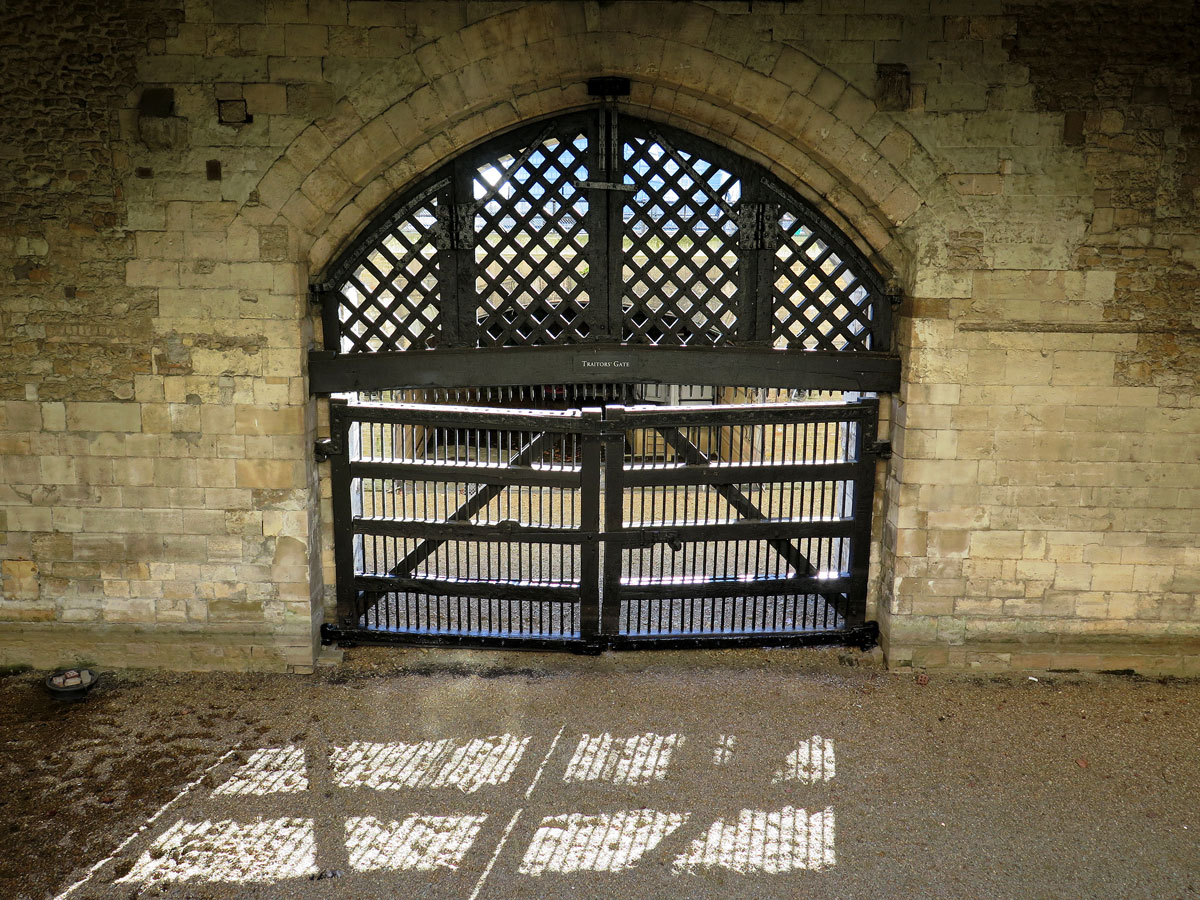
Underneath the tower he added a new water entrance which we now know as Traitor’s Gate.
Anne Boleyn was one of those who passed through the gate in preparation for her marriage to Henry VIII. Henry had St. Thomas’s Tower re-built for her in 1532, they got married in 1533 and she was beheaded on Tower Green in 1536.
The Wakefield Tower was built by Henry III between 1220 and 1240 and became his private chamber, but when his son Edward I came to power he changed its use and the present re-construction shows it as his throne room.
Before leaving, take a look behind the painted screen which hides a small chapel. You’ll see a reference in the tiled floor on the spot where the last Lancastrian king, Henry VI, was murdered in 1471.


As you walk along the wall towards the Lanthorn Tower it appears to be the best looking of the three towers, but the interior lacks the feel of the other two, and the reason for that is because it was re-built in the 19th century. The original was built at the same time as the Wakefield Tower and became the King’s Chamber after the death of Edward I. It was gutted by fire in 1774 and then demolished.
The tour of the Medieval Palace should take around 30 minutes. Bear in mind that although the buildings are medieval in origin, some of them would have changed their appearance somewhat over the years. The reconstructed rooms are obviously recent, but are based on historical fact as much as humanly possible.


Nearby is the infamous Bloody Tower.
Built in the 1220s, this infamous tower was situated on the river’s edge and was the main river entrance into the castle. It was to be another 50 years before St. Thomas’s Tower and Traitor’s Gate took over this role.
When it was built, the lower chamber belonged to the Constable of the Tower who probably used it for accommodating high ranking guests. Later on, it was used to accommodate high ranking prisoners instead.
Eminent people like Archbishop Thomas Cranmer, Archbishop William Laud and Judge Jeffreys were all treated with respect and allowed to live in relative comfort while they were here.

For supposedly plotting against King James I, Sir Walter Raleigh found that the Bloody Tower was to be his home for the next 13 years (1603-1616), and both the lower and upper chambers now show what life would have been like for him during that time.

The most famous prisoners of all though were the two young sons of Edward IV who have gone down in history as the ‘Princes in the Tower’. Following his father’s death in 1483, 12 year old Edward was next in line to the throne, but his uncle, Richard Duke of Gloucester, took him and his 9 year old brother Richard to the tower for their own protection whilst preparations were made for the coronation. It wasn’t Edward that was crowned King though. It was dear old Uncle Richard, who became Richard III.
What happened in between is anyone’s guess, but what is clear is that the two boys were never seen again. Nobody has ever been able to prove, or disprove, that King Richard was complicit in their murder.
In 1674 the bodies of two children were found buried nearby and have been re-buried in Westminster Abbey as the two princes, but permission to have their bodies exhumed and tested by modern methods have so far been refused – and so the truth still remains a mystery – as it has done for the last 500 years.

Originally posted 2019-01-21 15:24:12.
Excellent. I Have defo seen this bit of the Tower. I remember the Raleigh room. But very nice to revisti it and the history.
There’s a lot to see at the Tower in one visit, but the Raleigh room is probably something most people will come across.
Yes. I just can’t remember all the parts I saw round so I am enjoying the posts.
Do you know what Shey? I often go back over my posts to remind myself what I did or saw as well 😀
You bring it to life so vividly it is also armchair travel.
And memories!
That bit is always the best. The wee stories within the picture.
You’re making me think I should splash the cash and visit the Tower again – it must be decades since I was last inside!