
Westminster Abbey - Pt 4 The Coronation Church
Westminster Abbey is known as the Coronation Church, and on 6th May, King Charles III will become the 40th monarch to be crowned here, and at the age of 74, he will also be the oldest. Along with his wife and consort, Queen Camilla, the Gold State Coach will bring the couple from Buckingham Palace to the abbey in what is known as the ‘King’s Procession’.
There won’t be that many people who saw the last coronation, and although this one is bound to include a certain amount of pageantry, there will be some differences. Preparations would have undoubtedly been finalised, but the arrangements and timing have yet to be officially announced, but it seems likely that the ceremony will reflect a mixture of traditional and modern Britain.
I expect the royal couple to enter the abbey through the West Door where the procession will continue up the nave towards the quire screen. An anthem written by Andrew Lloyd Webber is one of twelve new pieces of music commissioned by King Charles for the occasion, and it remains to be seen whether it will have the same impact as Handel’s Zadok the Priest which was written for the coronation of King George II, Elgar’s Pomp and Circumstance (for Edward VII) or William Walton’s Crown Imperial (George VI).
Crown Imperial by William Walton
As the procession passes through the quire screen it will also be passing under the Harrison & Harrison organ. It’s the latest in a long line to grace the abbey, the earliest of which goes back as far as 1304. The first organ to appear here on the quire screen was built for the coronation of George II in 1727, and the latest one was built in 1937 with a complete overhaul in 2006. I have to admit at having a particular fondness for a church organ as I learnt to play one myself (not very well I might add), and they don’t come much grander than the one at Westminster Abbey which uses 7,000 pipes to fill the church with its magnificent sound.

The abbey has been evolving over the last thousand years and although we are now in the part of the church re-built by Henry III, the medieval Choir Stalls were replaced during the 18th century, and again in 1848 with the ones that are here now: Some of these are reserved for Commonwealth high commissioners.

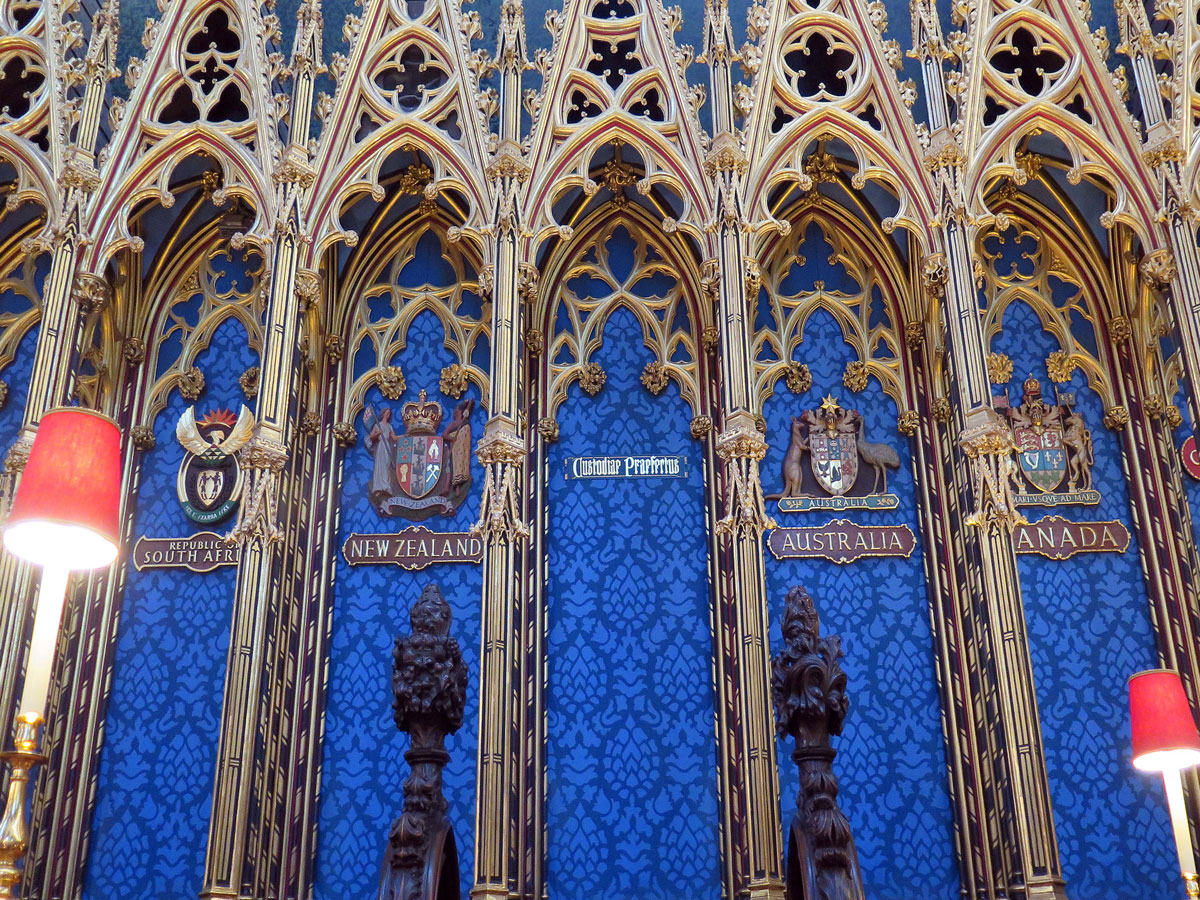
Henry III set about re-building the church specifically as a Coronation Church and we are now at the heart of it. The Crossing is in the centre of the abbey, and it separates the quire from the Sanctuary where the monarch is crowned.
Steps lead up from the Crossing to the Cosmati Pavement, considered to be one of the abbey’s most precious gems. It was laid down in 1268 by Italian workmen under a request from Henry III. It’s a form of mosaic, but more abstract than the familiar Roman square-shape designs, and its name comes from the Cosmati family who specialized in the technique. The geometrical patterns are made from 80,000 pieces of porphyry, glass and onyx set into Purbeck marble.
The pavement is off limits to the general public but I’ve read that there are some Latin inscriptions forecasting the end of the world. Translated into English, it says, “In the year of Christ one thousand two hundred and twelve plus sixty minus four, the third King Henry, the city, Odoricius (the project manager) and the abbot put these porphyry stories together. If the reader wisely considers all that is laid down, he will find here the end of the primum mobile; a hedge (lives for) three years, add dogs and horses and men, stags and ravens, eagles, enormous whales, the world: each one following triples the years of the one before. The spherical globe here shows the archetypal macrocosm.” If by any chance you can’t work out what it means, it adds up to a total of 19,683 years. If that’s from the time the pavement was made, I won’t need to put the date in my diary just yet.
Taking a satisfactory picture of the whole pavement wasn’t practical so I scanned a postcard I bought so that we can all get a better look at it.

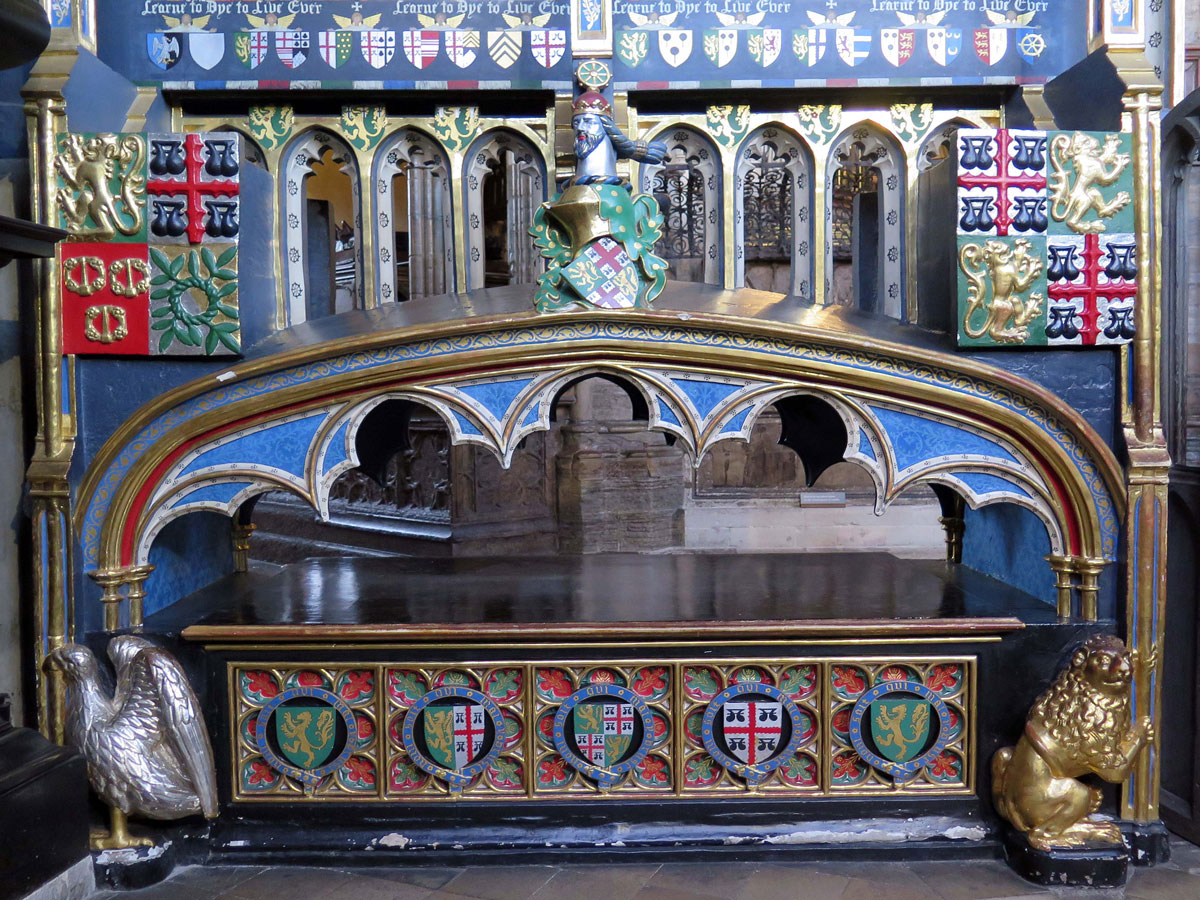
There were a couple of experts doing some restoration work in the Sanctuary when I was here, but it made no difference as to what could be seen. On the north side are some important medieval tombs and on the south side are some medieval sedilia (seats) used by the priests: Next to them is the tomb of Henry VIII’s fourth wife, Anne of Cleves.
The screen behind the altar is Victorian and was gilded only in the 1960s. Much older is Henry III’s altarpiece, or retable, but its fragility means that it is no longer on display here, but can still be seen in the Queen’s Diamond Jubilee Galleries. Dating from about 1270, it is the oldest oil painting in Britain.
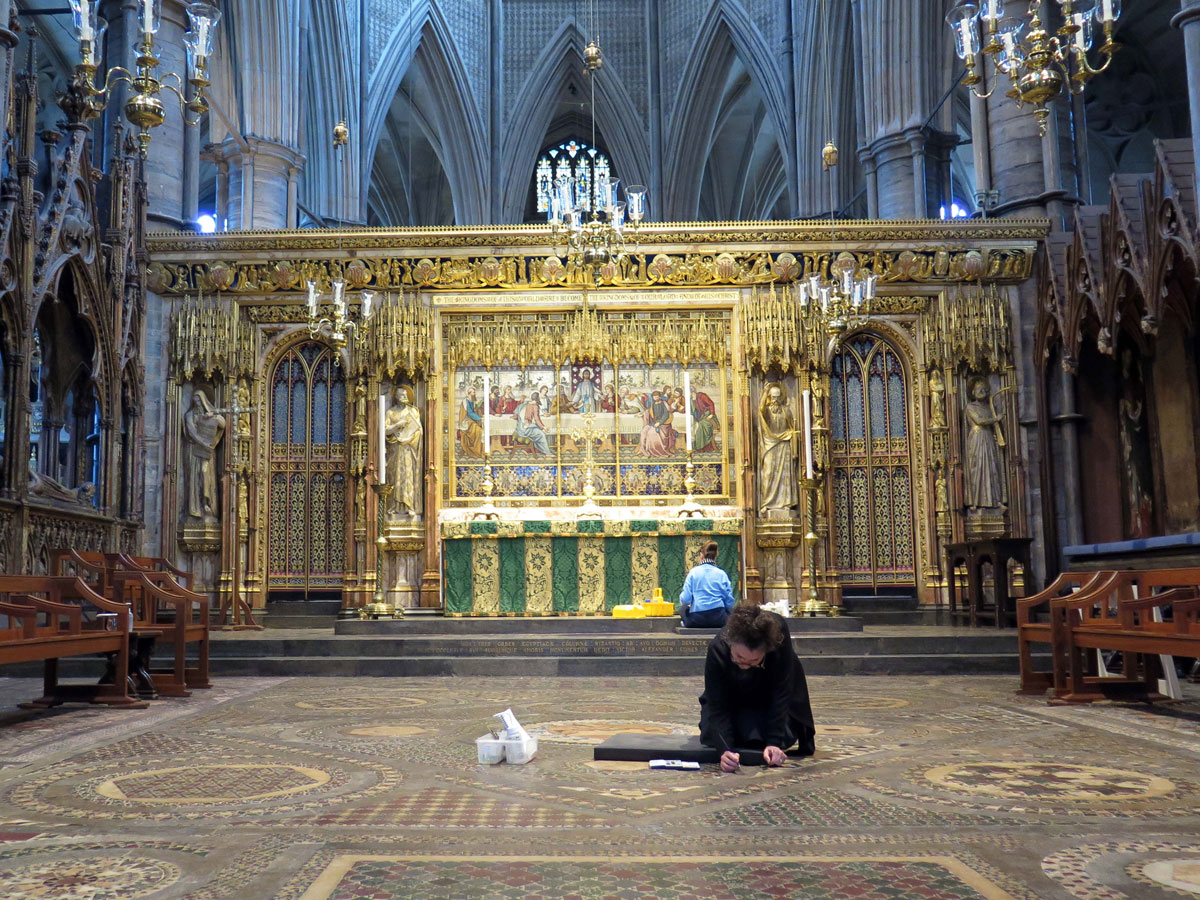
The Sanctuary is where King Charles III will be crowned. Sitting in the 700 year old Coronation Chair, he will be anointed by the Archbishop of Canterbury with (vegetarian) Holy Oil before St. Edward’s Crown is placed upon his head. This crown is the centrepiece of the Crown Jewels, which are kept in the Tower of London, but it isn’t Edward the Confessor’s original crown, as that went missing when Parliament abolished the monarchy in 1649. It was replaced with the present one when Charles II was restored to the throne in 1660.

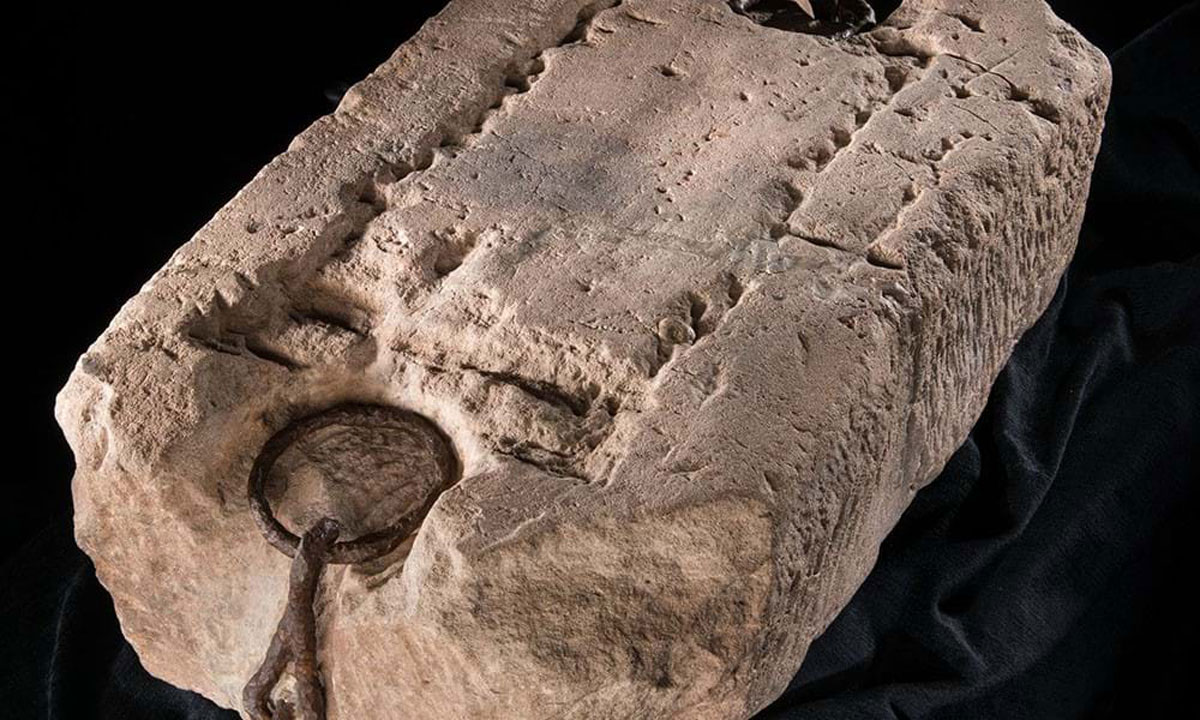
The Coronation Chair has a history of its own. It was made in order to house the Stone of Scone (or Stone of Destiny), a three-hundredweight block of sandstone which was used in the coronation of Scottish kings – or at least it was until Edward I stole it in 1296.
After defeating the Scots in the First Scottish War of Independence, Edward had it brought down to England to prevent Scotland from ever having its own king again, and then to rub salt in the wounds, he handed it over to Westminster Abbey to use for the coronation of English monarchs instead.
Sometime between 1297 and 1300 the Coronation Chair was made to accommodate the stone and placed in Edward the Confessor’s Chapel. Future monarchs sat on the stone itself until a wooden platform was added in the 17th century, and every crowned sovereign since Henry IV, and possibly Edward II, has been crowned in the chair: The only exception was the Catholic, Queen Mary.
When the chair was made it would have looked as though it was made of solid gold, and just like a coronation chair should do, but 700 years of misuse has taken its toll: It has been abused, attacked, carved with graffiti, climbed on, slept in, painted over and even had pieces hacked off for souvenirs. It has also survived Henry VIII’s dissolution, the abolition of the monarchy, two world wars, and a bomb attack by the Suffragettes. Even with careful restoration, it’s no wonder King Charles has shortened the service. After all, I’ve seen more comfortable chairs down the local cider bar.
As for the Stone of Scone, it was taken by Scottish Nationalists when they broke into the abbey on Christmas Day 1950 but was recovered in time for Queen Elizabeth’s coronation in 1953. In 1996 the British government advised Her Majesty to return the stone to Scotland on the understanding that it would be placed back under the Coronation Chair at any future coronation. This was agreed and the stone can normally be seen in Edinburgh Castle, but will return to Westminster for the coronation, but as you can imagine, there are some who are against the idea of it ever coming back over the border again.
The Coronation Chair is the oldest known dated piece of furniture in England, and apart from when it comes out for the coronation, is kept behind glass in St George’s Chapel near the West Door. It is usually the last thing visitors see before leaving the abbey, but difficult to photograph due to reflections from the glass.

The final part of the coronation ceremony usually involves the monarch moving from the Coronation Chair to a throne located on a dais in the Crossing, and St Edward’s Crown being replaced by the lighter Imperial State Crown. At each step of the way the Queen Consort will also be crowned, and the service is expected to last about an hour as opposed to the three hour coronation of Queen Elizabeth II.
The final part of the occasion will see the ‘Coronation Procession’ head back to Buckingham Palace where King Charles will greet crowds of well-wishers from the palace balcony.
Not everyone in the UK and Commonwealth are in favour of having a king as the head of state, but I don’t believe that a constitutional monarchy is such a bad thing. As Queen Elizabeth II showed with her “never explain, never complain” policy, it can be the glue that holds a nation together, no matter what political party is in power. The coronation ceremony includes swearing allegiance to the people of the United Kingdom and Commonwealth countries, and wouldn’t it be great if those who make the laws of the land in the Houses of Parliament opposite showed some of the same humility occasionally.
In case you were thinking that the rest of the tour around the abbey will be an anti-climax after seeing where the coronation takes place, then you couldn’t be more wrong, so join me again for the next chapter when we’ll be taking a look at the ambulatories around St. Edward’s shrine.
POSTED – MARCH 2023
Originally posted 2023-03-14 14:54:04.
Now, this is a post to come back. to. All these interesting details including that you played the organ. RESPET. Total respect.
I’m not ashamed to say that I really enjoyed watching the coronation. I realise that not everybody respects the Royal family, but over the years I’ve come to understand more about how our constitutional monarchy operates, and when you look at places like Russia where they got rid of theirs, it helps to make me value our traditions even more. As for being able to play a church organ, it reminds me that I should really do a post about the church where I (occasionally) played it.
Now… that would be even more brill
I was young and innocent back then 😇
What? And you’re not now?
LOL I wish I was 🤪
I wondered if you spotted this news story: https://www.bbc.co.uk/newsround/65056751?
I did Sarah 😊
Continuing to enjoy my virtual tour, especially that close look at the Cosmati Pavement and the Coronation Chair. Can you imagine sitting on that for the best part of three hours? No wonder our new king wants to shorten the service – it’s nothing to do with modernising the monarchy, he just wants to avoid the discomfort (and who can blame him at his age?!)
They were my thoughts too Sarah. Thanks for catching up on this series of posts even if you are aware of most of it.
Some, not most 😆
Another enlightening and fascinating chapter, Malc, and this has given me a really good insight into what will be going on where in the coming coronation. I’ve always wanted to see the coronation chair, and I’m looking forward to seeing how it looks after the restoration work has been completed. With it’s medieval origins and it’s extraordinary life, I think I’d put up with being uncomfortable to spend some time sitting on it. I remember in my Scottish module covering the Stone of Destiny and I’m glad it’s coming back for 6th May. I also remember seeing the Cosmati Pavement on a Time Team Special on WA, and getting a glimpse of the restoration work being carried out. Again, I’d give my eye teeth to see that. Interesting Latin inscriptions, but I have to say I reckon there aren’t many folk who could fathom out what it all means. I certainly couldn’t – it’s all Greek to me! Mind you, I bet Stephen Hawking would have worked it all out.
I wonder why they refer to the crown as St Edward’s when it’s blatantly not? Bit daft, really, but what a shame the original can’t be used, weaving history and monarchs together across so many centuries as it would have done, had the good old Parliamentarians not stuck their destructive oars in. Another great loss to our heritage to thank the Civil Wars for. Thanks for another superb read. More please! 😀
Restoration of the Coronation Chair is practically finished Alli and you’ll hardly see any difference. All the damage that has been done to the chair is part of its history, and all the conservators have done is to touch up the gold paint to stop any more flaking off, and that’s about it really.
I can see what you mean about St Edward’s crown, but the next chapter will reveal more about the man himself and some of the tombs surrounding his shrine – including Edward I.
There are plenty of people who would like to see our country become a republic, but the only time we were, was hardly a success was it? Thanks for your lovely comments as always 🙂
I can believe that about the coronation chair. Conservation isn’t the same as restoration after all. 🙂 I’m completely with you on the disaster that was the English republic. Some things just aren’t meant to be, and for me, that’s one of them.
Edward the Confessor was another great character from the middle ages, and I’d love to see his tomb in all it’s medieval glory. Can’t wait to see your take on it all. 🙂
The bad news is that you can’t normally go into his chapel, but you know me, where there’s a will, there’s a way – and forearmed is forewarned 🙂
Well done you then. Looking forward to reading all about it. 🙂
Another fascinating post with lovely photos Malc, those organ pipes and the gilded screen are fabulous. It was a pleasure to read this at 2.30am 🙂
I’m glad that it didn’t send you back to sleep then Eunice 🙂
So we’ll written and such details. Wonderful Malc! I truly appreciate the information you proffer. Cheers my friend!
Thank you so much Francesc 🙂
Always a pleasure and a learning experience!
Thank you for that F. You’ve taught me a lot about the art world, that’s for sure.
I appreciate that Malc, thank you!
As one from a colony (across the pond) gone astray, the protocols, rituals and ceremony can be overwhelming. That said, the amazing photographs and detailed descriptive text have captured my attention. Very impressive, Malc.
Stewart
I would have to say that it isn’t much different on this side of the pond either Stewart. In fact I think the whole world’s gone mad, but that aside, I’m pleased that you’re finding these posts on Westminster Abbey interesting. Thanks for your kind comments and following my blog. It’s very much appreciated.
Very detailed descriptions and really nice pictures! I knew the Stone of Scone but not as thoroughly as I know it now … so thank you very much, dear Malc 💙
And thank you Luisa. I hope all is well 💙
🤗🤗🤗
Malc,
Might you have any idea as to why the Coronation Chair has not been restored? Unless, of course, the graffiti and damage are considered too historical to be removed or at least gilded over.
You’ve got it in one. They’ve been restoring it recently in preparation for the coronation, but they treat it with kid gloves. They want to keep it very much as it is, as it’s part of the history, but of course they want to keep as much as the original gilded embellishment as possible.
This post, Malc, is fascinating in the amount of hardly known facts, and the addition of pictures makes it a masterpiece. I am all the time amazed how clever you are – playing the organ is the new high! I will together with million of others watch the coronation but your explanation will enrich the experience tenfold. Thank you!
I love the end of the world prediction, as long as I don’t need to be there. I agree that this country appreciate King
and monarchy, and the crowds gathered are the proof of the nation’s sentiment.
Thank you, Malc, again, you are a gem!
Joanna
Your comments always flatter me far too much Joanna, but it gives me a lot of pleasure to know that you get something from these posts. My aim in this series is to inform anyone who is interested at what to expect from the coronation and also give some practical advice to anyone who is thinking of visiting Westminster Abbey. Oh! and by the way, I’m going to make plans to get to Christ Church if I possibly can.
When you do get to Christ Church Cathedral, Malc please stroke the dog from me!
Flattery is not used when you are concerned, Malc, you are worth it!
Joanna
PS, Just waiting for more stamps delivered and it will be posted!
If I do get there, and I definitely hope to, I will definitely stroke the dog for you. I don’t always look forward to the postman coming but I will do now 🙂
Marvelous story telling, Malc. Timing is everything and this could not be more topical.
Thanks Pat. I’m glad you enjoyed it 🙂