
Derry and The Troubles - Pt 2 How 'The Troubles' Began
In 1964 Bob Dylan released an album entitled ‘The Times They Are a – Changin’ and they certainly were: During the first half of the 20th century, ordinary working men were expected to die for their country, women were expected to play second fiddle to men, and those who didn’t have white skin could expect nothing except discrimination – but by the end of the Second World War attitudes had started to change.
In the United States, Bob Dylan was just one of many folk singers who were increasingly turning their attention towards writing and singing songs protesting against the Vietnam War and social injustices. These ‘Protest’ songs were closely connected to the Civil Rights Movement, and as Georgia congressman and activist John Lewis said “If it hadn’t been for music, the civil rights movement would have been like a bird without wings”.
The movement had its roots in the Reconstruction Era which followed the American Civil War, but since 1954 it had taken on a new lease of life when people like Martin Luther King Jr led a non-violent campaign to fight racial discrimination against Black Americans.
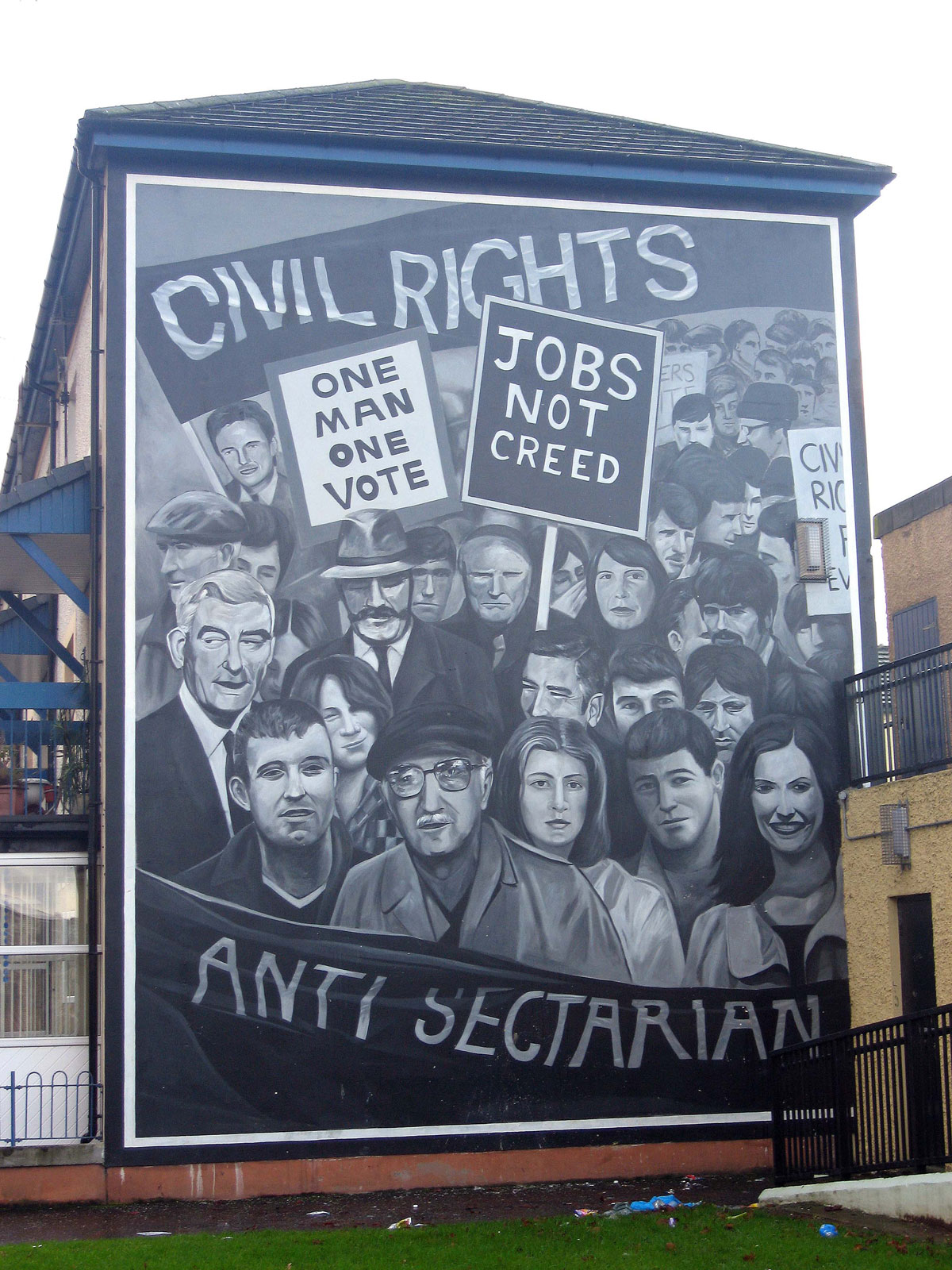
Britain may not have had the same racial problems that existed in America, but Catholics in Northern Ireland saw the discrimination against them in much the same way, and in February 1967 embarked on a civil rights movement of their own.
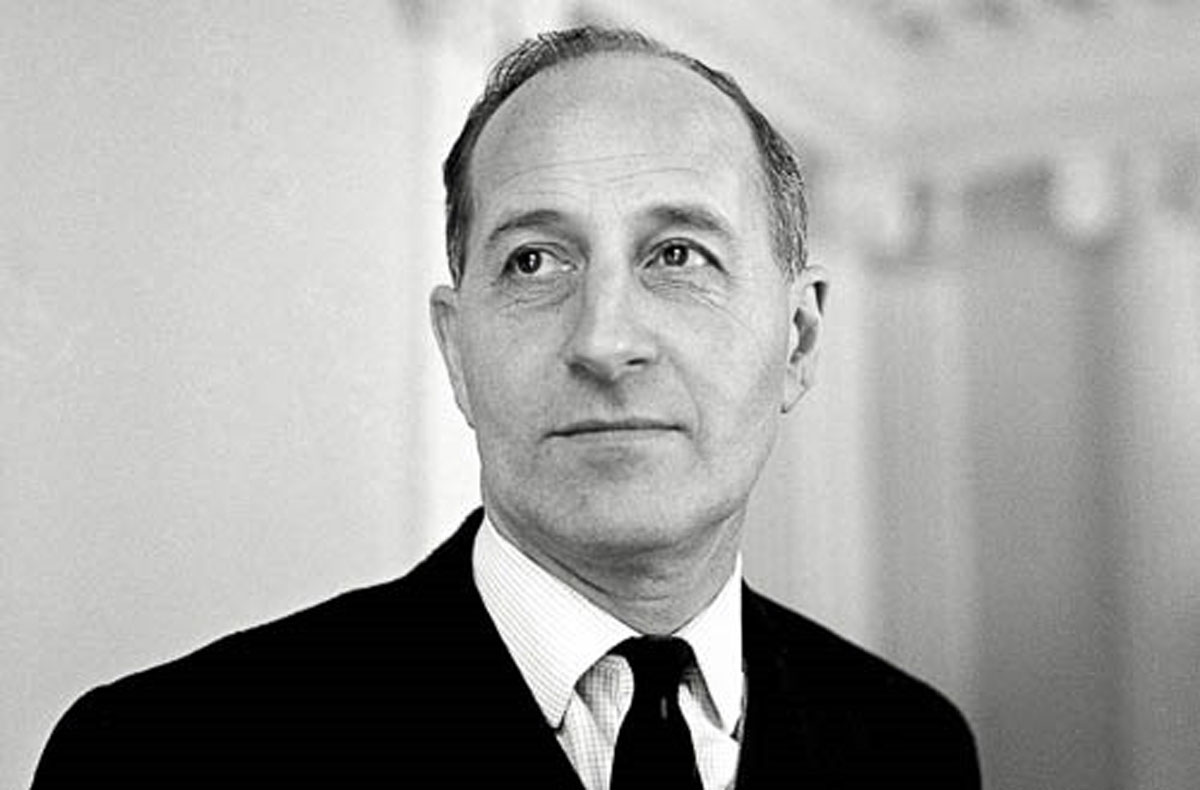
Almost four years before the Northern Ireland Civil Rights Association (NICRA) was formed, Terence O’Neil, became the 4th Prime Minister of Northern Ireland: He was a moderate leader of the Ulster Unionist Party (UUP) and was keen to address some of the issues that led to sectarian inequalities; he was even supported by a fair number of Unionists – but not all.
One of O’Neil’s opponents was the Reverend Ian Paisley, a larger than life character with a voice to match. He was to become an influential, but controversial figure in Northern Ireland politics throughout The Troubles and regarded O’Neil as a traitor. From Paisley’s perspective, he saw NICRA’s links with nationalist and republican groups as a threat to partition and an end to Protestant governance in Northern Ireland. Some agreed with him and some didn’t, but his hardline views led to a split between Loyalists on both sides of the argument.

As it happened, the Republicans had differences of opinion within their own ranks too. They had managed to secure independence through a combination of military and political means, but without going into all the ins and outs of Nationalist politics at this stage, the 1960s saw Sinn Fein (the political wing) closely allied to the Irish Republican Army (the military wing), and it was this affiliation between NICRA and the Republicans that worried Paisley and his supporters. Even though NICRA was a peaceful organization largely made up of people from outside of the Republican movement Paisley didn’t trust their motives.
To begin with, NICRA tried the diplomatic approach for change by writing letters, signing petitions and lobbying the Northern Ireland parliament, but when this was found to be ineffective, they decided, somewhat reluctantly, to step up the campaign by holding a protest march for 24th August 1968. Starting at Coalisland and ending at Dungannon, the organizers emphasized that it would be a peaceful, non-sectarian civil rights march, but that didn’t stop Paisley’s supporters organizing a counter-protest and the Royal Ulster Constabulary (RUC) stopped the march before it could enter Dungannon.
NICRA wasn’t the only organization that wanted change however: The Derry Housing Action Committee (DHAC) was formed earlier in the year to campaign against the way that housing was allocated. Their tactics, although non-violent, were disruptive, and a thorn in the side of the local council.
The DHAC planned a march of their own for the 5th October. NICRA were also naturally invited and initially agreed to join, but that was before the Minister for Home Affairs, William Craig, banned it on the grounds that it would follow a route through the city centre, which was not only out of bounds for Catholic public events, but also threatened by a counter- march by the Loyalist Apprentice Boys along the same route at the same time. The ban was imposed on both marches, and although the Apprentice Boys agreed to abide by the ban, the DHAC didn’t. Under the circumstances, NICRA was initially reluctant to take part, but in the end capitulated and agreed to join the march.
The march was planned to start from Duke Street in the Waterside area, which was just on the other side of the river from the city centre. It was then going to cross over the Craigavon Bridge and up to the Diamond, but as soon as the procession moved off, the route was blocked by the RUC. Clashes broke out, and MPs from both Northern Ireland and Westminster who were participating in the protest, hastily convened an impromptu open air meeting, and as they did so, the RUC blocked any avenues of escape for the marchers.
It was immediately apparent that the law enforcers were well prepared for any opposition to their blockade and unleashed an assault on the crowd using batons and water cannon to disperse them. In situations like these, the truth about who started the violence can often be open to debate, but this time, the international press were here to witness the events, and footage by RTE, the Irish TV and Radio broadcaster, proved beyond any shadow of doubt from which side the violence started. Dozens of protesters were injured during the altercation but there were no reports of any RUC casualties.
Many of the protestors found their way back to the safety of the staunchly Catholic Bogside area, where clashes occurred between local youths not involved in the march, and the RUC. The altercations carried on into the small hours and erupted again during the following day when hundreds of people came out onto the streets. During the skirmishes that followed, petrol bombs were thrown for the first time – and ‘The Troubles’ had begun.


N.B. As a non-religious person, this article is as unbiased as my knowledge will allow, and also no comparison should be made with the current wave of protests that are sweeping the world either.
Diamonds and Rust – Two of the great protest singers – Joan Baez singing about Bob Dylan
POSTED – OCTOBER 2024
Originally posted 2024-10-12 09:19:52.
An interesting,informative and thought provoking post Malc and I like the murals. I’ve never been into politics so most of this went over my head at the time but I remember seeing Ian Paisley on tv and thinking what a loud and aggressive man he was. I’ve never heard Diamonds and Rust before but what a beautiful song sung by a beautiful voice – thank you for posting it 😊
Thank you for taking a look Eunice even if the topic doesn’t appeal to you. At least you enjoyed the song. 😊
I struggle to realise that those protest songs are 60 years old, Malc! I loved Dylan and all that he stood for, without really understanding much of the world. I still don’t! I moved on to loving U2- not for their political opinions so much as for the passion with which they expressed them. Music plays a powerful part, doesn’t it? The backdrop to our lives. Thanks for trying to unmuddy the waters around the Troubles without pointing an accusing finger. It never helped anyone, did it?
‘Unmuddy the waters’ is a good way of putting it Jo, The problem with writing posts like these is that it’s sure to upset somebody somewhere, but that is not my intentions – in fact it’s the opposite. I realsed a long time ago that you can have a difference of opinion with someone on a subject and still both be right. Thanks for sticking your head above the parapet to comment 🙂
You’ve done a great job here in outlining the start of the Troubles. Very clear, very readable and very even-handed.
Thanks Sarah. Just how I wanted it to be.
Oh my goodness. Great post.. You really cover very contraversail subjects excellently. ALSO ….Diamonds and Rust. I LOVE that song.
Thanks Shey. I’ve got no Irish blood that I know of so I don’t have a vested interest as such, but the more I’ve delved into why Northern Ireland has such a complex history the harder it gets – and I’ve still got the Republic’s history to write about.
Seriously you write a good balanced account and it is very complicated. I have got quite abit of Irish ancestry on my mum’s side. Quite a few families came during the famine.
Ireland has a torrid history for all sorts of reasons and the famine is something I explored when I’ve been over there. It’s another painful topic which I would like to cover but there’s enough misery around at the moment without looking for more – but who knows? I may cover it one day.
Aye you’re right there Malc . There’s aspects of it I think were anything but co-incidental. More than one at that.
Putting my Nostradamus hat on for a moment I can see another famine coming. I’m not talking about Ireland now, but there’s going to be one somewhere, and it could be much closer to home than we might thiink unless somebody has the foresight to deal with the potential problem before it happens.
Well… I can see it too. I don’t want to say too much rre the crass stupidity of politicians, or thought a conspiracist re the stuff about central food hubs elsewhere….
as for all this tosh re how we will like eating bugs…well….
At least you’ve always got porridge to fall back on 😊
I hate the stuff.. so..
🤣
Those days they say were the best compared to now. Religion, the devil you know or the devil you don’t. Brought up a Catholic, detest all it stands for and now my religion is coffee. Thought provoking post, Malc.
Thank you for your comment Suzanne. The ability to be able to think for yourself – and be allowed to – is one of the most fundamental freedoms in life. Stick with the coffee if I were you.
Brilliant write-up, Malc. I learned a lot from this post. It seems like many things that start out peacefully but a few hard core people change that up quickly. We need a few more protest song writers today to give what’s going today some history and themes. I don’t want platitudes and bench-sitters. And if you have never been near the trenches, don’t write as if you have.
Thank you for the compliment Pat and well said. I can’t get my head around some of the nonsense that spills out of some people’s mouths. It’s all very well having opinions but they really should be based on fact.
This helps to explain how the toxicity spread and boiled over into the Troubles. Thought-provoking stuff, Malc, especially as this relatively recent history. Ian Paisley always seemed such a formidable and scary figure to me, not that I understood anything that was going on during the Troubles, being a bit wee at the time. I do remember, however, that I couldn’t understand how a man of the cloth could be so aggressive and uncompromising. After all, his job was supposed to be promoting love, reconciliation and forgiveness, wasn’t it? But he’d clearly missed the lessons on that in his theology school.
What a good example of life imitating art too. Music has a way of weaving right through society – even across the globe – and bringing common threads together, sometimes for hugely significant causes.
Paisley’s religious beliefs were hard-line. He was responsible for starting the Free Presbyterian Church of Ulster which was based on fundamentalist religious beliefs. I remember travelling around the Outer Hebrides on a Sunday which meant everything was shut and alcohol was forbidden. The ‘Wee Free’ as the Free Presbyterians of Scotland were known had a strong hold on local people and this is what Paisley introduced into Northern Ireland. You have to remember that Britain was becoming more secular at the time with things like homosexuality being legalised for example. It wasn’t just the Catholics he hated but anything that was non-evangelical. One of his quotes about Catholics was they “breed like rabbits and multiply like vermin”. Strange then that he and Martin McGuinness, two of the most disliked men in Northern Ireland, became the best of friends and brought peace there and became known as the Chuckle Brothers.
Wow, there’s nowt so queer as folk, as they say. I bet no-one saw that one coming.
Incredible ending, and if you remember, the two of them were involved in a power-sharing agreement that helped keep the peace, but after they both died the province couldn’t agree on anything.
Why doesn’t that surprise me? What a shame, and a waste of their agreement and goodwill.
I don’t believe it’s been a complete waste of time. One thing I’ve realised is that it’s easier to stop a war from starting than trying to end it after it’s started.
This is definitely true. Look at all the seemingly unstoppable conflicts going on today.
I believe that most of them could be stopped almost immediately but I would be here all night if I gave my ideas about how
I think so too, Malc. Most issues can be solved with relatively simple solutions, but the suited and booted don’t seem to have the sense to realise that. It’s almost as though they want to be at war. Honestly, I don’t know what the human race has come to, but like you, if I went into that I’d be here all night! Such a shame we don’t live closer, itsn’t it? Can you imagine how long we could spend putting the world to rights? The pub would do well out of us, anyway! 🙂
We could have our own United Nations. The Irish could supply the Guinness, the Scots the whisky, The Russians the vodka, you could supply the mead and I’ll supply the cider – and the best thing of all is we could veto all the Muslim extremists because they don’t drink 😊🍺🍷
Sounds like a plan! 😀
I think we’d do a better job than the official UN at least. Hope you’re keeping well and I never did hear whether you had your op or not.
I know, I’m sorry Malc. I haven’t forgotten but it’s tough times at Templeton Towers at the moment. so my own life is taking a back seat somewhat. Haven’t had op yet as they’re looking at the best way of doing what needs doing. It’s not as though it’s urgent though, rather just a nuisance now, so I won’t have anything done before Christmas as I don’t want to be recovering on the run-up, so it’ll probably be February or so next year now, depending on how things go. I will be in touch, I promise, and I’m trying to do a post too, because if I can’t put out more than I currently am it won’t be worth keeping my blog going. Hope you’re keeping well. 🙂
As for putting the world to rights, I think my cats would do a better job of running the UN!
That’s ok Alli. I’ve been wondering that’s all. As long as you’re ok. I think it’s about time that the UN was neutered.
Me too, along with several other notably awful global organisations.
The whole world’s become a basket case!
We’ve really got to have this meet-up .🍺😊
It’s a shame we haven’t done it before but if we can’t, perhaps one day we could have a virtual drink and chat 🍷🍺😊
That’s a great idea, Malc. Hadn’t thought of that. I’d still like to meet up in person one day, but in the meantime the virtual option would certainly be doable. 🙂
When it’s convenient we’ll make it a plan then
Good, will do. I’ll get an email over to you as well in the meantime. 🙂
Please do!
🙂
Fascinating post as usual, dear Malc! I read it with real pleasure and found it a storehouse of knowledge that helped me to broaden my understanding of that period 🙏🙏🙏
Thanks also for talking about the great committed musicians of that time 🎶
Thank you once again Luisa. Broadening our knowledge of events like these has to be a good thing. Basing opinions without knowing all the facts doesn’t do anyone any favours do they?
I can’t agree with you more! 👍
I thought you might 😊🙏
Thank you Francesc. Your comments, as always, are very much appreciated
Fabulous! Extremely interesting, especially contrasting and comparing the artists (musicians) of that time with the lame ones now… Brilliant article Malc!