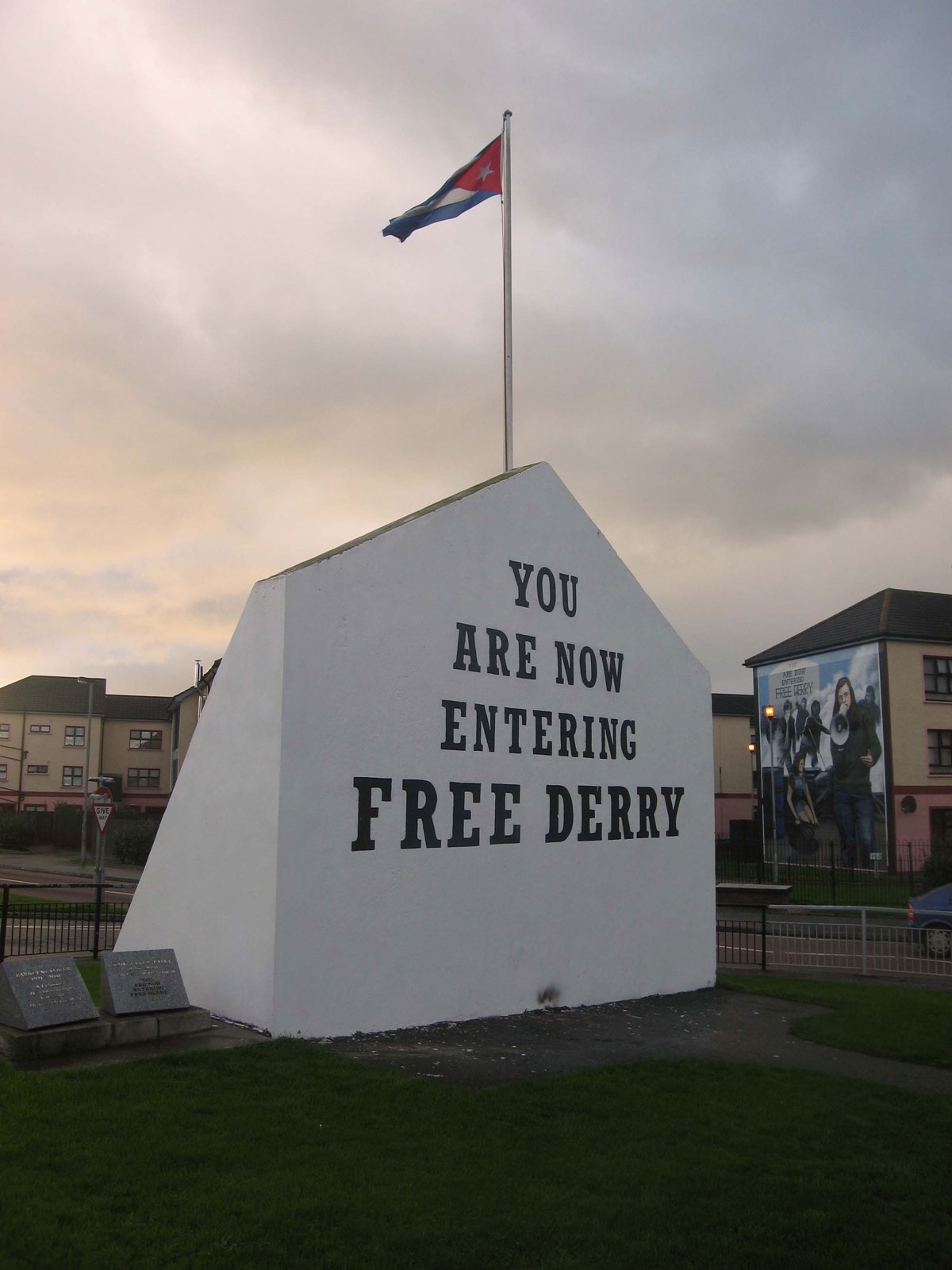
Derry/Londonderry's West Bank - Pt 1 The Creggan and Fountain Estates
My previous eight posts about Derry/Londonderry largely concentrated on how the city grew to become an integral part of the Anglo-Irish conflict. Trouble started when the Norman/English were invited over to Ireland to help the King of Leinster regain his throne, but all it achieved was a simmering resentment that periodically boiled over into further hostility. Becoming ever more complex, these hostilities involved not just Ireland and England, but Scotland as well, and to complicate matters even further, not all the Irish involved were Catholic and not all the English/Scottish were Protestant.
The Partition of Ireland in 1921 was supposed to resolve the problem once and for all, but it didn’t, and during the second half of the 20th century ‘The Troubles’ began when a civil rights march in Derry descended into chaos. For the next thirty years Northern Ireland became embroiled in a bitter sectarian war that only officially ended with the Good Friday Agreement of 1998.

Derry was the initial flashpoint in October 1968 for what was to become a bitter feud between Republican and Loyalist paramilitary forces after failure between the main political parties failed to find a solution. The British Army were brought in to keep the peace, but it only made matters worse, with death and destruction occurring on a regular basis, both in the province and on the British mainland. The Irish Republic didn’t escape bloodshed either, but it was Derry/Londonderry that suffered the most when The Troubles erupted.
It’s been a while since I wrote my last post on Derry, partly because the world’s got enough problems at the moment as it is without bringing up old wounds from the past, but I wouldn’t be satisfied if I left it hanging there. It’s a sensitive subject at the best of times, but it’s now 18 years since I came here to try and understand why the city became so involved, and I believe that now is as good a time as any to finish my ‘Digital scrapbook’ about a city that has had such a turbulent background.
Unlike Belfast, the demographics of Derry are fairly straightforward. The majority of Protestants live on the eastern side of the River Foyle, while the majority of Catholics live on the western side: The one glaring anomaly though is the walled city (and therefore the city centre) which is on the western side.
I’ve already covered the history of the Walled City, and found it no problem to visit, but to wander around the Catholic estates of the West Bank wouldn’t be quite so easy, and so rather than travel independently like I normally would, I arranged for a Catholic taxi driver to show me around, much as I did in Belfast.
My taxi driver’s name was Paul and was one of 12 kids from a family on the Creggan Estate. He started the tour by taking me to the Bogside, but as I was coming back later, we didn’t spend as much time here as I think he was expecting to; and as the Bogside was the scene of some of the most significant events at the time, I’ll be discussing the area as a separate article in part 2.
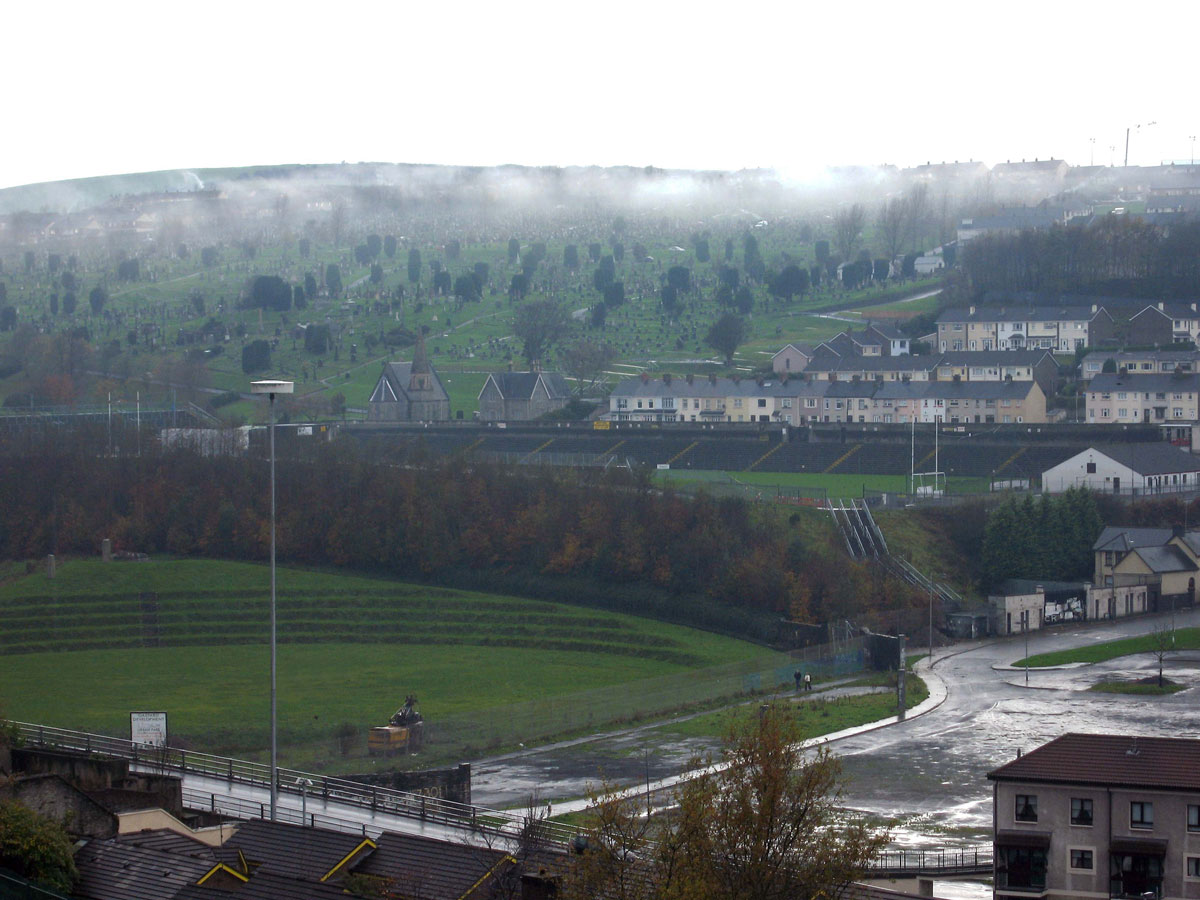
After driving along Lecky Road we turned off right into Brandywell where we passed two sports stadiums, the first one being the home of Derry City FC, and then Celtic Park, where GAA (Gaelic Athletic Association) fans can watch Gaelic Football and Hurling.
Even today, Derry is not a very big city, and within no time at all, I found myself being driven around Paul’s Creggan Estate, which in actual fact is only a 5 minute drive from the Irish border. With all the hand-waving going on, I quickly realised that I was in safe hands with my driver, but I had the distinct feeling that if I’d attempted to come here under my own steam I would have been met by gestures of a different kind. During The Troubles, the Creggan had a fearsome reputation and became a no-go area for any non-Catholics. Even during the time I was here there were still plenty of Republican murals around, including one of a woman who was shot dead in her own back garden when there was a confrontation between locals and British troops – and this happened just a few doors down from where Paul lived. Under the circumstances, it didn’t seem right to take any pictures of the murals. This felt different to Belfast somehow.
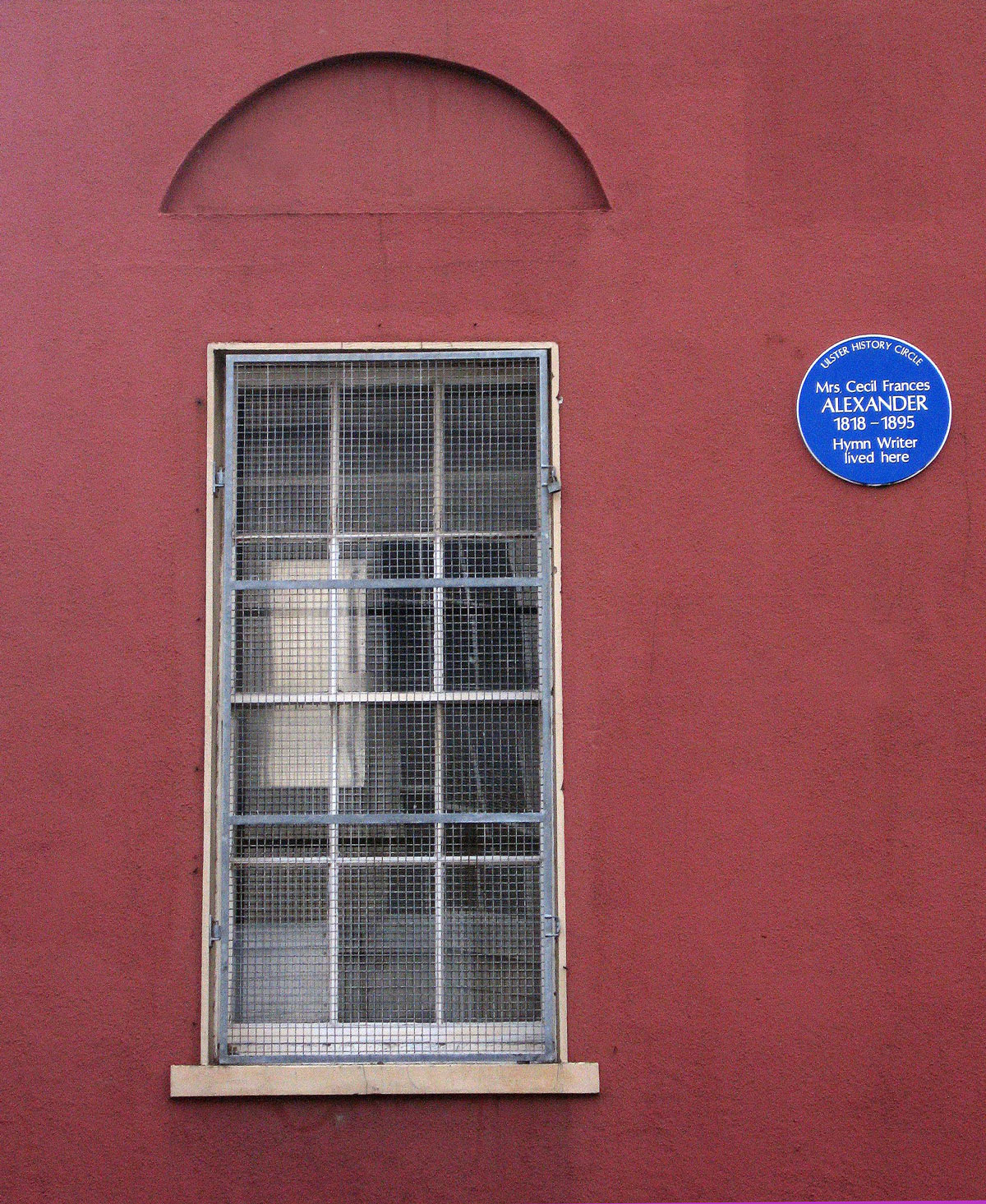
The city’s cemetery is also located in the Creggan, and with 70,000 deceased souls buried here, it’s full to bursting point. Amongst all these gravestones is one for Mrs. Cecil Frances Alexander: Born in Dublin in 1818, she ended up in Derry after marrying the Bishop, William Alexander. She died, aged 77, in the Bishop’s Palace, where a blue plaque still marks her achievements for writing hymns such as All Things Bright and Beautiful, There is a Green Hill Far Away, and the Christmas Carol, Once in Royal David’s City.
Those hymns are fondly remembered by many people, but John Hume, who is also buried here, should be, but probably won’t. Hume was an architect of the Good Friday Agreement and a moderate member of the Social Democratic and Labour Party (SDLP) who campaigned on behalf of Catholics for a peaceful solution to the conflict. He was rewarded for his efforts, along with the Ulster Unionist Party’s David Trimble, by winning the 1998 Nobel Peace Prize.
Another Irish Nationalist buried here, but who had a different approach, was a Creggan man, Martin McGuiness. A member of the provisional IRA, McGuiness was a controversial character to say the least, but he too became a signatory of the Good Friday Agreement and became joint First Minister with the DUP leader Ian Paisley in a power sharing executive for Northern Ireland in 2007. It was a historical moment that people thought would never happen, and the two arch-enemies got on so well that they became known as The Chuckle Brothers.
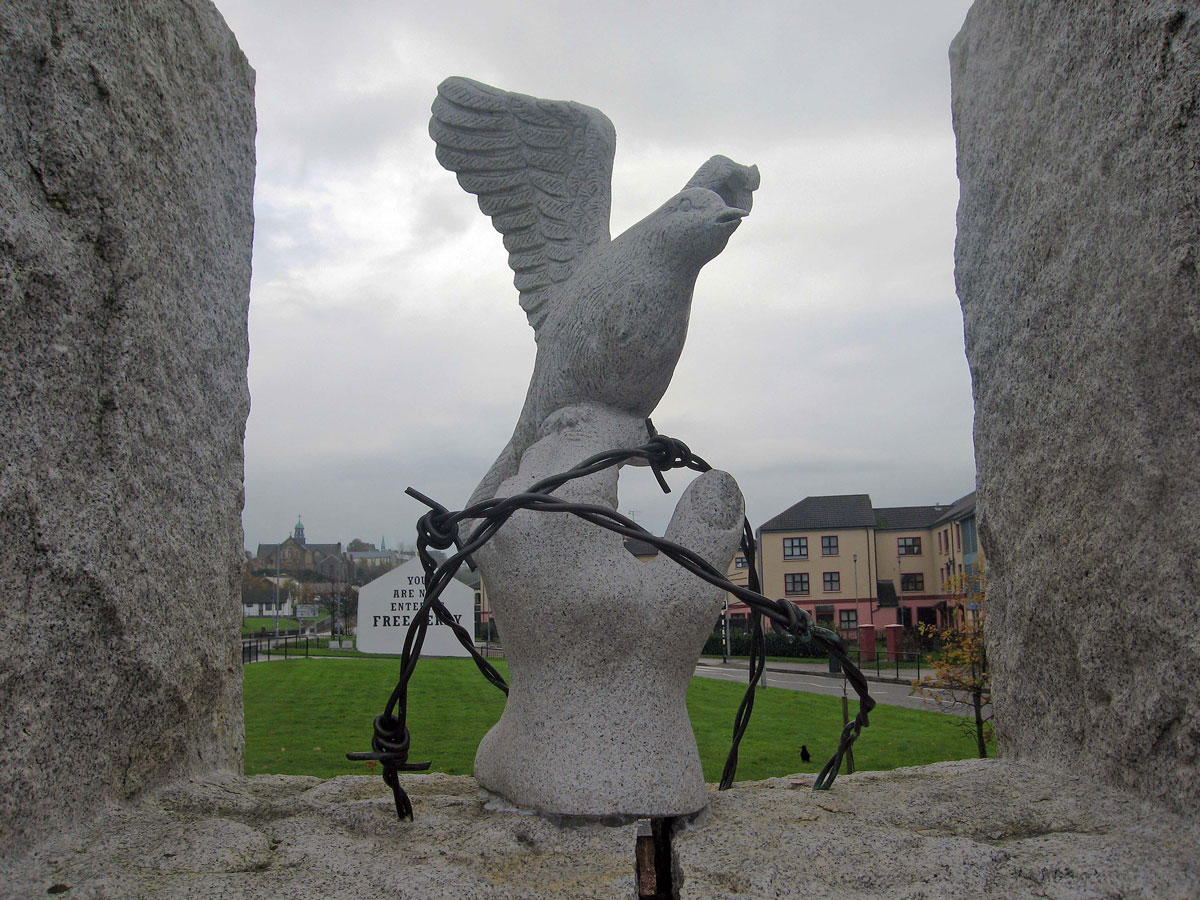
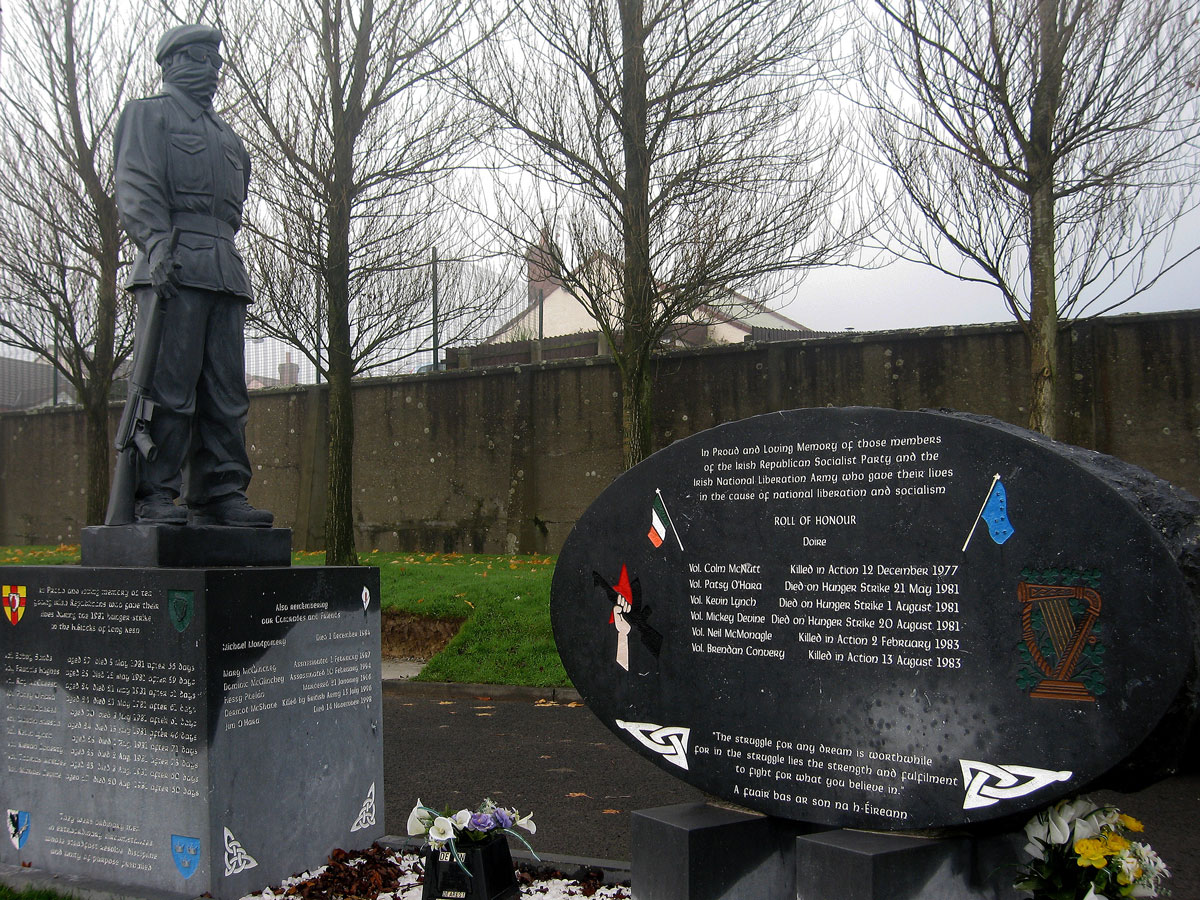
As it happened, I didn’t get to visit any of these graves, but Paul ushered me along to a memorial that he seemed keen for me to see. Commemorating the ten hunger strikers who died in the Maze prison in 1981 (including three Derry men), they no doubt would have all been recognised in the local community as martyrs, but what Paul may not have realised is that I’ve always thought of the episode as just an unnecessary waste of life, but I don’t suppose it really matters what I think.
It was time to move on now and so we headed back towards the city centre, but before being dropped off, Paul asked if I would like to run the risk of taking a look around the Fountain Estate. It was only when I realised that a risk for him was also a risk for me that I fully understood why he asked the question.
The reason why it was a risk to him was that The Fountain is the only Protestant enclave on the West Bank (outside of the city walls), and had been under siege behind a peace wall ever since Bloody Sunday. Before that terrible event (which I’ll be talking about in Pt 2) there were around 1500 people living in The Fountain, but that number has since been reduced to about 250 stalwarts who have refused to be forced out. Most of those who left retreated to the Waterside area on the East Bank, and those that stayed, remained behind a gate that still gets locked every night at 9 pm.
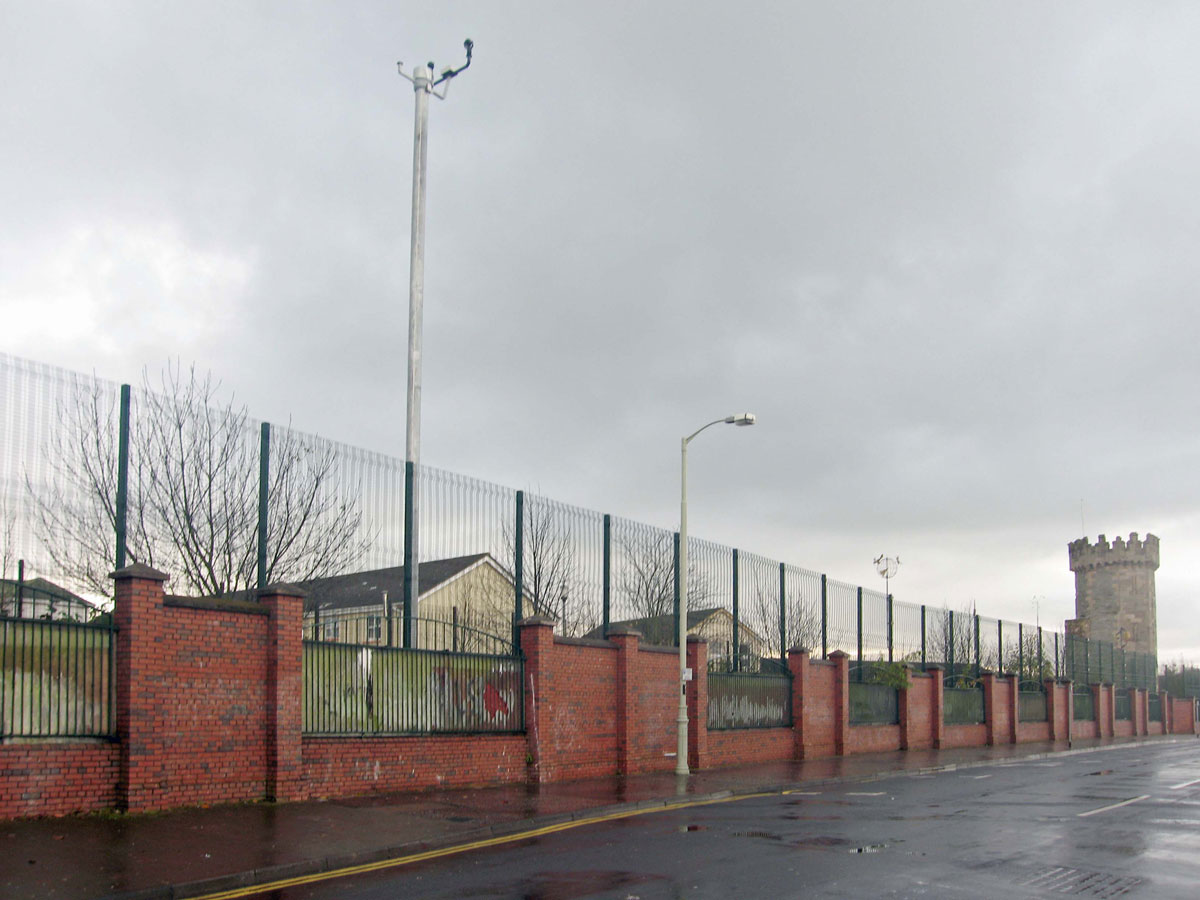
Of course, if the Fountain’s Protestant community needed to be protected from the area’s Catholic communities, then is it any wonder that people like Paul would hardly be welcome in theirs: Some extracts from a 2017 article in the Belfast Telegraph may go some way to explaining why.
Fountain community worker, Jeanette Warke was brought up in one of the streets that became a target for sectarian intimidation. She recounts that “When the Troubles began, the area we lived in was a very mixed community. Everyone got on with their neighbours. We used to go down to the Bogside into our Catholic friend’s house and watch the riots down below. Then the buildings began to be set on fire, the CS gas hung in the air, people started to get singled out as Protestant and Catholic. Fear set in, you were looking over your shoulder all the time,” and it didn’t end there – “ my husband David worked night shifts. One night as he came home he got caught up in a gun battle between the IRA and the army not far from home. He came in that morning and said that he didn’t think we would be able to stay here much longer. Not long afterwards the door started to get banged, men would shout in at all hours for us to ‘Get out, you Orange b*******’. It went on nightly. The kids were targeted in the street. One night, not long after Bloody Sunday, they came banging and shouting at the door, faceless men. I was alone, David was on night-shift. I was terrified for my children. I sat huddled on the stairs with my three young children around me, the youngest was just a baby. We moved out that morning as did many of our neighbours. We had bought that house, it was our pride and joy. We had to go and leave everything.”

Others, like Wilma Burnside remembers how they were intimidated but stuck it out: “When we were growing up here it was a beautiful, vibrant place that was full of life. There were red brick houses all around. Everyone had pride in their homes. Outside the doors the paths were shining, the windows were gleaming. Everyone knew one another. I was 28 when the Troubles started. I remember the armoured trucks coming up the road with the army. I remember the army putting the wooden barricades with the barbed wire across the road and I remember the men barricading us into the Fountain to stop people coming in. There was a real sense of fear. We were paint bombed and petrol bombed and had our windows smashed constantly. It was home, and that was the way it was. We stood our ground and we are still here”
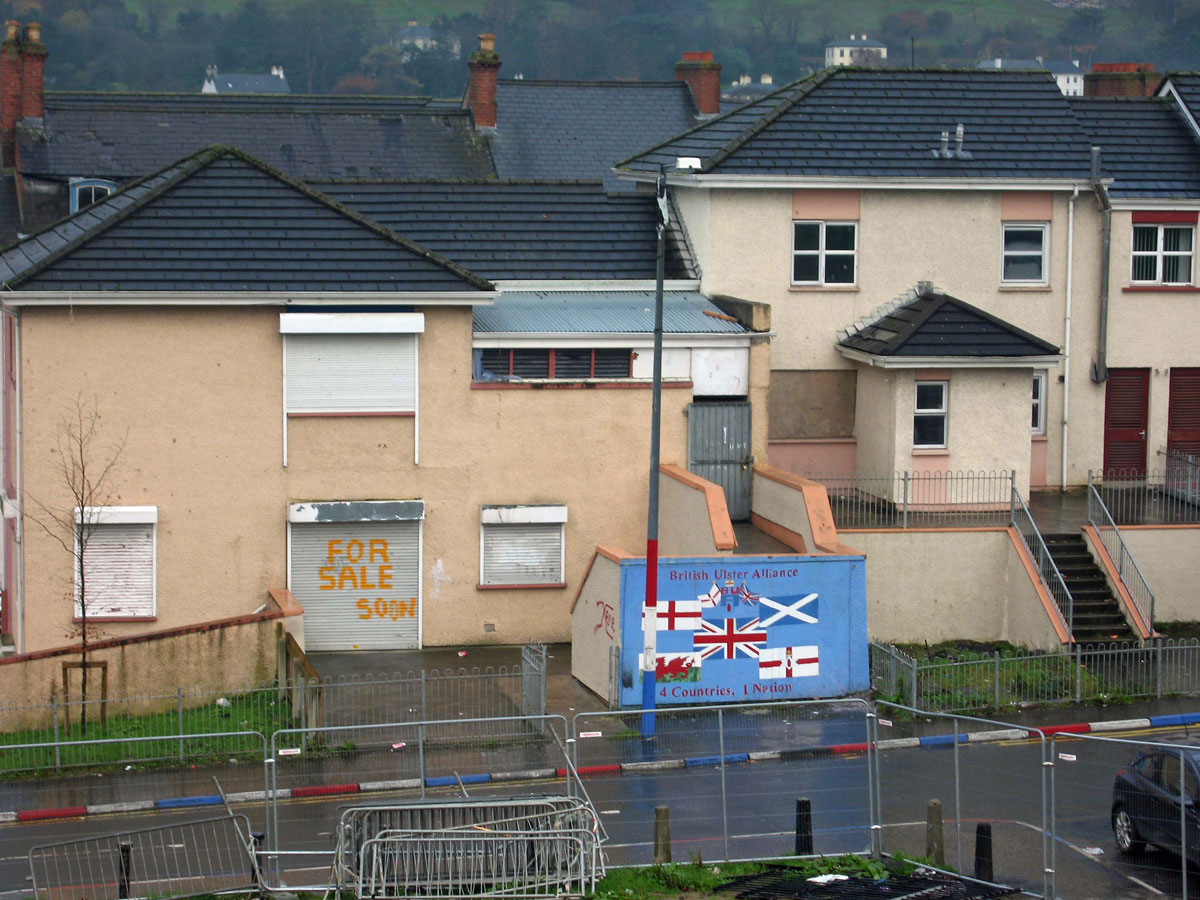
Recently, Paul had taken another fool like me around The Fountain for the first time – and got away with it, so he was prepared to give it another go – and if it was alright with him, then it was alright with me. Mind you, I did start to have a few reservations when he jumped out of the car, removed the taxi sign and hid it under the back seat before driving down Hawkin Street. All of a sudden I felt more vulnerable in Londonderry than I did in Derry, if you get my drift. Needless to say, we weren’t there long.
I got dropped off just outside the city walls where Paul knew of a café that would be open on a Sunday morning. I had made arrangements to visit the Bogside with a guide later, but as it was raining, it wasn’t just a good option, but the only option really. It was a greasy spoon sort of place with stained polystyrene tiles on the ceiling and a pegboard menu on the wall with dishes such as cheese tacos and chips for £2.50. I opted for just a coffee, but sitting here with a few other people who had nowhere to go, gave me time to think about what I was letting myself in for next, and so after finishing my coffee, I headed up Waterloo Street past a motley crew of street drinkers towards The Bogside where I was about to find out.

POSTED – MARCH 2025
Originally posted 2025-03-26 15:29:29.
An interesting but quite a grim post Malc, I felt uneasy reading it so heaven knows how you felt being there although it sounds like you were in good hands with your taxi driver/guide. I like the story of Cecil Frances Alexander – in the days when I went to church (before I rebelled in my mid teens) ‘There is a green hill’ was one of my favourite hymns.
Lamorna Cove it isn’t Eunice, but I’ve always had a desire to find out what places are like behind the headlines. I’ve never trusted the msm to tell us the whole truth and is why I’ve gone to places like this to find out for myself, and I always try to understand both sides because each side of the story is bound to be biased. There are also other things about a place such as CFA that remind us that there are other aspects to a place as well.
I could feel your unease throughout this post, Malc. What really strikes me is just how much tension there still is, so much so that Paul described the visit to the Fountain Estate as a ‘risk’. In fact, I was surprised to learn that it’s even described today as a Protestant enclave. The wounds still run very deep, don’t they? The first hand accounts add another dimension, and I found Jeanette Warke’s memories of the mixed community early on and her visiting her Catholic friend rather poignant. It just shows how ordinary people were just people, and could rub along together fine until the troubles got so desperately out of hand. Madness.
The graveyard seems an interesting place in it’s own right, however, and it put me in mind of Glasgow’s Necropolis. Good to know the about the lady who wrote some of our best known hymns, and where she lived and is buried. I love Once in Royal David’s City… 🙂
You left us on a cliffhanger, so don’t keep us waiting too long to find out what happened to you in The Bogside.
Thanks for taking a look Alli at a part of British life that still lingers in many people’s minds. Even though I’d lived during those times and watched and read many stories about what life was like in Derry and other parts of the province during those dark days, nothing really prepared me for talking to people who lived through it personally. It was very sobering and a reminder that it’s much easier to prevent a war than to stop it.
So true, Malc, if only the powers that be could see that when it comes to war (and most other issues, to be honest) prevention is better than cure.
From what I’ve read in your posts on the Troubles, I think it would be impossible to know what it was truly like to have lived through those times, unless you had.
And it never ceases to amaze me how many leaders think they’re the ones who are always going to win. It doesn’t matter what the issue is, I’ve always thought that sometimes (but not always) it’s better not to fight than to fight and lose.
I think it comes with a massive, overblown ego that most leaders seem to have. That and a big dose of arrogance.
The cream rarely rises to the top in politics does it Alli?
No, but something else that’s much less appetising does! 😉
LOL 😀
Malc, I remember your prvious psots on NI and I am glad you revisited to add this one. It is an excellent post especially for covering the social history which is so often lost against the bigger canvas.
Thank you Shey. I decided to put my head above the parapet again 😊
I am glad you did. I thought your posts were excellent. It is a fraught subject that.
The next one will be even more fraught 😟
I like the way you decided to see round actually. .
Where there’s a will there’s a way!
I hadn’t realised that there are still estates walled off from their neighbours like that!
Although this post is talking about my visit in 2007, it’s still the same.
Fascinating stuff, from a time that many young people simply know nothing about.
Very true. Things are gradually improving all the time thankfully, but it will still need more.
To find out… interesting Malc. Phenomenal post.
Thank you Francesc. Glad you enjoyed it.
Pleasure Malc, like always.
It’s a town that I have unfortunately not seen yet, as I have never visited Northern Ireland
Thanks for sharing this wonderful post full of history, fantastic information and fabulous images🩵
Thank you Luisa. I hope that one day the country can show its true colours instead of its sorrowful past. 🩵
I hope so too, dear Malc, with all my heart❤️
Malcolm, your blog is extremely well-written, interesting and very thought provoking. It made me think seriously about my own trip to Northern Ireland 10 years ago which included stays in both Belfast and Derry. It also brings to mind a visit to London long ago when passengers were encouraged to be alert to any unattended bags, suitcases, etc., on The Tube because of threats from the IRA as I recall. Thanks so much for sharing your insights into the history of Derry and The Troubles.
Thanks Syl. Normally I like to remind people about the good times they’ve had somewhere, but there’s a difference between going on holiday and travelling isn’t there? – as you well know 🤗
I have to start again as the comment page suddenly disappeared! Yes, I do admire your effort to write at length about a grim subject just because it is there. Your usual history lesson is fascinating, especially the story of the talented Cecil Frances Alexander, who wrote beautiful and famous hymns. The story of the violently hostile religious divide is truly horrific to anyone sane. I warmed up to Paul, the taxi driver, and your guide. Your photographic ability makes reading come to life. Thank you!
Joanna
I realise that a topic like this isn’t something that you particularly want to read Joanna, so thanks for doing so. That’s what makes us good friends 🤗
You would be surprised, Malc, if you knew how much I know about the place and the people already, and that is the reason I read and commented about your post because of our long standing friendship.
Joanna
Maybe one day you’ll tell me more – if you want to of course. 🤗
Quite the experience,😉, Malc. You have a talent for leaving us hanging.
LOL. I need to tread the path of subjects like this carefully Pat, because even though peace in the province has been officially attained for a number of years now, there is still a lot of history to come if you know what I mean. Thanks for commenting 🤗
Yes and we don’t always know where the virtual or literal landmines are hidden. Looking forward to part 2.
Good answer Pat!
Thanks, Malc.
As always, Malc, I admire your dedication to any subject you choose to write about, however
A very interesting read. Derry/ Londonderry is a city I’ve only passed through really (on a Saturday night- was quite wild!) but I had a similar impression to you I think; if Belfast can be considered healing, Derry/L’derry is still an open wound.
Thanks Helen for your observations, and I believe you’re right, but I hope that we’re both wrong and the wounds heal quicker than we think.