Tag Archives: Geology

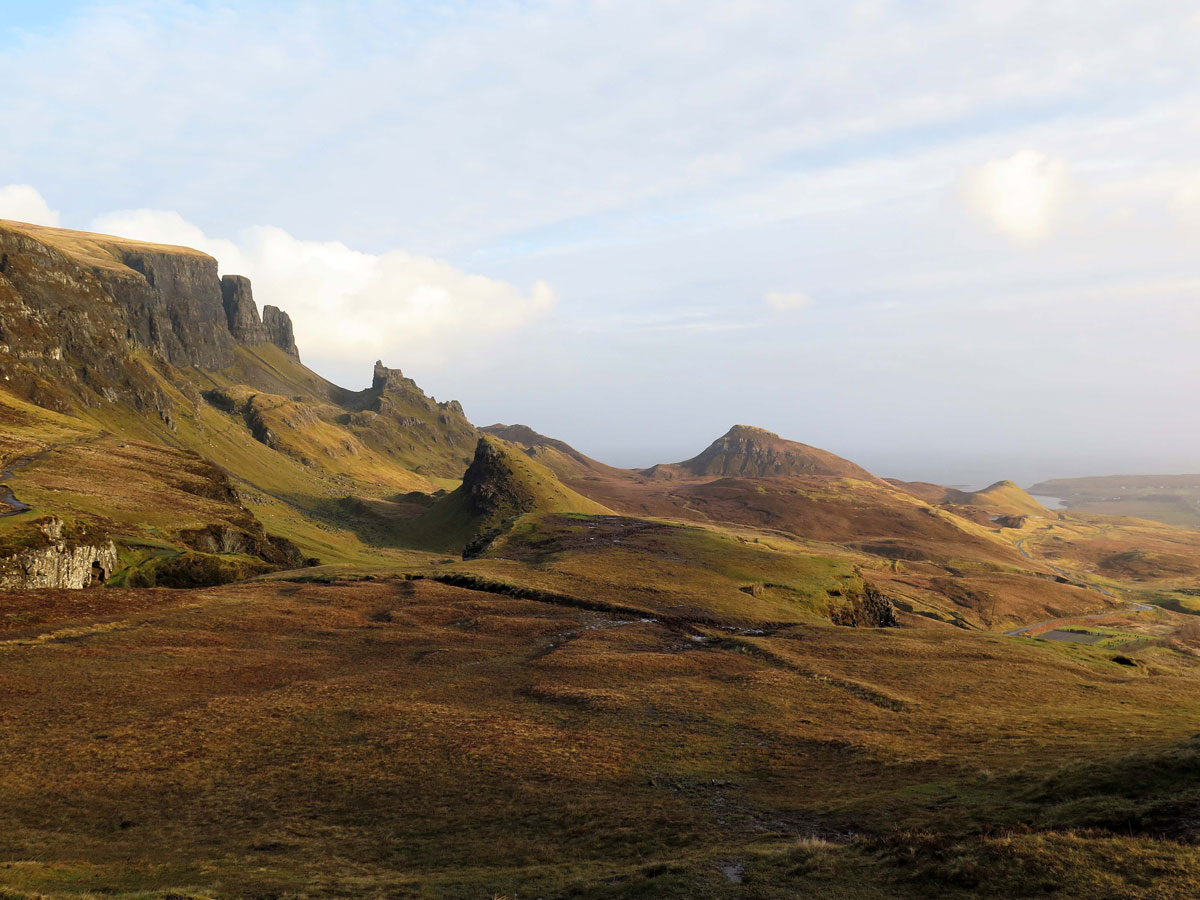
A Drive Around Skye’s Trotternish Peninsula

A Drive Around Skye's Trotternish Peninsula

I’ve often found travelling to places that I’ve always wanted to go a risky business because my imagination, and the real time experience, doesn’t always match up, but my first visit to the magical Isle of Skye in 1983 was the complete opposite – and one of the reasons why the island exceeded my expectations was the wonderful Trotternish Peninsula.

That first journey to Skye involved a 600-mile journey from the West Country in a rusty old Fiat Mirafiore: There were no cheap flights then, and there was no Skye Bridge either – it was ‘Over the Sea to Skye’ by ferry from the Kyle of Lochalsh. The toll-free bridge has made the island far more accessible now, not just for me, but for everyone else too, so it makes sense to come out of season if possible when there are fewer people around and the only difference in the weather is that the rain is a bit colder.

Continue reading

Originally posted 2020-05-24 08:40:35.

The Treshnish Isles and Staffa

The Treshnish Isles and Staffa

When I was growing up, water and me didn’t mix. From being badly scolded with boiling hot water to needing artificial insemination respiration, it’s no wonder I never became a Mark Spitz or Michael Phelps, but even though it’s nearly killed me, as we all know, water is the staff of life, and whenever I get the opportunity, I like to be out on a boat. Not mine I hasten to add because I just wouldn’t be safe being in charge of one. I’m no Captain Cook, more like a Captain Pugwash.

Fortunately, we were in a safe pair of hands when we left Ulva Ferry for the Treshnish Isles, a small group of uninhabited islands off Mull’s West Coast in Scotland’s Inner Hebrides. There’s not a lot to say about the Treshnish Isles except that they’re made up of a number of skerries and around eight larger islands, the largest being Lunga – our destination, and instead of waffling on, I’m just going to leave you with a gallery of pictures that, even on an inclement day, will show you why we thought it was worth the lumpy boat ride out here.

Continue reading

Originally posted 2024-01-11 16:26:12.

Dartmoor Tors and Tales

Dartmoor Tors and Tales

If you were to ask anyone who’s been to Dartmoor “What is the thing you remember the most about it?”, there’s more than a fair chance that the answer would be “the tors” – but what exactly are tors? According to the Oxford English Dictionary, a tor is a topographical name to describe a ‘high rock or pile of rocks, generally on the top of a hill’.

The word has been in use since Anglo-Saxon times, and although they aren’t confined to Dartmoor, there are some 890 of them here according to a website called Tors of Dartmoor. The website is a ‘Bible’ for aficionados of these granite rocks, but even they would probably have to admit that it’s not easy to decide what constitutes a Tor and what doesn’t. Some are unmistakeable, but others are not, and just to confuse the issue, not every one of them is called a Tor, such as Blackingstone Rock pictured below. There are plenty of people who like to ‘bag’ as many tors as possible, but if you’re not one of them, I’m going to mention just a few that are worth seeking out should you ever find yourself in ‘Hairy Hands’ country.

Continue reading

Originally posted 2022-08-03 16:11:48.

Kents Cavern and the English Riviera Geopark

Kents Cavern and the English Riviera Geopark

People who come to Torbay don’t think of it as somewhere with much history, and it’s true in some respects, but search a bit deeper and you’ll find that the area’s history goes back a long way – about 400 million years in fact – give or take a few million.

Explaining the planet’s history is really best left to the experts, but as one of the geological time periods is named after the county of Devon, I think it’s worth knowing how this occurred and how it all fits into the grand scheme of things.

To put it into some sort of perspective, geologists tell us that the earth was formed some 4,600 million years ago, with the oldest rocks in Britain being about 3,000 million years old (and found in North-Western Scotland). From this we can see that Devon’s beginnings don’t go back quite as far back as they might first appear, so why was the Devonian Period so named?

We only need to go back to the 1830s to find the answer. Up until that point, scientists from the early 18th century onwards were trying to map and categorize different geological time periods, and Roderick Murchison and Adam Sedgwick, two eminent members of the Geographical Society in London, had identified two separate eras which they called the Silurian and Carboniferous Periods.

This neat classification was thrown into some disarray when a colleague, Henry De la Beche, who was categorizing rocks himself in Devon, suggested there was also likely to be an intermediate period: The disagreement between the two parties led to the debate becoming known as the ‘Great Devonian Controversy’.

Paradoxically, it was Murchison who made the discoveries to prove that De la Beche was right all along. This intermediate era was determined to be between 359 and 419 million years ago, and was subsequently called the Devonian Period.

In the chart below, the Devonian Period is half-way down the Paleozoic column coloured brown.

Continue reading

Originally posted 2019-10-04 06:40:58.
Thatcher Point to Anstey’s Cove

Thatcher Point to Anstey's Cove

Between Meadfoot Beach and Babbacombe is one of Torquay’s most exclusive areas. Centred on Thatcher Avenue, the area is known locally as Millionaire’s Row, but you don’t need to be a millionaire to enjoy what is arguably the most interesting part of the Torquay coastline.

This area of Torbay is as good as anywhere to understand why the English Riviera was given status as a UNESCO Global Geopark, one of only seven locations in the UK. Kent’s Cavern is the best place to begin discovering what all this means, and if you want to find out how the area gave its name to the Devonian Period, check out my post, Kent’s Cavern and the English Riviera Geopark.

Continue reading

Originally posted 2019-04-13 17:11:58.