Category Archives: Featured Home Page

Stockholm’s Gamla Stan

Stockholm's Gamla Stan

I like Stockholm, I like it a lot: Maybe it’s the fresh northern air that does it, or maybe it’s because the Stockholm Archipelago brings the great outdoors right into the city centre. I don’t know who counted them, but there are supposed to be 24,000 islands within the archipelago, 14 of which are part of the city itself.

Stockholm’s historic core is Gamla Stan (Old Town) and is centred on the island of Stadsholmen. The adjacent smaller islands of Helgeandsholmen, Riddarholmen and Stromsborg are also included, but for most people, Stadsholmen is Gamla Stan.

Today, Stockholm is home to around 1.6 million people which is roughly 22% of Sweden’s total population, but with water everywhere you look, it doesn’t feel like most other major cities.

Continue reading →

Originally posted 2021-11-18 14:54:29.

The Ninth Fort

The Ninth Fort

Today was my last day in Lithuania, and thanks to a late flight home I was able to fulfil one last wish before leaving.

The Ninth Fort might not be on everyone’s list of places to see, but one of my passions, if that’s the right word, is to try and understand what caused the turmoil in Europe during the 20th century. I have always had an interest in the two World Wars as well as the Cold War: The Ninth Fort is one of those places that is uncomfortable to visit, but one that has left a profound effect on me ever since.

I don’t know if things have changed, but at the time I was here there was very little information about the fort and how to get there – certainly not in English.

Even though it’s located on the outskirts of Kaunas at Sargenai, and quite a long bus ride to get there, it wasn’t as difficult to find as I thought it was going to be.

Before the outbreak of the First World War, Lithuania was part of the Russian Empire, and as relations deteriorated with Germany, it was decided to build Kaunas Fortress to protect its western border.

The Ninth Fort was part of this huge complex that surrounded the city covering an area of 25 square miles.

To learn more about the history of the fort there’s a museum housed in a soviet concrete monstrosity, which if they leave it as it is, could become part of the fort’s history itself in years to come.

Continue reading →

Originally posted 2019-09-26 16:54:08.

The Magical Sunsets of Zadar

The Magical Sunsets of Zadar

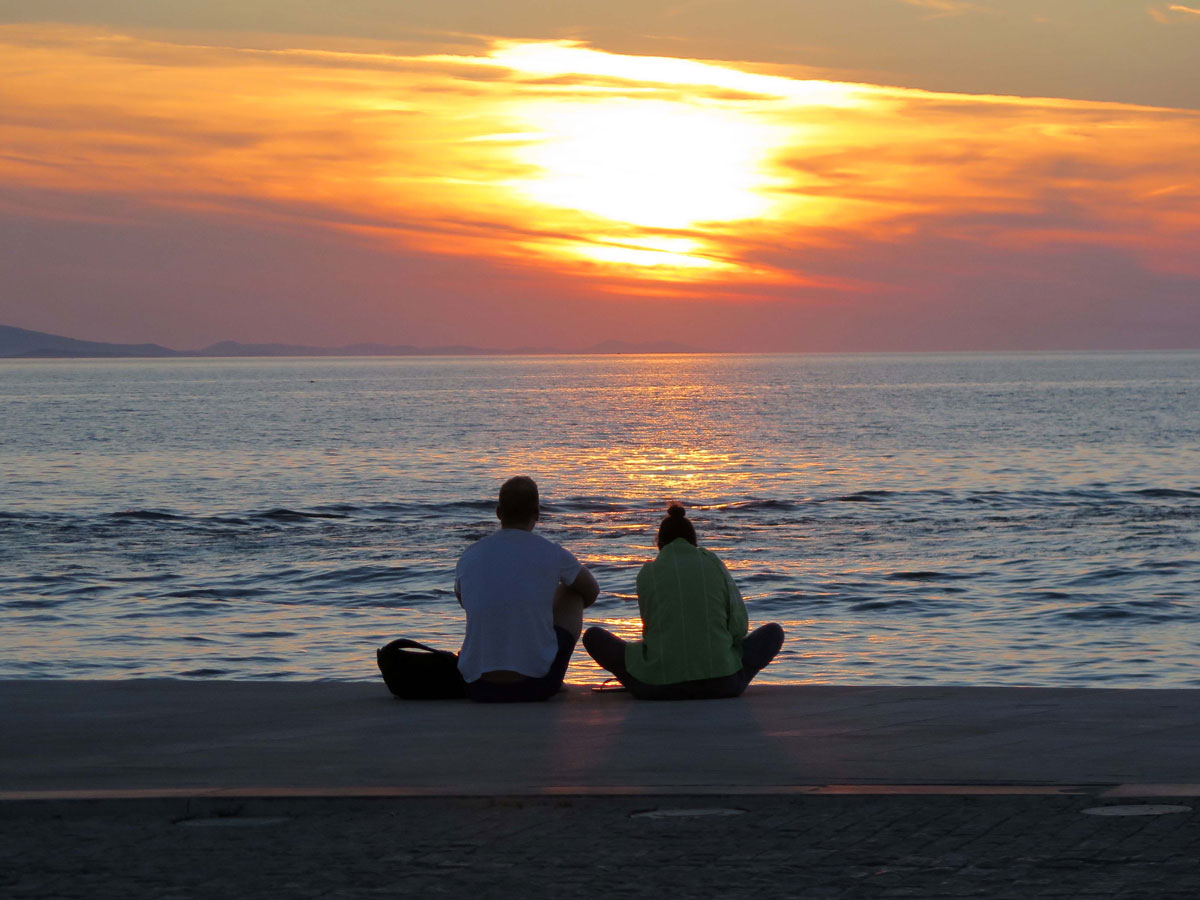
There are any number of reasons to recommend Zadar for a holiday, but to sit and watch the sun go down has to be one of the best reasons of all.

Alfred Hitchcock once described the sunsets here as “the most beautiful in the world”. That’s quite a statement to make, especially as there must be so many contenders for the title, but regardless of whether they are or not, they certainly take some beating.

This historical city sits on Croatia’s Dalmatian coast, and I’ll be describing it in more detail later, but for now, I’m just going to introduce you to the ‘Magical Sunsets of Zadar’.

Continue reading →

Originally posted 2020-10-04 08:18:22.

The Kaiser Wilhelm Memorial Church – Berlin’s Memorial to Peace

The Kaiser Wilhelm Memorial Church - Berlin's Memorial to Peace

In its attempt to atone for the horrors inflicted on the world by the Nazis, Berlin has gone out of its way to confront its past with monuments of what it sees as reconciliation. For example, the Memorial to the Murdered Jews of Europe covers an area in the centre of the city which was used by the Nazi war machine, but it would be easy to forget that the German people also suffered from the horrors of war. The Kaiser Wilhelm Memorial Church in Breitscheidplatz goes some way towards rectifying that by remembering what Berliners had to endure too, but it also acts as a memorial to peace for everyone.


THE OLD CHURCH

The memorial actually consists of two churches, and it’s only natural that I start with the original one that was built in memory of Kaiser Wilhelm I. The foundation stone was laid four years after he died on what would have been his 94th birthday (22nd March 1891). This monumental church had a spire that rose to a height of 113m (371ft) and was able to accommodate a congregation of 2,000 people. It also boasted an entrance with some superb mosaics that made a connection between the ‘throne and the altar’.

On the night of 23rd November 1943 allied air raids caused extensive damage to the landmark church including the spire. A post-war assessment of the ruins led to a decision to keep what was left as a symbol of peace, but it took several attempts before the final plan was accepted by the people of Berlin. Initially, it was suggested that what was left of the spire should be torn down, but Berliners saw it as the ‘Heart of Berlin’ and so a compromise was reached where its height was reduced to 71m (233ft), prompting Berliners to call it “Der Hohle Zahn”, meaning The Hollow Tooth

Continue reading →

Originally posted 2021-08-31 13:59:47.

Glen Etive

Glen Etive

People who visit Glen Coe for the first time will invariably miss a small turning opposite the Kingshouse Hotel, and even if they knew it was there would probably give it a miss anyway, because this narrow single track road comes to a dead end after 14 miles, which means that you have to turn around and come all the way back – so why bother?

The answer is simple – the breathtaking scenery makes it, in my humble opinion, one of the best short scenic drives in Scotland.

As with all scenic drives, it’s best done outside of the peak holiday season. Fans of James Bond come here to see where some of ‘Skyfall’ was filmed, and it’s also popular with kayakers – and of course, climbers and hillwalkers.

Fortunately, when I drove down here one winter’s day, apart from one notable exception, we never saw a soul.

Several streams provide the River Etive with its source on Rannoch Moor, but for most people their acquaintance with it starts at Buachaille Etive Mor, the pyramid shaped mountain at the top of the glen.

The road follows the river down through the valley, at first underneath Buachaille Etive Mor, and then Stob Dubh before widening out as it flows into the head of Loch Etive.  Continue reading →

Originally posted 2019-11-22 17:37:13.

Chepstow Castle – Is it Welsh or English?

Chepstow Castle - Is it Welsh or English?

I used to work with someone who came from Newport, and like most people from Wales, he was fervently patriotic. It was easier to have a bit of banter about somebody’s background in those days, and I often used to wind him up by saying that he was English, not Welsh. He could be fiery at times, and I knew it was time to back off when I saw flames coming out of his mouth like a Welsh dragon.

The reason I accused him of being English was because Newport was in Monmouthshire, and Monmouthshire was seen as an English county. If you’re already confused, then you’ll be even more so when I tell you that Chepstow is also in Monmouthshire, but in Wales – and what’s more, Chepstow Castle was built to protect England from the Welsh. If you haven’t given up the will to live yet, I’ll attempt to explain how all this came about.

Continue reading →

Originally posted 2022-09-20 06:40:11.

Following in The Beatles Early Footsteps – Pt 1 Getting to Know their Roots

Following in The Beatles Early Footsteps - Pt 1 Getting to Know their Roots

The Beatles have sold more records than anyone else, a staggering 600 million copies. Just think about it – that’s 600,000,000 records, and presumably they’ve included the ones I’ve bought in that figure as well. I was a huge fan of the Fab Four and still am, and when the opportunity arose, I didn’t hesitate to use my birthday as an excuse to make a pilgrimage to visit the place where they came from, to learn more about how and why they became the phenomenon that they did.

Between 1962 and 1970 they recorded 213 songs, 188 of which they penned themselves, mostly by John Lennon and Paul McCartney. Everyone has their own favourite Beatles album or song, and their music changed direction more than once, but for me personally, it was their early stuff that I loved the most. It was raw music at its best and could change from Paul hammering out a heavy rock number like Long Tall Sally one minute to John Lennon singing a ballad like This Boy the next.

Continue reading →

Originally posted 2021-10-07 11:29:15.

Lincoln Cathedral

Lincoln Cathedral

At the time of William the Conqueror’s arrival in England, Lincoln was one of the largest towns in the country, and so it was understandable why he would want to subjugate it as quickly as possible. Within two years, Lincoln Castle was built on the same site as the old Roman fortress, but the success of his conquest didn’t just depend on military might, he also needed the support of the all-powerful church as well.

To help him consolidate his position, William called upon one of his supporters, Bishop Remigius de Fécamp, to take over the vacant See of Dorchester, which at the time was the largest diocese in England – and one that also included Lincoln.

Continue reading →

Originally posted 2022-12-30 15:44:22.

Torre Abbey

Torre Abbey

Torre Abbey is without doubt the most important historical building in Torbay, and although its appearance has changed from what it was originally designed for, it should be on everyone’s list of places to see.

Not only does a visit offer an insight into how Torquay developed from the time Torre Abbey was founded in 1196, you can also impress your friends by telling them it was occupied by the Canons of the Premonstratensian order. These wealthy landlords were responsible for adding the ‘quay’ to Torre, and were here for over 300 years until Henry VIII dissolved the monasteries.

Continue reading →

Originally posted 2018-04-03 14:02:51.